10 billion-year-old supernova sheds new light on cosmic expansion and dark energy
A rare lensed supernova appears four times in the sky, offering new insight into cosmic expansion and dark energy.

 Edited By: Joshua Shavit

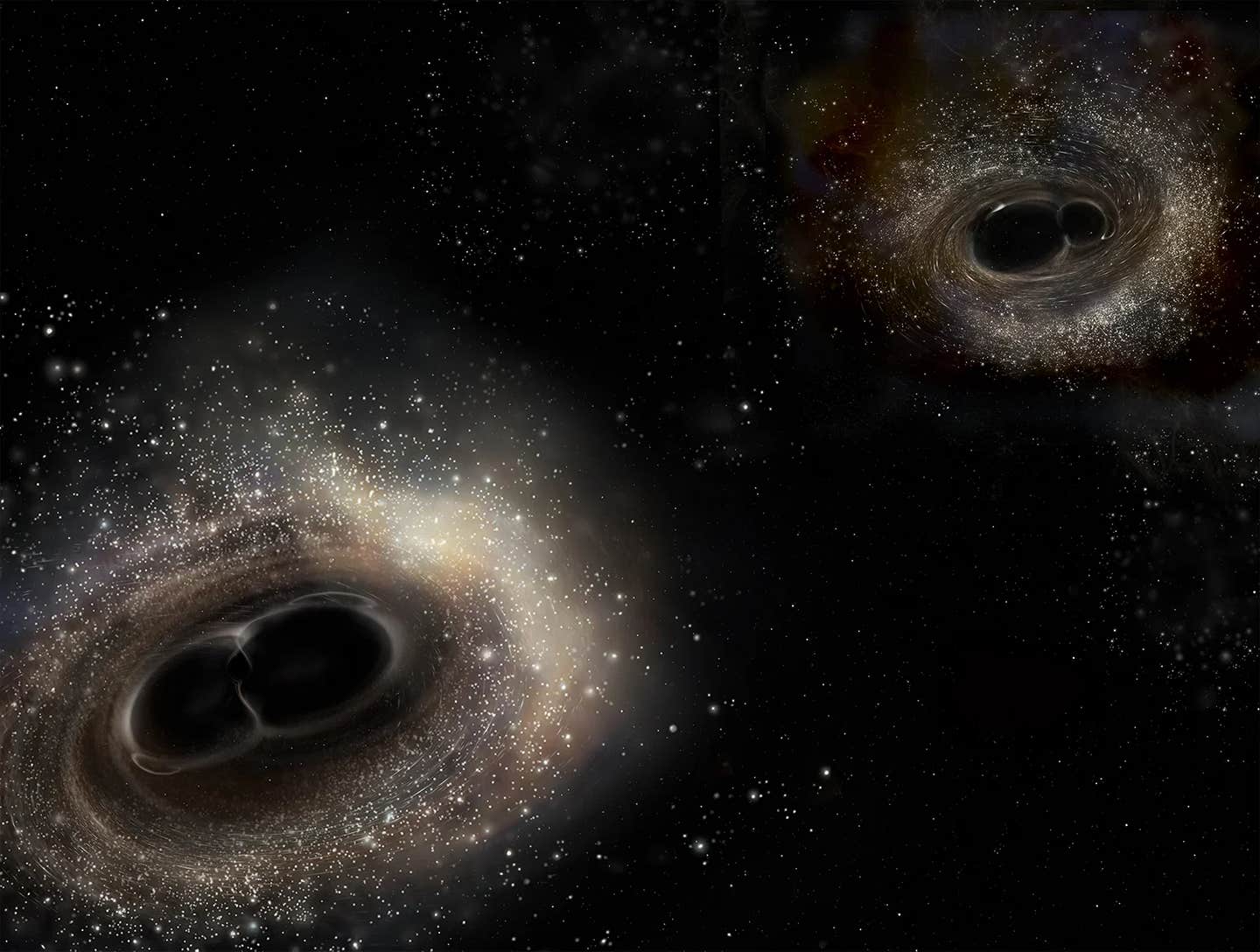
An artist’s interpretation of light from a supernova passing through a gravitational lens, reaching Earth at different times. (CREDIT: Oskar Klein Center, University of Stockholm / Samuel Avraham & Joel Johansson)
A distant stellar explosion has offered astronomers a rare natural experiment, one that turns gravity into a powerful optical tool. The object, known as SN 2025wny, appears not once but four times in the sky, its light split and magnified by a massive foreground galaxy. The result resembles a cosmic hall of mirrors and provides a new way to study how the universe expands.
SN 2025wny is classified as a superluminous supernova, a rare and extremely bright type of stellar death. It sits at a redshift of 2.010, meaning its light has traveled for more than 10 billion years before reaching Earth. On its own, such an explosion would be far too faint to examine in detail from the ground. What changes everything is gravity.
A galaxy closer to Earth, at redshift 0.375, lies almost directly along the line of sight. Its immense mass bends the supernova’s light, splitting it into four distinct images arranged in a cross pattern known as an Einstein cross. This is the first known example of a gravitationally lensed superluminous supernova and the first supernova of any type whose multiple images can be cleanly resolved from the ground under ordinary observing conditions.
Because each image takes a slightly different path through space, the light arrives at different times. That subtle timing difference turns SN 2025wny into more than a striking visual. It becomes a new tool for probing galaxy structure and measuring how fast the universe is expanding.
From nightly surveys to a cosmic lens
The discovery began with routine sky patrols. The Zwicky Transient Facility in California, which scans the sky each night for changing objects, flagged a new source on August 29, 2025. A review of earlier images showed the object faintly present two days earlier. Around the same time, the Gravitational wave Optical Transient Observer also reported the event, highlighting how quickly multiple teams converged on the same signal.
What caught astronomers’ attention was the object’s location. The brightening light appeared close to a massive red galaxy with a precisely measured distance from the Dark Energy Spectroscopic Instrument. At that distance, the brightness made no sense for a normal supernova. It pointed instead to a background explosion magnified by lensing.
Cross checks with the Strong Lensing Database strengthened that idea. The position matched a known lens candidate, suggesting that gravity was already known to warp light in that region. Archival images from the Legacy Survey and the Canada–France–Hawaii Telescope added another clue. They revealed four blue images of a background galaxy arranged in a cross around two red galaxies, hinting that the stage was set for a lensed transient.
Follow up observations soon confirmed it. Early images from the Liverpool Telescope showed only one bright point. By mid September, improved conditions and careful image subtraction revealed three clear points and a fourth faint one, exactly where the background galaxy images appeared. The supernova itself had been split into four.
Reading the light of an ancient explosion
Spectroscopy allowed researchers to identify the nature of the blast. Early spectra from the Nordic Optical Telescope looked almost featureless, with only faint absorption lines. A clearer picture emerged with observations from the Keck I telescope using the Low Resolution Imaging Spectrometer.
Those data revealed narrow absorption lines that all lined up at a redshift of 2.010. When compared with ultraviolet spectra of known events, the match pointed to a Type I superluminous supernova. Broad absorption features from elements such as carbon, magnesium, silicon, titanium, and iron supported that conclusion.
Even within this rare class, SN 2025wny stands out. Its colors are bluer than those of similar events, and its absorption features appear weaker and broader. Simple fits to its ultraviolet light suggest temperatures between about 29,000 and 19,000 Kelvin, hotter than typical values for comparable explosions.
The spectrum also carries fingerprints of the supernova’s host galaxy. Narrow absorption lines from hydrogen, silicon, carbon, and magnesium appear unusually weak. Measurements suggest a low amount of neutral hydrogen along the line of sight, far below what is seen in most gamma ray burst environments. These clues point to a small, low mass, star forming dwarf galaxy with little gas and possibly low metal content.
Gravity, brightness, and cosmic expansion
The supernova’s brightness pushes existing models. After correcting for distance but not for lensing, SN 2025wny would appear extraordinarily luminous in the ultraviolet.
"From these numbers, we conclude that at least one of three things must be true. The lensing magnification is extremely large, with a factor of 20 or more and possibly close to 50. Or SN 2025wny is intrinsically an unusually bright SLSN in the ultraviolet. Or we are seeing it at an earlier and hotter phase in the ultraviolet than has usually been captured for such events, meaning that some SLSNe may be more ultraviolet luminous early on than previously expected," Dr. Daniel Perley, a reader in astrophysics at Liverpool John Moores University explained to The Brighter Side of News.
"Future monitoring and detailed modeling will be needed to tell which of these explanations, or which combination, is correct," Perley concluded.
Beyond stellar physics, the system offers a path toward answering a deeper question. “No one has found a supernova like this before, and the nature of the system means it may be able to help solve some big problems in astrophysics, such as the nature of the force that drives the expansion of the universe,” Perley continued.
Gravitational lensing creates time delays between the images. “When light is ‘lensed,’ the different paths the light follows to get to Earth don’t all have the same length, so light moving along different paths takes variable amounts of time to reach us,” explained Ph.D. student Jacob Wise, who first recognized the system’s importance.
Those delays depend on how fast the universe is expanding. Measuring them could help resolve the so called Hubble Tension, the disagreement between expansion rates measured in the early universe and those measured nearby. “Studies of the afterglow of the Big Bang give one number for the Hubble constant, while studies of nearby galaxies give a different number,” Perley said. “Studies of lensed supernovae could indicate which of these two numbers we should really believe.”
Practical Implications of the Research
SN 2025wny shows how lensed supernovae can serve as precise tools for cosmology. By measuring time delays between images, researchers can refine estimates of the universe’s expansion and probe the nature of dark energy.
The event also acts as a bright beacon, allowing detailed study of tiny, distant galaxies that would otherwise remain hidden.
As new surveys and space telescopes come online, similar discoveries could turn rare cosmic alignments into routine laboratories for understanding both stars and the universe itself.
Research findings are available online in The Astrophysical Journal Letters.
Related Stories
- Fist-of-its-kind supernova offers rare look into the explosive death of a star
- Supernova explosion blamed for two extinction events on Earth
- New supernova discovery may hold key to the history of the Universe
Like these kind of feel good stories? Get The Brighter Side of News' newsletter.
Joseph Shavit
Writer, Editor-At-Large and Publisher
Joseph Shavit, based in Los Angeles, is a seasoned science journalist, editor and co-founder of The Brighter Side of News, where he transforms complex discoveries into clear, engaging stories for general readers. With vast experience at major media groups like Times Mirror and Tribune, he writes with both authority and curiosity. His writing focuses on space science, planetary science, quantum mechanics, geology. Known for linking breakthroughs to real-world markets, he highlights how research transitions into products and industries that shape daily life.