250-million-year-old Australian ‘sea-salamander’ sheds new light on the dawn of the dinosaurs
Lost Kimberley skull fragments reveal two sea amphibians and hint at rapid global spread after Earth’s worst extinction.

 Edited By: Joseph Shavit

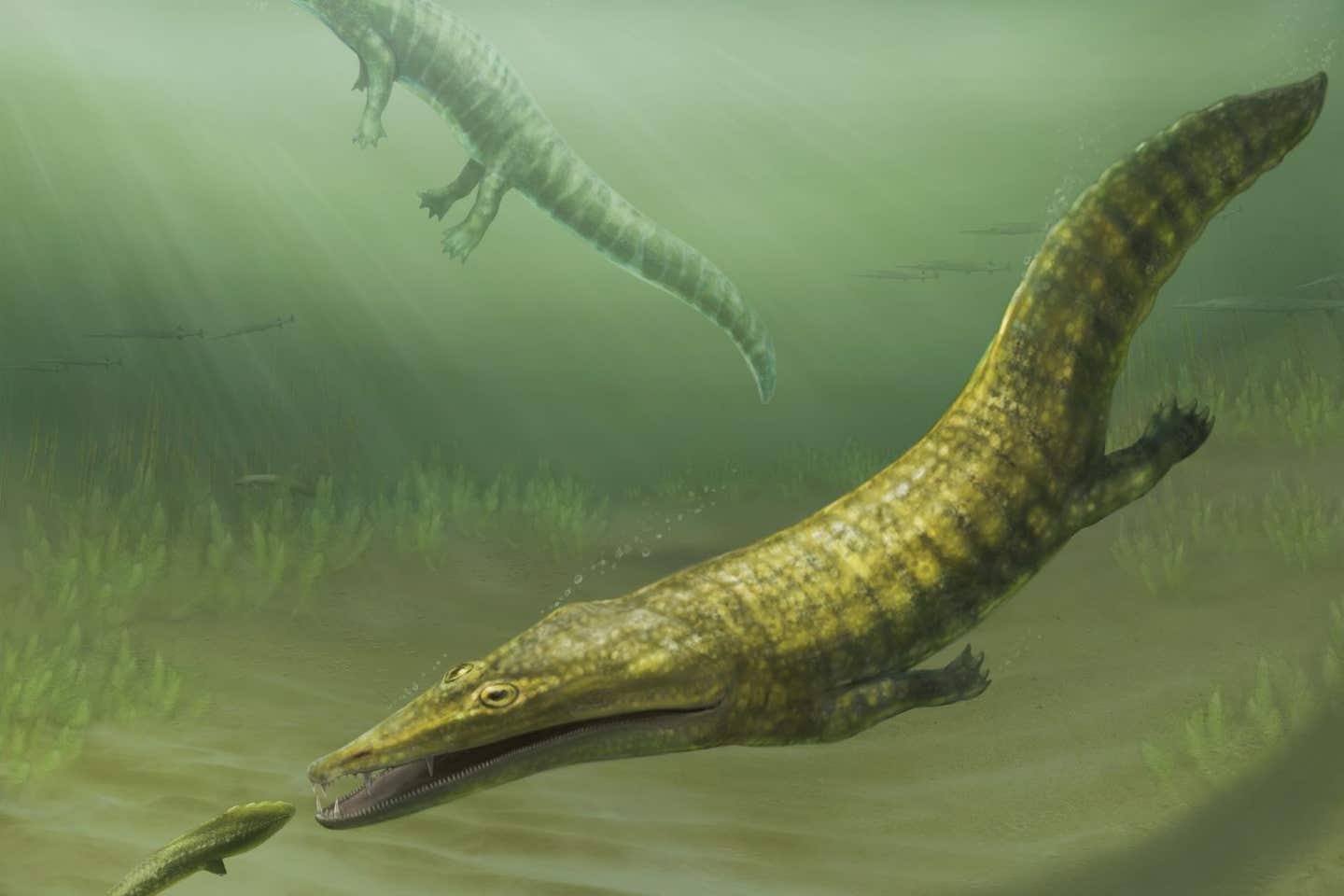
The ancient marine amphibians Erythrobatrachus (foreground) and Aphaneramma (background) swimming along the coast of what is now far norther Western Australia 250 million years ago. (CREDIT: Pollyanna von Knorring (Swedish Museum of Natural History))
The skull pieces sit in the rock like a faint fingerprint, the kind you could walk past in the Kimberley heat and never notice. But those scraps, collected more than 60 years ago from what is now desert in far northwestern Western Australia, are changing the picture of who first took charge in the seas after Earth’s worst mass extinction.
About 252 million years ago, the end-Permian crisis tore through life on land and in the oceans. Soon after, during the earliest Triassic, limbed vertebrates began pushing into coastal waters and rising into predator roles. Fossils of these early sea-going tetrapods have mostly come from the Northern Hemisphere. The Southern Hemisphere record has stayed thin and patchy.
Now a reexamination of Early Triassic remains from the Blina Shale, near Derby in the central-southern Kimberley region, points to a marine amphibian community that was more diverse than previously thought, with links that stretched far beyond Australia.
A species named, then misplaced
The story starts with expeditions in the early 1960s and 1970s. The fossils were split among museum collections in Australia and the United States. In 1972, researchers identified a single marine amphibian species from the site: Erythrobatrachus noonkanbahensis, named from skull fragments found weathering out on Noonkanbah Station, east of Derby.
Over time, the original Erythrobatrachus fossils went missing. A search through international collections later led to their rediscovery and reassessment in 2024.
That trail includes an “unofficial loan” of key material to John W. Cosgriff in 1984, when he was affiliated with WSU, according to personal communication from Western Australian Museum staff member Helen Ryan dated 2025. The holotype, WAM 62.1.46, and another specimen designated as a topotype, WAM 71.6.22, could not be found during initial surveys.
The team did locate a high-definition plaster cast of the holotype, WAM 62.1.59, along with another specimen, WAM 62.1.50. Then came the surprise. The original holotype turned up at the University of California Museum of Paleontology (UCMP), labeled as “cf. Tertrema sp.” It had also been registered a second time under UCMP 65858, a duplicate that has since been de-accessioned and repatriated to the Western Australian Museum, again noted via Helen Ryan’s 2025 communication.
Two hunters, one shoreline
Erythrobatrachus belonged to trematosaurids, a group of temnospondyl amphibians sometimes described as crocodile-like relatives of modern salamanders and frogs. Some grew to about 2 meters long. The group matters because trematosaurid fossils appear in coastal deposits laid down less than a million years after the end-Permian extinction, making them among the oldest recognizable marine tetrapods of the Mesozoic.
When the researchers looked closely at the Kimberley material, the “single species” idea began to fall apart.
The skull fragments attributed to Erythrobatrachus did not all match. Instead, the material represents at least two trematosaurid types: Erythrobatrachus itself, and another species referred to the well-known genus Aphaneramma.
High-resolution 3D imaging of the Erythrobatrachus skull cast suggests a complete skull length of about 40 centimeters. The animal likely had a broader head and a large body, consistent with a top predator role. Aphaneramma reached roughly the same skull length, but with a long, narrow snout suited for catching small fish.
Both animals swam in the water column. They likely hunted different prey in the same habitat.
The work also tightens what counts as Erythrobatrachus. The authors now limit the species definition to the holotype specimen, WAM 62.1.46. They argue it still carries enough distinctive features to keep the genus and species valid, including an unusually elongate cultriform process of the parasphenoid that extends to the front edges of the choanae.
The long route around a supercontinent
Aphaneramma matters for a second reason: it does not belong to Australia alone.
Fossils assigned to Aphaneramma have been reported from similar-aged deposits in the Svalbard archipelago, Pakistan, Madagascar, and the Russian Far East. Erythrobatrachus, by contrast, remains known exclusively from Australia. Taken together, the Kimberley finds suggest that trematosaurids spread quickly into different ecological roles and also moved across enormous distances early in the Triassic.
The authors outline one possible route: dispersal along the continuous coastal margins of the Pangean supercontinent, including the Tethyan periphery, rather than only through inland waterways. They also note that the Blina Shale setting itself looks transitional, with evidence pointing to very shallow, tidally influenced deposition on a delta front, and a mix of freshwater and marine assemblages.
The fossils do not arrive in pristine condition. Blina Shale temnospondyl remains usually appear disarticulated, often as impressions and internal casts. Size-sorting, breakage, and worn surfaces point to short-distance transport by currents before burial. That kind of preservation helps explain why this record stayed hard to read for decades.
The study also revisits an older claim: reports from the 1960s and early 1970s suggesting “large pieces of bone” might represent a marine reptile, even “perhaps [an] ichthyosaur.” The researchers say they did not recognize any diagnostic ichthyosaur remains in the Western Australian Museum or UCMP collections. They note that other authors have also treated the earlier ichthyosaur report as a misidentification.
The rediscovered Erythrobatrachus fossils are now being repatriated to Australia. Other amphibian fossils from the Age of Dinosaurs are on display at the Swedish Museum of Natural History.
Research findings are available online in the Journal of Vertebrate Paleontology.
The original story "250-million-year-old Australian ‘sea-salamander’ sheds new light on the dawn of the dinosaurs" is published in The Brighter Side of News.
Related Stories
- Mosasaur tooth fossil reveals giant sea reptiles lived in freshwater rivers
- Triumphant return of 'living dinosaur' to Big Stone Lake in Minnesota
- Fossilized dinosaur vomit reveals new pterosaur species in Brazil
Like these kind of feel good stories? Get The Brighter Side of News' newsletter.
Rebecca Shavit
Writer
Based in Los Angeles, Rebecca Shavit is a dedicated science and technology journalist who writes for The Brighter Side of News, an online publication committed to highlighting positive and transformative stories from around the world. Her reporting spans a wide range of topics, from cutting-edge medical breakthroughs to historical discoveries and innovations. With a keen ability to translate complex concepts into engaging and accessible stories, she makes science and innovation relatable to a broad audience.