3D printed moon dust structures could be the future of lunar construction
Laser printing can transform lunar soil into strong structures, raising new possibilities for Moon bases and space construction.

 Edited By: Joseph Shavit

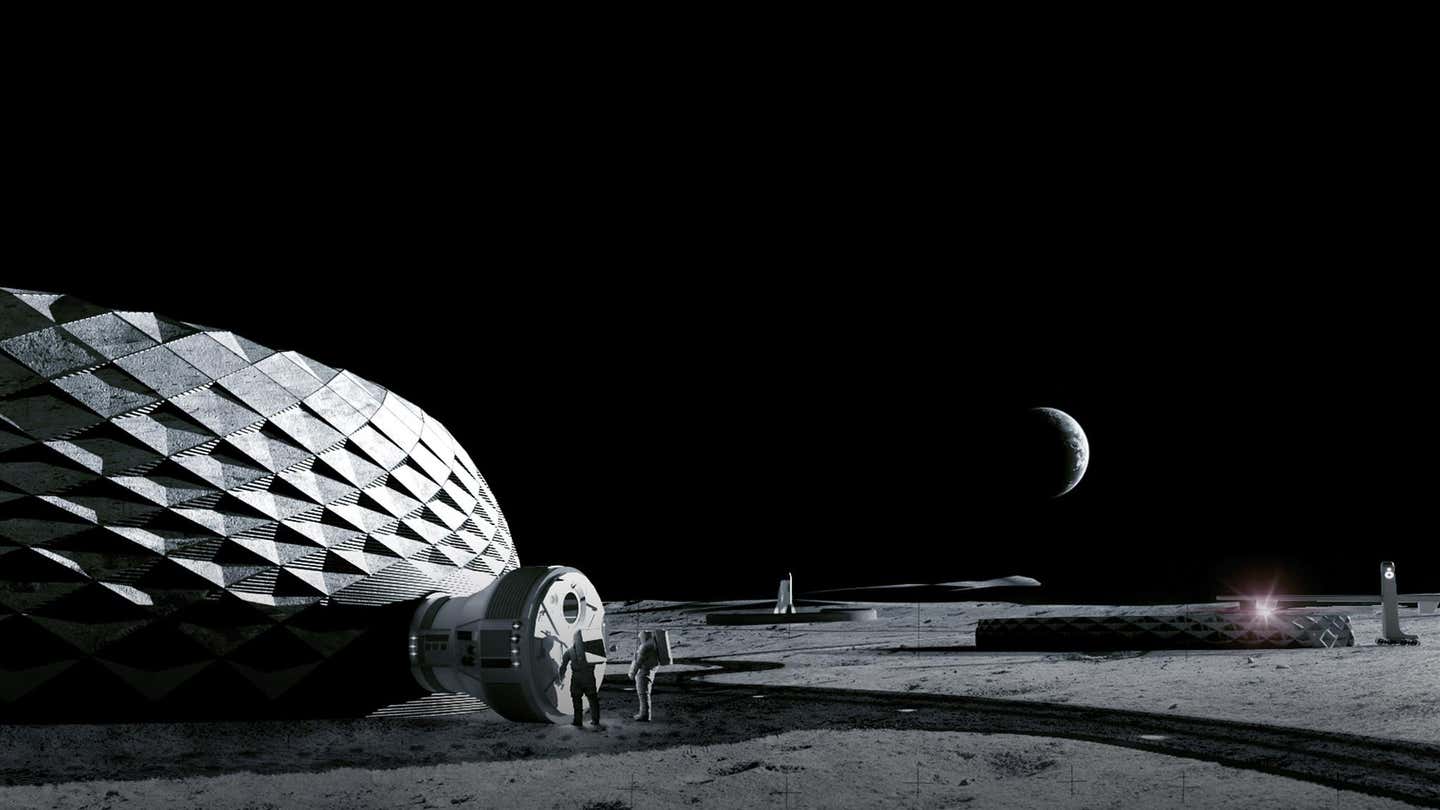
Scientists used lasers to turn simulated moon dust into durable material, offering a path for building structures directly on the Moon. (CREDIT: ICON)
A gray powder that looks like ash can become something closer to stone when hit with the right beam of light.
Engineers have shown that simulated lunar soil can be melted and layered into solid shapes using a laser-based 3D printing technique, producing materials that tolerate heat and mechanical stress. The approach could help future astronauts build tools, landing pads, and habitat components directly on the Moon instead of hauling heavy supplies from Earth.
The work, led by researchers at The Ohio State University and published in Acta Astronautica, focuses on a manufacturing strategy known as laser-directed energy deposition, or LDED. It involves feeding powdered material into a laser-generated melt pool, where it rapidly cools and solidifies into a new structure.
A construction material already waiting on the Moon
Lunar regolith, the dusty layer covering the Moon’s surface, comes from billions of years of meteor impacts that shattered rock into fine fragments. Because actual samples are scarce, scientists often rely on laboratory substitutes. The team used a version called LHS-1, designed to mimic soil from the Moon’s highland regions.
That material contains minerals similar to ceramics, which makes it a promising candidate for heat-resistant structures. But turning it into reliable building material is not straightforward. Small changes in processing conditions can alter how the material forms at the microscopic level, affecting strength and durability.
“By combining different feedstocks, like metal and ceramics, in the printing process, we found that the final material is really sensitive to the environment,” said Sizhe Xu, lead author of the study and a graduate research associate in industrial systems engineering at Ohio State. “Different environments lead to different properties, which directly affect the mechanical strength and the thermal shock resistance of certain components.”
The team tested the printing process under multiple conditions, including open air, low-oxygen argon gas, and partial vacuum environments meant to approximate space.
Surfaces matter as much as the dust itself
One early challenge involved getting the molten material to stick to a base surface during printing. Stainless steel and glass both performed poorly. On steel, the melted simulant formed bead-like droplets that failed to spread or bond. Glass fused at low laser power but cracked when the energy increased.
A ceramic base made of alumina and silica worked far better. The researchers believe the chemical similarity between the base and the printed material helped crystals form across the interface, improving adhesion and stability.
That discovery points to a key lesson for lunar construction. The surrounding environment and the surfaces used during fabrication may be just as important as the regolith itself.
Tiny crystals with big consequences
At high temperatures, the simulant transformed into a mix of mineral phases dominated by anorthite, with smaller amounts of mullite and quartz. Mullite drew particular attention because of its strong thermal stability, low expansion, and resistance to cracking. Those properties make it valuable for aerospace and high-temperature applications on Earth.
The study found that oxygen levels influenced how mullite crystals formed. Low-oxygen conditions produced smaller, more uniform grains, while open air created larger and more uneven structures. Those microscopic differences translated into changes in hardness and durability.
Samples printed in an argon environment reached an average hardness of about 625 Vickers hardness units. Open-air samples measured around 610, while partial-vacuum samples averaged roughly 590. The values are comparable to other advanced manufacturing methods used with lunar soil analogs.
Porosity remained a limitation. Many samples contained internal bubbles and voids, which weaken materials. Still, the experiments demonstrated that continuous millimeter-scale structures could be produced reliably under certain parameter combinations.
“There are conditions that happen in space that are really hard to emulate in a simulant,” said Sarah Wolff, senior author of the study and an assistant professor of mechanical and aerospace engineering at Ohio State. “It may work in the lab, but in a resource-scarce environment, you have to try everything to maximize the flexibility of a machine for different scenarios.”
Preparing for construction beyond Earth
The research connects directly to in-situ resource utilization, the idea of using local materials at exploration sites. NASA’s Artemis program aims to establish a sustained human presence on the Moon later this decade, and transporting building supplies from Earth remains one of the biggest logistical hurdles.
Additive manufacturing systems that rely on lunar materials could reduce launch mass and enable on-site repairs. Robots might fabricate infrastructure before astronauts even arrive.
The current experimental setup uses argon gas to deliver powder to the laser, which would be impractical on the Moon because the lunar environment contains almost no usable atmosphere. Future systems may need mechanical feeding mechanisms instead. Power could also shift from conventional electricity to solar-driven or hybrid energy systems.
Xu said the technology still requires refinement, but the potential uses are broad. “There are so many applications that we’re working toward that with new information, the possibilities are endless,” he said.
The research was supported by Ohio State’s Institute for Materials and Manufacturing Research and the Center for Electron Microscopy and Analysis. Co-authors include Marwan Haddad, Aslan Bafahm Alamdari, Annabel Shim, and Alan Luo.
Research findings are available online in the journal Acta Astronautica.
The original story "3D printed moon dust structures could be the future of lunar construction" is published in The Brighter Side of News.
Related Stories
- Recycled waste could make the moon or Mars suitable for growing food
- Solar cells made from moon dust could power future space missions
- Lunar-based manufacturing: Building humanity’s future on the Moon
Like these kind of feel good stories? Get The Brighter Side of News' newsletter.
Joshua Shavit
Writer and Editor
Joshua Shavit is a NorCal-based science and technology writer with a passion for exploring the breakthroughs shaping the future. As a co-founder of The Brighter Side of News, he focuses on positive and transformative advancements in technology, physics, engineering, robotics, and astronomy. Having published articles on AOL.com, MSN, Yahoo News, and Ground News, Joshua's work highlights the innovators behind the ideas, bringing readers closer to the people driving progress.