40,000-year-old Paleolithic carvings may be the precursor to human writing
Repeated Ice Age marks on ivory objects carry an information pattern that overlaps with the earliest proto-cuneiform tablets.

 Edited By: Joseph Shavit

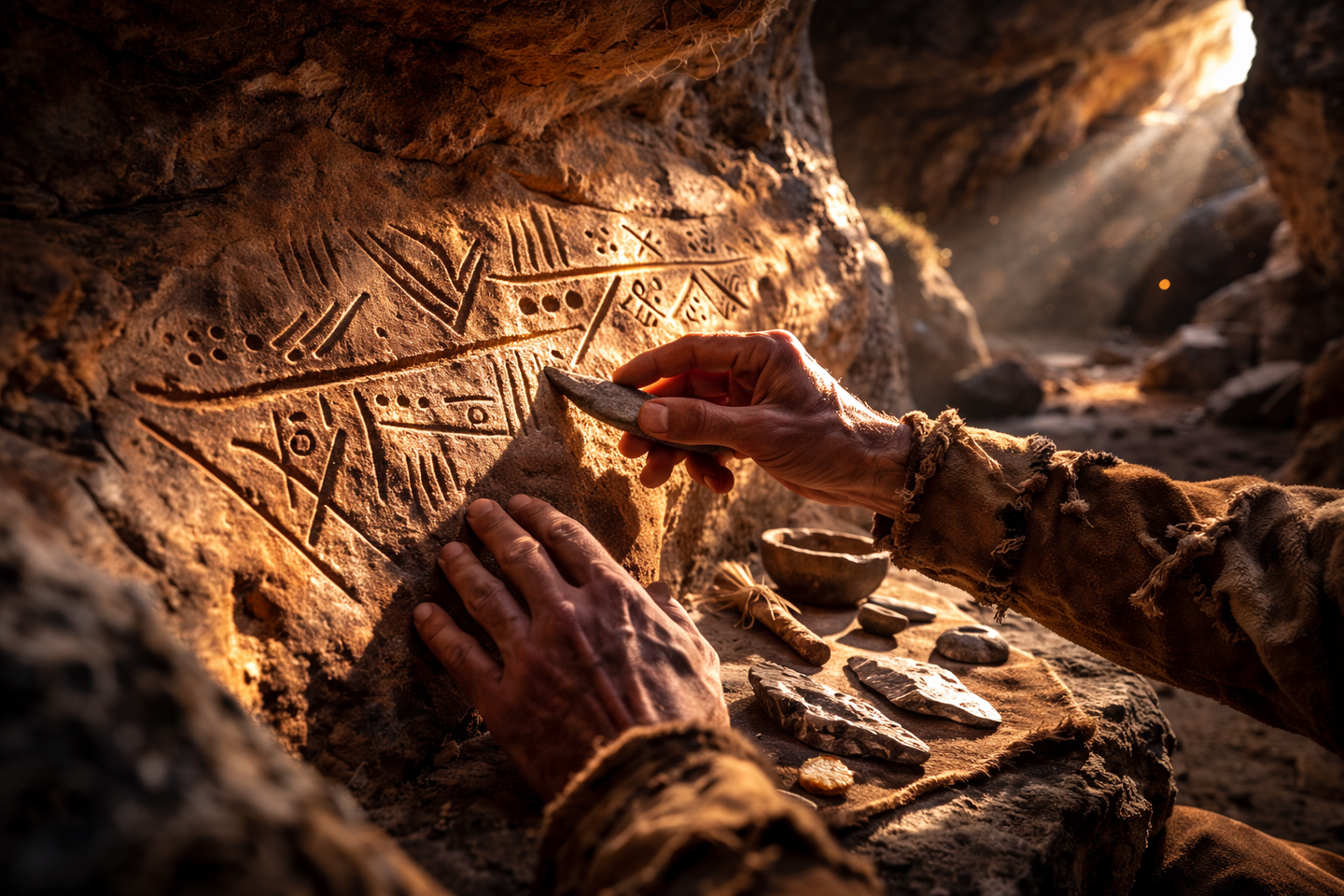
Ice Age carvings of dots and crosses show information patterns that match early proto-cuneiform, a new PNAS study finds. (CREDIT: AI-generated image / The Brighter Side of News)
Rows of tiny crosses and dots run along the flank of a mammoth no bigger than your palm. Someone carved it from a tusk around 40,000 years ago, then went back and added the marks with care. They show up again on other Aurignacian objects from southwestern Germany, on ivory plates and figurines and bones. For a long time, it was easy to treat them as decoration, or as something too fragmentary to take seriously.
A new computational analysis argues otherwise.
Linguist Christian Bentz of Saarland University and archaeologist Ewa Dutkiewicz of Berlin’s Museum für Vor- und Frühgeschichte say the repeated sign sequences on Ice Age objects carry a measurable “statistical fingerprint,” and that fingerprint looks unexpectedly close to the earliest proto-cuneiform tablets from ancient Mesopotamia. Their work appears in PNAS.
They do not claim these marks are writing in the modern sense. Still, the numbers suggest the marks were more than idle doodles.
A familiar set of marks, older than writing by millennia
The team focused on geometric signs carved into “mobile” objects from the Upper Paleolithic, especially in the Swabian Jura. This cluster of cave sites, in the Lone and Ach valleys, includes places like Vogelherd, Geißenklösterle, Hohle Fels, and Hohlenstein-Stadel. Modern humans lived in these caves roughly 43,000 to 34,000 calibrated years before present, during the Aurignacian.
The signs look simple on first glance: lines, points, crosses, notches, grids, zigzags, even stars. They often appear in sequences, arranged in rows. The mammoth figurine from Vogelherd Cave (see below) carries multiple runs of crosses and dots. An ivory plate known as the “Adorant,” found at Geißenklösterle, shows a hybrid lion-human figure on one side, and rows of dots and notches on the other. The famous Lion Human from Hohlenstein-Stadel has notches placed at regular intervals along an arm.
Dutkiewicz and Bentz argue those regularities matter. “Countless tools and sculptures from the Paleolithic, or the Old Stone Age, bear intentional sign sequences,” Dutkiewicz says. Bentz adds, “Our research is helping us uncover the unique statistical properties, or statistical fingerprint, of these sign systems, which are an early predecessor to writing.”
Measuring repetition instead of guessing meaning
Rather than trying to decipher what the marks meant, the researchers measured how they behave as sequences. They compiled a database of more than 3,000 signs on 260 objects from the Swabian Aurignacian. Dutkiewicz assigned sign types based on first-hand microscopic work, then mapped them to digital characters for analysis.
They then compared the Aurignacian material with three early phases of proto-cuneiform from Uruk, labeled Uruk V (about 3500–3350 BC), Uruk IV (about 3350–3200 BC), and Uruk III (about 3200–3000 BC). For a modern contrast, they used a sample called TeDDi, covering 89 languages written in 16 scripts.
Bentz, who studies frequency trends in language, focused on measurable features from quantitative linguistics: type-token ratios, repetition rates, and entropy-based measures that estimate information density. High repetition makes the next sign easier to predict, which lowers entropy. “Because of the high rate of repetitions and the high predictability of the next sign, we were able to show that the entropy, a measure of information density, is comparable to that of proto-cuneiform,” Bentz says.
That result surprised the team. They expected proto-cuneiform to look more like today’s writing, simply because it sits closer in time. Instead, the earliest proto-cuneiform period, Uruk V, statistically overlapped with the much older Paleolithic sequences. In one analysis that reduced the statistics to two principal components, the Aurignacian and Uruk V clusters fully overlapped, while modern writing sat far away.
The team also used machine-learning classifiers. Those systems could separate Aurignacian sequences from modern writing with near-perfect accuracy. Yet they could not reliably distinguish Aurignacian from Uruk V beyond a baseline that simply guesses the most common label.
Not writing, but not nothing
The paper spends time on a definitional fight archaeologists know well. Many scholars reserve “writing” for visible marks that represent spoken language. The Aurignacian material does not fit that strict category. Modern languages typically avoid adjacent repetition at many levels, and modern scripts show lower adjacent repetition than these Ice Age sequences.
Proto-cuneiform complicates things. Early Uruk tablets include many numeric signs, arranged by value, and only later expand into broader sets of ideographic signs. The paper notes a sharp shift in sign inventories over time: a Uruk V sign list of 47 signs, mostly numeric, compared with a Uruk III list of 838 signs, mostly ideographic. That expansion tracks with rising entropy and falling repetition from Uruk V to Uruk III.
In the Swabian Aurignacian, the statistical picture stays stable. The study reports no significant change in information density across roughly 10,000 years of objects, even as the artifacts vary in type and condition.
One pattern did stand out. Figurines tended to carry denser sequences than tools. Regression models estimated that ivory figurines held about 15% higher information density than tools. Tools, in turn, ran about 10% higher than tubes or flutes, and around 15% higher than personal ornaments. Fragmented objects showed about 10% lower information density than nearly complete pieces, which fits the practical reality of missing segments.
All of this points to deliberate use, not random scratching. It still does not tell you what the marks meant.
Limits the study can’t cross
The authors keep their claims bounded. They cannot “decipher” these signs, and they do not try. Statistical similarity offers a necessary clue, not a guarantee of shared function. As the paper puts it, the same “statistical fingerprint” is necessary but not sufficient for functional equivalence.
The database itself carries uncertainty, too. The paper reports agreement scores of 91–94% when other researchers assigned sign types, but Cohen’s Kappa values ranged from 0.29 to 0.44, reflecting how tricky fine-grained coding can be. Some flute notches may straddle the line between “utilitarian” and “nonutilitarian,” and the authors include them when function is unclear.
Proto-cuneiform brings its own caveats. Even in Uruk V, the numeric value of early number signs can be hard to fix, and some tablets show repetitions that break expected maximums. And unlike Mesopotamian writing, the Aurignacian sequences have no descendant system that could anchor interpretations.
Research findings are available online in the journal PNAS.
The original story "40,000-year-old Paleolithic carvings may be the precursor to human writing" is published in The Brighter Side of News.
Related Stories
- 500,000-year-old elephant bone tool reveals advanced planning and skill in early human ancestors
- Writing by hand boosts reading skills in young children, study finds
- Handwriting beats typing and watching videos for learning to read
Like these kind of feel good stories? Get The Brighter Side of News' newsletter.
Rebecca Shavit
Writer
Based in Los Angeles, Rebecca Shavit is a dedicated science and technology journalist who writes for The Brighter Side of News, an online publication committed to highlighting positive and transformative stories from around the world. Her reporting spans a wide range of topics, from cutting-edge medical breakthroughs to historical discoveries and innovations. With a keen ability to translate complex concepts into engaging and accessible stories, she makes science and innovation relatable to a broad audience.