67 million-year-old fossil reveals the origin of freshwater fish hearing
A UC Berkeley-led study finds freshwater superhearing likely began in marine fish, with two later moves into rivers and lakes.

 Edited By: Joseph Shavit

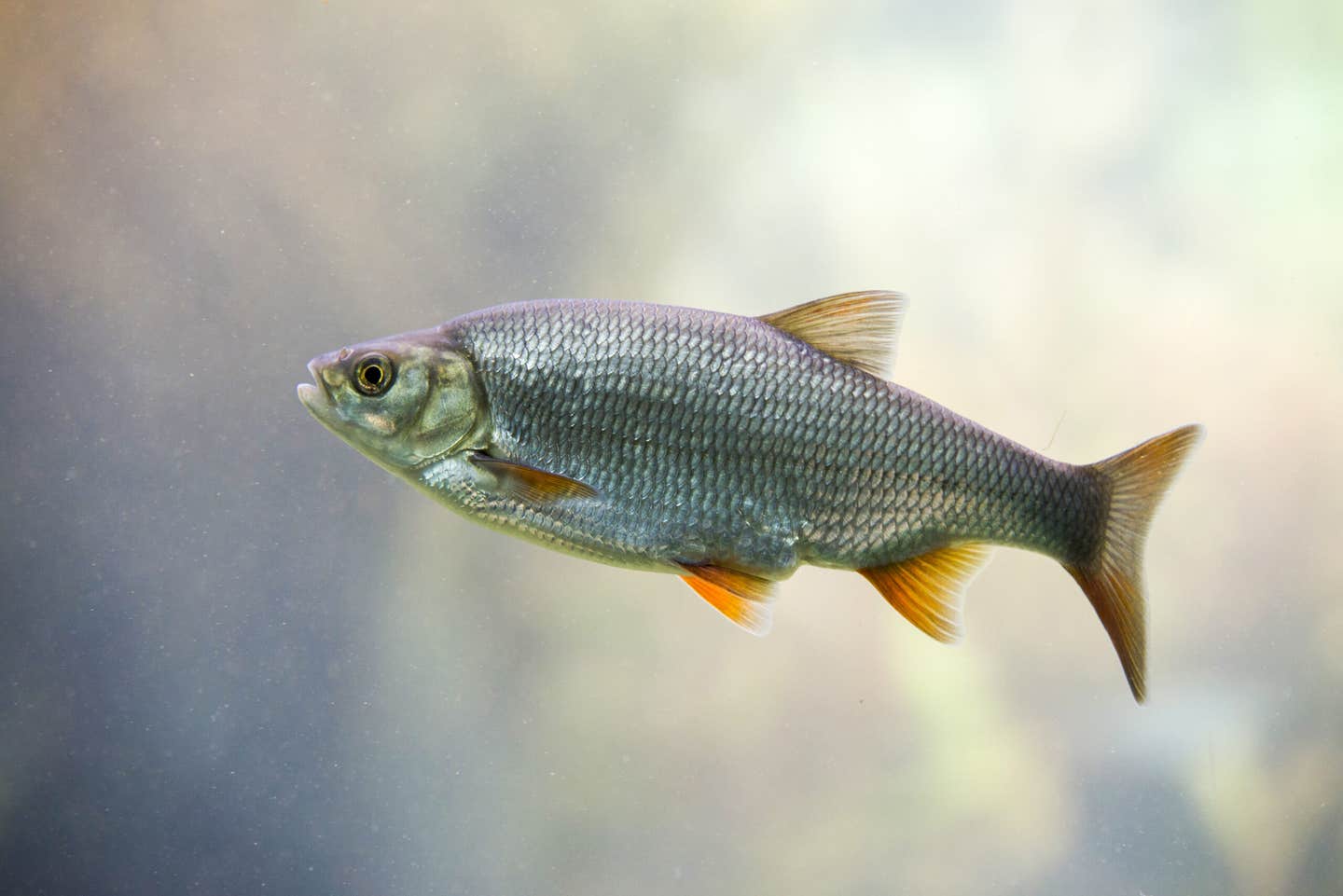
A 67-million-year-old fish fossil preserved rare middle ear bones that amplify sound. New analyses suggest otophysan fish evolved from marine ancestors and entered freshwater at least twice, reshaping the timeline for the world’s most diverse freshwater fish group. (CREDIT: Shutterstock)
A tiny fossil fish from Alberta is forcing scientists to rethink a story that has sat quietly in textbooks for decades. It is a story about how freshwater fish rose to dominance, and how a few bones in the head may have helped them do it.
In a paper, University of California, Berkeley paleontologist Juan Liu and colleagues describe a newly named fossil, Acronichthys maccagnoi. The fish lived about 67 million years ago. It measured only about 2 inches long. Yet it preserved something rare and powerful: a clear middle ear structure that lets many freshwater fish hear far better than most ocean fish.
That structure is called the Weberian apparatus. It is a chain of tiny bones that links an air-filled bladder to the inner ear. In modern fish, that bony bridge expands hearing into higher pitches. It gives many freshwater species a sensory edge that still echoes today.
A Freshwater Success Story Gets a New Beginning
Roughly two-thirds of freshwater fish alive today, more than 10,000 species, belong to a group with this hearing system. These fish include catfish, tetras, carp, minnows, suckers, zebrafish, and knife fish. They are often called otophysan fish.
For a long time, scientists believed their ancestors moved into fresh water once, about 180 million years ago. That was before the supercontinent Pangea fully broke apart. Under that view, otophysan fish evolved in inland waters, then spread as continents separated.
"Our team now argues for a different origin. The fossil, along with analyses of genomes and anatomy from modern fish, suggests the most recent common ancestor of otophysan fish was marine. The timing shifts too. Instead of 180 million years ago, the group likely arose about 154 million years ago, during the late Jurassic Period, after Pangea’s breakup had begun," Liu, an assistant adjunct professor of integrative biology and an assistant curator in the UC Museum of Paleontology, told The Brighter Side of News.
“The marine environment is the cradle of a lot of vertebrates,” he continued. “A long time consensus was that these bony fish had a single freshwater origin in the large continent Pangea and then dispersed with the separation of different continents. My team’s analysis of some fantastic fossils that shed new light on the evolutionary history of freshwater fish and found completely different results: the most recent common ancestor of otophysan fish was a marine lineage and there were at least two freshwater incursions after that lineage split up.”
That “two incursions” point matters. The team says one lineage later produced catfish, knife fish, and African and South American tetras. Another lineage later produced carp, suckers, minnows, and zebrafish, the largest order of freshwater fish today.
How Fish Hear Underwater, and Why Some Hear More
Hearing in water brings a basic problem. Sound waves travel through a fish’s body easily because fish and water have similar density. That makes it harder for fish to capture sound in a focused way.
Many land animals solved a different problem. They evolved an eardrum and a set of middle ear bones. In humans, those bones are the malleus, incus, and stapes. They amplify vibrations and deliver them to the fluid-filled inner ear.
Fish do not have eardrums like that. Instead, many have an air bladder inside the body. It acts like a bubble that vibrates when sound passes through. In most saltwater fish, that vibration reaches the inner ear in a basic way. It limits hearing to low notes, often below about 200 Hertz.
Otophysan fish took a more advanced path. They evolved small bony “ossicles” between the air bladder and inner ear. Those bones act like an amplifier. They extend hearing into higher pitches.
Zebrafish can hear up to about 15,000 Hertz. Humans top out near 20,000 Hertz. For a fish, that is a striking range.
Why these fish needed higher-pitched hearing remains uncertain. Liu notes a possible clue. Many live in complex habitats, from rushing streams to still lakes. Those places create a dense mix of sounds.
A Fossil Ear Put to the Test
The fossil fish that triggered the new timeline came from Alberta, Canada. Ichthyologist Michael Newbrey of Columbus State University collected many specimens over six field seasons starting in 2009. The fossils now sit in the Royal Tyrrell Museum in Drumheller, Alberta.
A couple of specimens preserved the middle ear bones well enough to identify them as Weberian. Older otophysan fossils exist elsewhere, but none preserved the structure so clearly, Liu said.
Technicians at the Canadian Light Source at the University of Saskatchewan and at McGill University captured 3D X-ray scans. Liu then modeled the ossicles in her lab. She also used computational simulations to estimate how the apparatus would respond to different sound frequencies.
“We weren’t sure if this was a fully functional Weberian apparatus, but it turns out the simulation worked,” Liu said. “The Weberian apparatus has just a little bit lower output power, which means lower sensitivity, compared to a zebrafish. But the peak, the most sensitive frequency, is not too much lower than zebrafish; between 500 and 1,000 Hertz; which is not too bad at all and which means the higher frequency hearing should have been achieved in this old otophysan fish.”
Newbrey said the fossil helps resolve a long-standing puzzle.
“For a long time, we presumed that the Otophysi probably had a freshwater origin because this group consisted almost exclusively of freshwater fishes,” Newbrey said. “The new species provides crucial information for a new interpretation of the evolutionary pathways of the Otophysi with a marine origin. It just makes so much more sense.”
Practical Implications of the Research
This work reshapes how scientists study freshwater biodiversity. It suggests repeated moves into new habitats, not one migration, can drive rapid speciation. That insight can guide future research on why certain groups explode into thousands of species.
The study also shows the power of combining fossils, genetics, and 3D imaging. That approach can refine evolutionary timelines for other animals whose histories remain debated.
Finally, understanding how the Weberian apparatus boosts hearing may help biologists ask new questions about sensory evolution. It may also help engineers think about sound detection in water, though the study focuses on biology.
Research findings are available online in the journal Science.
Related Stories
- New box jellyfish species has 24 eyes and can see in all directions at once
- Do fish make noise? New technology lets the public hear coral reefs up close
- Zebrafish could help scientists fully restore human vision loss
Like these kind of feel good stories? Get The Brighter Side of News' newsletter.
Mac Oliveau
Writer
Mac Oliveau is a Los Angeles–based science and technology journalist for The Brighter Side of News, an online publication focused on uplifting, transformative stories from around the globe. Passionate about spotlighting groundbreaking discoveries and innovations, Mac covers a broad spectrum of topics including medical breakthroughs, health and green tech. With a talent for making complex science clear and compelling, they connect readers to the advancements shaping a brighter, more hopeful future.