A giant star’s sudden shift signals it might be ready to supernova
WOH G64 abruptly changed color around 2014, and its spectrum stopped looking like a classic red supergiant.

 Edited By: Joshua Shavit

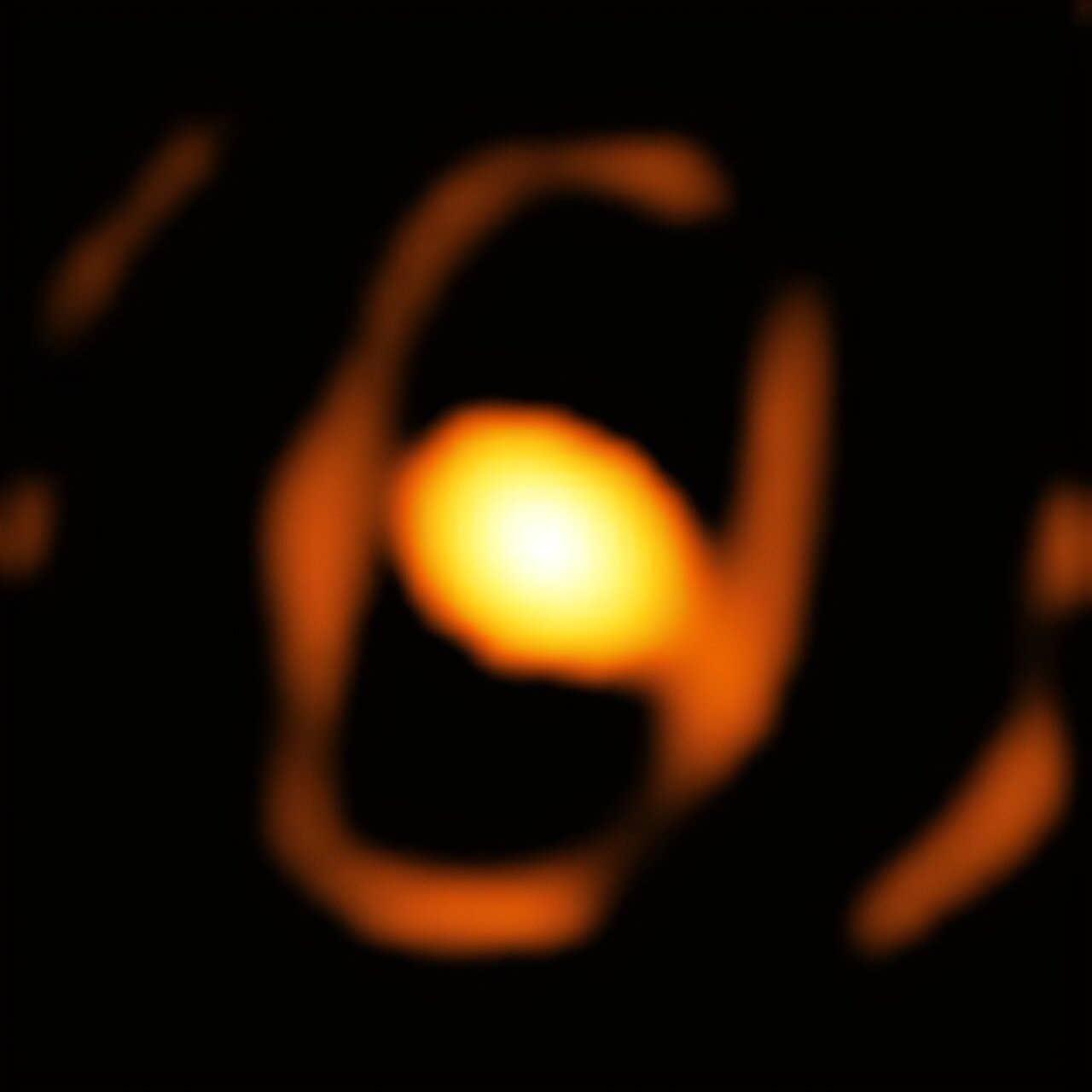
Image of WOH G64, taken by the GRAVITY instrument on the European Southern Observatory’s Very Large Telescope Interferometer (ESO’s VLTI). ESO/K. (CREDIT: Ohnaka et al.)
WOH G64 has always been an oddball. It sits in the Large Magellanic Cloud, a small galaxy that orbits the Milky Way, and it ranks among the most extreme red supergiants known. Earlier estimates put it at roughly 1,540 times the Sun’s radius. It also sheds mass at an unusually high rate and sits inside a thick, dusty environment that partly hides what is going on.
Then, around 2014, the star did something rare: it changed in a way that did not bounce back.
A new study led by Gonzalo Muñoz-Sanchez at the National Observatory of Athens, published in Nature Astronomy, argues that WOH G64 shifted away from its red supergiant state and into a warmer, short-lived phase that resembles a yellow hypergiant. That kind of transition matters because it can signal a star that is shedding its outer layers and edging toward the final stages of its life.
A long-running pattern suddenly snapped
The team pieced together decades of sky-monitoring data. Before 2014, WOH G64 looked and behaved like a very cool, swollen red supergiant. Its brightness rose and fell on a rough cycle of about 850 days, with big swings in visible light.
At first glance, that rhythm made it look like a pulsating star. But the study argues the ups and downs mostly came from changing dust along our line of sight. In other words, the star was often not changing so much as the view of it was.
Things got stranger in the early 2010s. A strong dimming event hit in 2011. After that, between mid-2013 and mid-2014, the star became much bluer. That was the key moment.
What is striking is how the color change happened. The star brightened quickly in visible light, while staying about the same in redder light. The authors interpret that as a real temperature jump, likely more than 1,000 degrees Kelvin. Since 2014, the star has not returned to its old, steady rhythm. Its brightness has become irregular, including a sharp fade during 2025.
Its spectrum stopped looking like a red supergiant
The cleanest evidence comes from spectroscopy, which breaks starlight into its component colors and reveals what kind of star you are looking at.
Back in 2007, WOH G64 showed strong molecular features that are typical for very cool red supergiants. After the 2014 shift, those features vanished. Instead, the optical spectrum became packed with emission lines, including both common hydrogen lines and many metal lines, some from low-density gas around the star.
That kind of spectrum resembles a class of objects known as B[e] stars, which often involve hot stars surrounded by disk-like material. But here is the catch: WOH G64 did not look like a hot B-type star in the near-infrared. In that part of the spectrum, the star looked more like a warm supergiant, closer to a late-G or early-K type star. The study estimates an effective temperature around 4,800 Kelvin, with a few hundred degrees of uncertainty.
So the system sends mixed signals: warm-star fingerprints in the infrared, but a gas-rich, emission-heavy environment dominating the optical view.
A binary system may explain the mess
To make sense of the conflicting clues, the authors argue that WOH G64 is likely a massive symbiotic binary. In these systems, a luminous giant or supergiant shares space with a companion that can gather gas and build an accretion structure. That structure can light up the surrounding material and create the forest of emission lines.
This idea also fits with the star’s unusually complex circumstellar environment. Observations have suggested WOH G64 sits inside a thick, non-spherical dust structure, described as a torus, holding several solar masses of material. A system like that can easily produce large swings in brightness just by moving dust around, without requiring the star itself to change much.
The study also reports radial-velocity behavior that supports a two-object system. Different sets of spectral lines appear to shift in different ways, which is hard to explain with a single star alone.
Did the star shed part of its outer layers?
The 2014 transition still needs an engine. The study lays out two leading possibilities.
One is that the system went through a period of strong interaction between the two stars. In some binaries, a red supergiant can start transferring mass to its companion. In extreme cases, both stars can end up wrapped in a shared envelope. If that envelope becomes unstable, it can be ejected quickly. The authors point to recent three-dimensional simulations showing that large fractions of a giant’s envelope can be expelled on roughly year-long timescales, which matches how fast WOH G64 changed.
The second possibility is that the event came from the star itself. WOH G64 sits near a luminosity limit where very bright stars are expected to become unstable and erupt. The paper compares WOH G64 to a famous case in another galaxy, Var A, which spent decades in a state that looked cooler than it really was because it drove an optically thick wind. In that scenario, WOH G64 may have looked like an extreme red supergiant for years because it was wrapped in its own outflow, then “cleared” enough to reveal a warmer underlying star.
The authors do not claim to know which explanation is correct. They stress that the system is complicated, with multiple sources of light, dense dust, and geometry that makes simple modeling unreliable.
What comes next is unclear
If you hoped for a countdown to a supernova, the study does not offer one. The team says they cannot predict the system’s future because the basic physical and orbital details remain poorly pinned down.
It also gets even messier: observations in 2025 suggest the star currently shows optical features consistent with a red supergiant again, rather than the strong B[e]-like traits seen from 2016 to 2021. The authors describe two ways to interpret that. It could mean another thick-wind phase has begun, if the changes are driven by eruptions. Or it could mean the system rebuilt a cool extended envelope after earlier mass loss, if binary interaction is the main driver.
Either way, WOH G64 is doing something astronomers rarely get to watch: an extreme massive star changing character on human timescales.
Practical implications of the research
This study highlights a practical problem astronomers face when they try to identify which stars are about to explode. A star buried in dusty circumstellar material can look cooler and redder than it truly is. That means some supernova progenitors may be misclassified if researchers rely mostly on color and brightness, without detailed spectra.
The work also underscores how strongly a surrounding disk or torus can shape what a future supernova looks like. If WOH G64 does explode, the blast could interact with dense material in some directions and escape more freely in others. The same explosion might look very different depending on the viewing angle.
Research findings are available online in the journal Nature Astronomy.
The original story "A giant star’s sudden shift signals it might be ready to supernova" is published in The Brighter Side of News.
Related Stories
- What a rare lensed supernova could mean for measuring cosmic expansion
- JWST detected a supernova from the dawn of the universe
- New images reveal an early-stage stellar eruption (nova) in stunning detail
Like these kind of feel good stories? Get The Brighter Side of News' newsletter.
Joseph Shavit
Writer, Editor-At-Large and Publisher
Joseph Shavit, based in Los Angeles, is a seasoned science journalist, editor and co-founder of The Brighter Side of News, where he transforms complex discoveries into clear, engaging stories for general readers. With vast experience at major media groups like Times Mirror and Tribune, he writes with both authority and curiosity. His writing focuses on space science, planetary science, quantum mechanics, geology. Known for linking breakthroughs to real-world markets, he highlights how research transitions into products and industries that shape daily life.