A rare sperm whale birth captured how families rally around a newborn
Researchers recorded a sperm whale birth and found coordinated care from two usually separate family groups.

 Edited By: Joseph Shavit

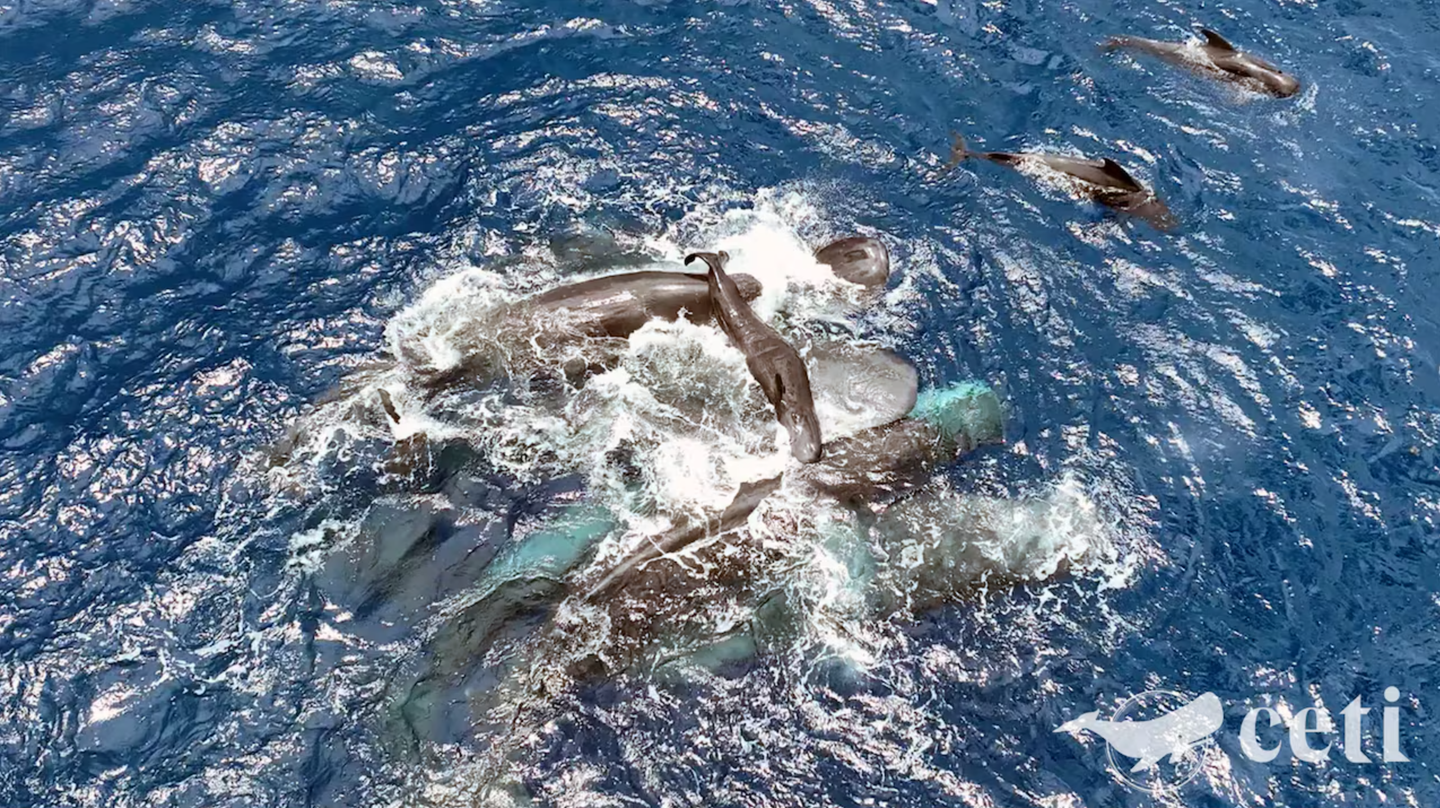
A rare sperm whale birth shows kin and non-kin working together to help a newborn survive its first critical hour. (CREDIT: CETI)
Eleven sperm whales gathered near the surface off the coast of Dominica on the morning of July 8, 2023, and stayed there for hours. That alone was unusual. What researchers watching from a drone above them were about to record had never been documented in such detail in any cetacean.
A calf was coming.
What unfolded over the next several hours, captured on aerial video and underwater audio, has now been published across two separate papers: one in Science, one in Nature's Scientific Reports, both produced by Project CETI, the Cetacean Translation Initiative.
Together they provide the most complete account of a sperm whale birth ever recorded, and the first quantitative evidence that non-primate animals cooperate during birth in ways that parallel some of the most sophisticated social behaviors observed in humans.
A Family That Normally Keeps Its Distance
The whales gathered that morning belonged to a social unit researchers call Unit A, a group that has been followed and documented since 2005 by Shane Gero, the Biology Lead for Project CETI and founder of the Dominica Sperm Whale Project. Gero, now Scientist in Residence at Carleton University, has spent two decades learning these animals individually.
Unit A is composed of two genetically distinct matrilines, family lines descending through mothers and grandmothers, that share a loose social affiliation but normally forage separately. On typical days, the two subgroups rarely cluster together at the surface. They keep their distance. Yet on this morning, all 11 members had converged, mingling in ways the researchers' long-term data had never shown before.
The reason became clear when the flukes of a calf emerged from Rounder, whale 5714, a female known to the team since 2005, at 11:12 a.m. What followed was a 34-minute delivery, with adult females positioning themselves closely around the laboring mother. At 11:46 a.m., a plume of blood and the appearance of the newborn marked the moment of birth.
"This is the most detailed window we've ever had into one of the most important moments in a whale's life," Gero said. "Because this family unit has been studied for decades, we could see what the grandmother was doing, how the new big sister acted, and how each helped mom and newborn."
Lifting, Supporting, Taking Turns
Newborn sperm whale calves are believed to be negatively buoyant; they cannot easily reach the surface on their own to breathe. In the hour after delivery, the researchers observed multiple adult females doing something striking: taking turns physically lifting and pushing the calf toward the surface.
This was not random or chaotic. Using drone footage, machine learning-based tracking, and a custom annotation platform called Whale Tales, the research team quantified exactly who was doing what and when. The analysis tracked individual positions, body orientations, physical contact, and proximity to the newborn across the entire event.
The results were precise. A core group of four individuals provided continuous physical contact with the newborn for 96% of the postnatal support period. That group included the mother, Rounder; her half-sister, Aurora; a juvenile female from the other, unrelated matriline named Ariel; and an elder female from Rounder's own matriline. When the mother was absent from immediate contact, Aurora stepped in 60% of the time. When neither was present, Ariel covered about half the remaining gaps.
Importantly, every single whale in the 11-member unit served as the primary supporter of the newborn at some point during the event. No individual was excluded. No contribution was random. The coordination between pairs of whales exceeded what chance alone would predict, particularly among non-kin dyads from the second matriline, suggesting the behavior was organized rather than coincidental.
Three generations of Rounder's family were present: her mother, Lady Oracle, whale 5712, and her own daughter, Accra. The grandmother played a more peripheral role in the active postnatal support, often positioning herself at the edge of the group or tending to other calves. The elder generation, it seems, supervised rather than lifted.
Two Families, One Purpose
What makes the findings especially striking is the mixing of the two normally separate matrilines. Researchers measure kinship homophily, the tendency of individuals to associate with their own kin rather than others. During typical foraging, homophily in Unit A was effectively total: the two subgroups simply did not cluster together. During the birth event, homophily dropped close to zero. The families were fully intermingled.
Collective attention, measured by tracking the direction each whale was oriented, shifted in revealing sequence. Before and during delivery, the group faced the mother. The moment the calf appeared, attention transferred sharply to the newborn and stayed there throughout the postnatal care period. An adolescent male named Allan repeatedly attempted to join the group and was consistently avoided.
Hours after the birth, as the intensity of the event wound down, the two matrilines gradually separated again. Homophily returned toward its baseline. The animals dispersed into smaller clusters resembling typical foraging behavior.
The moment had passed. The bonds it reinforced, apparently, had not.
"What we're seeing is deeply coordinated social care during one of the most vulnerable moments of life," said David Gruber, Founder and President of Project CETI and Distinguished Professor of Biology at the City University of New York.
An Ancient Behavior
The Science paper's phylogenetic analysis pushes the significance of these findings beyond a single birth. Collective lifting behaviors may predate the most recent common ancestor of all toothed whales, a lineage that diverged more than 36 million years ago. That would make cooperative birth assistance not a recent development in cetacean evolution, but an ancient one, suggesting the social architecture underlying it has deep roots.
The Scientific Reports paper adds another dimension: audio. Hydrophone recordings captured six-plus hours of sound during the event, and researchers identified distinct shifts in vocal patterns at key moments, including the presence of vowel-like structures during critical phases. This connects to Project CETI's broader work analyzing the complexity of sperm whale communication, which has previously identified a phonetic alphabet and diphthong-like spectral patterns in the click sequences these animals use to communicate.
"This work speaks to the fact that longitudinal studies are critical," said Dr. Diana Reiss, Professor in the Animal Behavior and Conservation Program at Hunter College, CUNY. "When you're as familiar with the individual animals, like the CETI team is with this unit of whales, the trust these whales have with their team is unique."
Practical Implications of the Research
Understanding how sperm whale societies are organized around birth has direct implications for conservation. Sperm whales are long-lived, reproduce slowly, and form stable social units whose disruption, by historical whaling, ship strikes, or acoustic disturbance, can have cascading effects across generations.
If cooperative birth behavior is foundational to social cohesion and calf survival, then the loss of experienced adult females from a unit may compromise not just individual births but the social fabric that makes group survival possible.
The methods developed for this study, combining drone footage with machine learning tracking, long-term individual identification, and network analysis, offer a template for studying other difficult-to-observe cetacean species.
Behaviors once assumed unknowable because of the depths these animals inhabit are now measurable in ways they simply were not before. For species already under pressure from climate change, noise pollution, and entanglement, that kind of knowledge is not merely academic.
Research findings are available online in the journals Science and Scientific Reports.
The original story "A rare sperm whale birth captured how families rally around a newborn" is published in The Brighter Side of News.
Related Stories
- Researchers discovered a previously unknown ‘alphabet’ in sperm whale calls
- Whale fossils reveal evidence of ancient shark attacks
- Indigenous communities in southern Brazil hunted large whales 5,000 years ago
Like these kind of feel good stories? Get The Brighter Side of News' newsletter.
Hannah Shavit-Weiner
Medical & Health Writer
Hannah Shavit-Weiner is a Los Angeles–based medical and health journalist for The Brighter Side of News, an online publication focused on uplifting, transformative stories from around the globe. Passionate about spotlighting groundbreaking discoveries and innovations, Hannah covers a broad spectrum of topics—from medical breakthroughs and health information to animal science. With a talent for making complex science clear and compelling, she connects readers to the advancements shaping a brighter, more hopeful future.