AI-powered electronic nose can ‘smell’ early signs of ovarian cancer in the blood
A sensor device paired with AI “smells” ovarian cancer clues in blood plasma, aiming for faster, cheaper screening.

 Edited By: Joseph Shavit

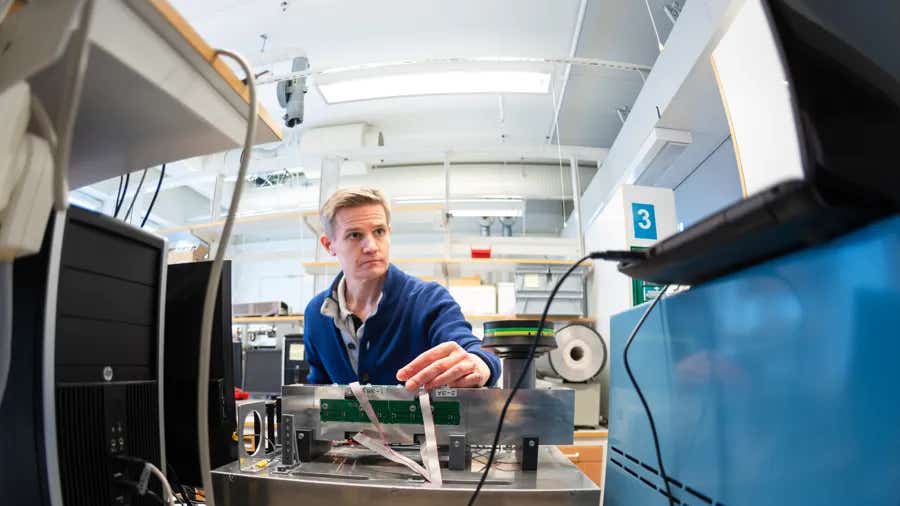
A Linköping University team uses a 32-sensor electronic nose and machine learning to spot ovarian cancer patterns in blood plasma. (CREDIT: Olov Planthaber)
A blood sample does not have an obvious odor to a person in a lab coat. But to an electronic nose, it can carry a chemical signature that points toward disease.
In a new study from Linköping University in Sweden, researchers report that a sensor device paired with machine learning can sort blood-plasma samples into three groups, ovarian cancer, endometrial cancer, and healthy controls. The team says the approach may eventually help screen for several cancers, without relying on a single biomarker test.
“We’re trying to mimic the mammalian sense of smell artificially. We’ve now developed an algorithm that can distinguish ovarian cancer from endometrial cancer and healthy control groups, using data from an electronic nose,” said Donatella Puglisi, an associate professor at Linköping University.
Vague symptoms, late diagnoses
Ovarian cancer is often detected late because early symptoms can be hard to pin down. They can look like far more common problems, and that makes it easy for the disease to advance before anyone suspects cancer.
The stakes are high. In 2022, about 325,000 new cases of ovarian cancer and more than 200,000 deaths were reported worldwide, according to figures cited by the researchers. The World Cancer Research Fund estimates those numbers will rise sharply by 2050.
“More and more people are being diagnosed with cancer, especially young adults, and this is alarming,” Puglisi said. “If screening were more accessible, both in terms of cost and location, it would be possible to improve early diagnosis. Our approach could facilitate the adoption of new screening protocols and the development of new diagnostic methods, improving survival rates, quality of life, and overall clinical outcomes.”
The problem is not a lack of effort. Health systems already use blood tests for cancer screening, but they usually depend on searching for particular biomarkers tied to a suspected cancer type. The study’s authors argue that these tests can be slow to analyze and, in many cases, not accurate enough for confident early detection.
The nose, rebuilt in hardware
Electronic nose technology is not new. Versions of it have existed for around 60 years. The Linköping team used a prototype with 32 sensors that react to different volatile substances given off by the sample being tested. The idea is simple: different cancers release different blends of volatile substances. Those blends create different “smell” patterns.
The sensors themselves, the researchers say, are relatively simple and commercially available. The newer piece is the machine learning that can pick out patterns in the sensor data, even when the chemical mix is complex and noisy.
Instead of looking for one biomarker, the electronic nose reads a broad range of volatile substances emitted from blood plasma. The machine-learning models then search for patterns that match ovarian cancer.
The models are trained on known samples from a biobank. In the study, the researchers report 97 percent accuracy.
“It’s a simple test that takes 10 minutes and gives a clear result,” said Jens Eriksson, an associate professor at Linköping University and chief technology officer at VOC Diagnostics AB, a company developing the electronic nose. “Our method can test many people at a low cost and is much more accurate than what’s on the market today. This study is a pilot, but we hope it will be used as part of cancer screening within three years. Right now, we’ve focused on detecting cancer, but the applications are endless.”
A closer look at what the model learned
The paper digs into how the system reached that performance. The team analyzed blood-plasma samples from 134 people with ovarian cancer, 41 with endometrial cancer, and 115 healthy controls.
For the first major task, separating healthy controls from ovarian cancer, they evaluated 43 different machine-learning models and extracted 85 features from each sensor signal. They used a 90–10 train-test split and fivefold cross-validation. A model they describe as an “Optimizable Ensemble” performed best as a baseline, but the team then worked to improve the results by examining which sensors helped and which ones did not.
Some sensors appeared to add little useful information. Through an iterative process, the researchers removed sensors one by one and tracked performance. A configuration that excluded two sensors, identified as sensor #17 and sensor #25, produced high validation and test performance without the overfitting they warned can happen when too much information is stripped away.
Across repeated training and testing runs, the model’s mean test accuracy reached about 97 percent, with sensitivity and specificity also around that level.
The researchers also emphasized a clinical concern that can quietly inflate performance in lab-style machine learning studies, data leakage. In real screening, the goal is patient-level prediction, not classifying many repeated signals from the same person as if they were independent samples. To address that, the team performed a patient-level split and then used majority voting across multiple signals to make a final patient-level call.
They report perfect patient-level classification in that setup.
Not just detection, but staging
Early-stage detection is the point of screening. The paper includes work aimed at distinguishing stage I ovarian cancer from more advanced stages II to IV.
Using a similar approach, the researchers trained a classifier within the ovarian cancer group, comparing stage I samples (41 cases) against stages II to IV (93 cases). In that task, they report mean test accuracy around 93 percent across repeated runs, with sensitivity in the mid-90 percent range and lower specificity in the mid-80 percent range.
Those numbers matter because they show both promise and friction. The tool did well at flagging stage I cases, but it was less consistent at ruling out stage I when a case was actually later-stage disease.
The endometrial cancer problem
Another limitation in ovarian cancer screening is confusion with other gynecologic cancers, especially endometrial cancer. Misclassification could send patients down the wrong diagnostic path, add distress, and drive up costs.
The team developed a classifier to distinguish ovarian cancer from endometrial cancer using the same electronic nose signals. They report mean test accuracy around 97 percent across repeated runs, with high sensitivity and strong specificity. They also report perfect patient-level classification after majority voting.
When the researchers tried more complicated, screening-like scenarios, performance slipped. In tests that mixed endometrial cancer, healthy controls, and various ovarian cancer stages into broader comparison groups, sensitivity did not rise above 80 percent even though specificity stayed high. In plain terms, the system was better at saying “no” than reliably catching every early-stage case in a messy real-world population.
That is an important constraint, and the authors did not hide it.
Practical implications of the research
If this approach holds up beyond a pilot study, it points toward a different kind of blood screening test, one that does not depend on a single biomarker and might be run quickly, at low cost, in more locations. The strongest results in the paper come from controlled comparisons and patient-level voting across repeated signals, which could fit a clinic workflow if the testing setup is standardized.
At the same time, the study’s harder experiments, the ones that mixed multiple conditions into a screening-like pool, show that early-stage detection in the real world will be the true test. The work suggests the tool may be most useful as part of a stepwise pathway, flagging likely cancer cases and then helping clinicians narrow the diagnosis.
Research findings are available online in the journal Advanced Intelligent Systems.
The original story "AI-powered electronic nose can 'smell' early signs of ovarian cancer in the blood" is published in The Brighter Side of News.
Related Stories
- New 'glue sniffer' sensor lets scientists watch brain cells talk in real time
- Electronic nose accurately sniffs out hard-to-detect cancers
- Engineers develop prototype of electronic nose
Like these kind of feel good stories? Get The Brighter Side of News' newsletter.
Mac Oliveau
Writer
Mac Oliveau is a Los Angeles–based science and technology journalist for The Brighter Side of News, an online publication focused on uplifting, transformative stories from around the globe. Passionate about spotlighting groundbreaking discoveries and innovations, Mac covers a broad spectrum of topics including medical breakthroughs, health and green tech. With a talent for making complex science clear and compelling, they connect readers to the advancements shaping a brighter, more hopeful future.