Ancient supernova remnants found in Antarctic ice
Ancient Antarctic ice contains iron-60, linking Earth’s recent cosmic dust to the Local Interstellar Cloud.

 Edited By: Joseph Shavit

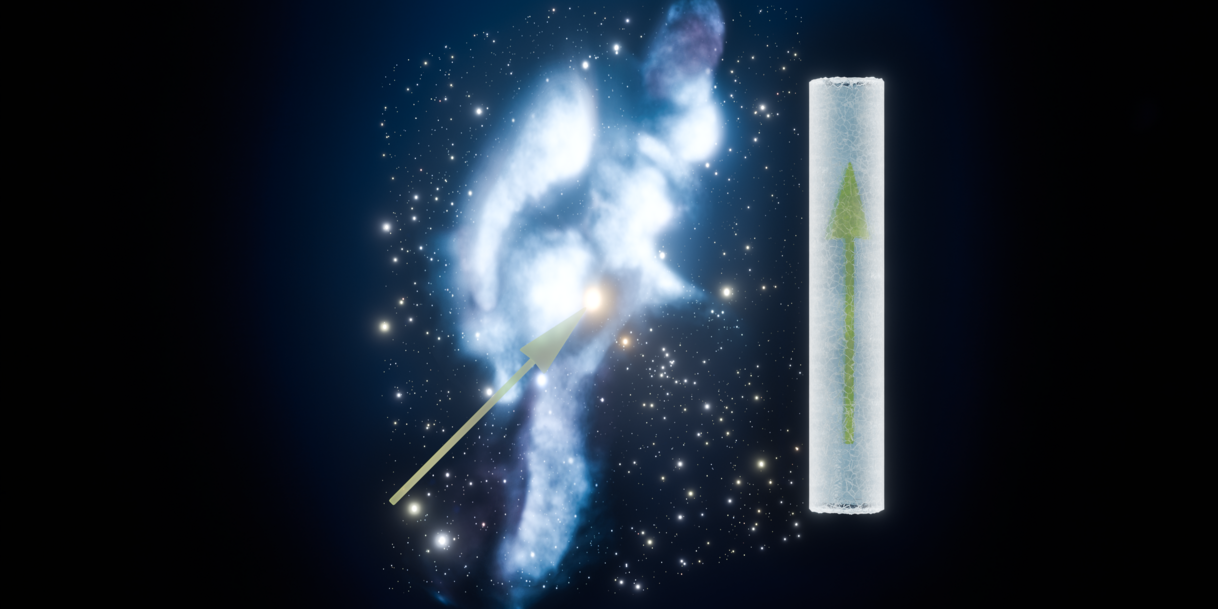
Path of the solar system through the Local Interstellar Cloud. (CREDIT: Alfred Wegener Institute / B. Schröder/HZDR/ NASA/Goddard/Adler/U.Chicago/Wesleyan)
Earth is quietly collecting fallout from a blast that happened long before humans existed, and a new look at ancient Antarctic ice suggests that material has been riding inside the cloud of gas our Solar System is passing through.
An international team led by the Helmholtz-Zentrum Dresden-Rossendorf, or HZDR, reports that Antarctic ice dating from 40,000 to 80,000 years ago contains traces of iron-60, a rare radioactive isotope forged inside massive stars and flung into space when they explode. The amounts are tiny, but they matter. They point to the Local Interstellar Cloud, the patch of interstellar matter now surrounding the Solar System, as a likely long-term reservoir of debris from an ancient stellar explosion.
That idea had been proposed before, but it was hard to prove.
“Our idea was that the Local Interstellar Cloud contains iron-60 and can store it over long time periods. As the Solar System moves through the cloud, Earth could collect this material. However, we couldn’t prove this at the time,” said Dr. Dominik Koll of HZDR’s Institute of Ion Beam Physics and Materials Research.
The new measurements, published in Physical Review Letters, help close that gap by pushing the record deeper into the past and showing that the iron-60 influx was lower tens of thousands of years ago than it is in younger samples.
A radioactive breadcrumb trail through space
Iron-60 is not something Earth makes in meaningful amounts on its own. It is produced in stellar interiors and during supernova explosions, which makes it a useful marker for ancient cosmic events. Earlier work had already found two clear iron-60 influx peaks in geological archives from about 2 to 3 million years ago and around 7 million years ago, evidence that material from nearby supernova activity reached Earth in the distant past.
More recently, scientists found a much lower but still measurable amount in Antarctic surface snow less than 20 years old. Deep-sea sediments from the Indian Ocean later extended that recent record back about 33,000 years. Those discoveries raised a basic question: if no nearby stellar explosion happened in recent times, where was this iron-60 coming from?
The Local Interstellar Cloud became a prime suspect. The Solar System is moving through that cloud now, after entering it sometime within the last tens of thousands of years. Estimates cited by the researchers place the entry at roughly 40,000, 64,000, or 124,000 years ago. The Solar System is now near the cloud’s edge and is expected to leave it again within about 2,000 to 6,000 years.
That timing matters.
If the cloud contains iron-60 left behind by an older supernova, then Earth’s intake of the isotope should change as the Solar System moves from one interstellar environment to another.
Ice from Antarctica offered a cleaner test
To check that, the team turned to an Antarctic ice core from the EPICA drilling project, provided by the Alfred Wegener Institute Helmholtz Centre for Polar and Marine Research. The sampled ice spans roughly 40,000 to 81,000 years ago, a period chosen because it may include the Solar System’s entry into the Local Interstellar Cloud.
The researchers worked with about 295 kilograms of ice from Kohnen Station in Antarctica. After the ice was melted, acidified, evaporated, and chemically processed in Dresden, only a few hundred milligrams of dust remained for study.
That is where the work became almost absurdly delicate.
At HZDR’s DREAMS accelerator mass spectrometry facility, the team checked whether any material had been lost during storage or chemical preparation. They used two better-known radioisotopes, beryllium-10 and aluminium-26, as tracers. Their concentrations matched expectations, which gave the team confidence that the iron-60 signal had survived the process intact.
They also ruled out a large contribution from meteorite fragments by checking for calcium-41 and not finding it.
For the final iron-60 measurement, the samples were sent to the Heavy Ion Accelerator Facility at the Australian National University, which the researchers describe as the only facility currently able to detect such tiny amounts. There, electric and magnetic filters stripped away unwanted atoms until only a few iron-60 atoms remained.
“It’s like searching for a needle in 50,000 football stadiums filled to the roof with hay. The machine finds the needle in an hour,” said Annabel Rolofs of the University of Bonn.
Less iron-60 in older ice than in younger records
The core result is not simply that iron-60 was present. It is that the deposition rate in the older Antarctic ice, measured at 0.22 atoms per square centimeter per year, was much lower than in recent Antarctic surface snow, where the rate was 1.2 atoms per square centimeter per year, and lower than in Indian Ocean sediments covering the last 33,000 years, where the rate was 3.5 atoms per square centimeter per year.
That shift over just a few tens of thousands of years is quick by cosmic standards.
“This suggests that we were previously in a medium with lower iron-60 content, or that the cloud itself exhibits strong density variations,” Koll said.
Either way, the researchers argue, the pattern fits better with the Solar System moving through a structured local interstellar environment than with older supernova debris simply fading away over millions of years. The study says the changing signal over the last 80,000 years lets the team rule out several alternative explanations, including a slow decline from the 2 to 3 million-year-old supernova influx.
The Local Interstellar Cloud
The broader picture is messy, and the authors do not hide that. The Local Interstellar Cloud is one small part of a cluster of nearby warm, diffuse cloudlets embedded in the larger Local Bubble, a hot, low-density cavity thought to have been shaped by 14 to 20 supernovae in the Scorpius-Centaurus Association between about 10 and 15 million years ago. The cloudlets’ origin remains unsettled. Proposed explanations include superbubble interactions, shell fragmentation, shock compression, and supernova shocks moving into an already cleared cavity.
The new iron-60 record does not settle that origin story. It does, however, add a new line of evidence.
“This means that the clouds surrounding the Solar System are linked to a stellar explosion. And for the first time, this gives us the opportunity to investigate the origin of these clouds,” Koll said.
The team also says the measurements do not favor the idea that the Local Interstellar Cloud is a pure fragment of supernova ejecta. The observed iron-60 input is too low for that simple picture, unless dust penetration into the Solar System is far less efficient than some models suggest. A more plausible possibility is that the cloud contains older interstellar dust that was later seeded or mixed with fresh supernova material.
What the isotope record may reveal next
The group is already planning a tougher test: measuring even older ice from before the Solar System entered the Local Interstellar Cloud. That work could help show whether iron-60 levels changed sharply at the boundary or varied more gradually across overlapping clouds and density structures.
“Through many years of collaboration with international colleagues, we have developed an extremely sensitive method that now allows us to detect the clear signature of cosmic explosions that occurred millions of years ago in geological archives today,” Prof. Anton Wallner said.
The value of that method goes beyond one isotope in one core. If the pattern holds, Earth’s ice and sediments may preserve a time-resolved record of the Solar System’s path through the local galaxy, including the boundaries and internal structure of the cloud systems surrounding it now.
Practical implications of the research
The findings give researchers a new way to study the Solar System’s galactic surroundings using Earth itself as a long-term detector.
By tracing iron-60 through older and younger archives, scientists may be able to reconstruct when the Solar System entered the Local Interstellar Cloud, how patchy that cloud is, and whether nearby interstellar clouds carry their own radioactive signatures.
The work also strengthens the case that interstellar dust can deliver supernova-made material to Earth even without a blast wave directly hitting the Solar System.
Source material provided by Helmholtz-Zentrum Dresden-Rossendorf (HZDR). The original university release was written by Simon Schmitt and has been expanded and edited for content, style, clarity, and length.
Research findings are available online in the journal Physical Review Letters.
The original story "Ancient supernova remnants found in Antarctic ice" is published in The Brighter Side of News.
Related Stories
- Antarctic seismic data points to an ancient structure circling Earth’s core
- Three million years of climate history, captured in Antarctic ice
- Scientists reveal why gravity is weaker beneath Antarctica than elsewhere on Earth
Like these kind of feel good stories? Get The Brighter Side of News' newsletter.