Archeological findings in Iraq rewrite history of religious coexistence
New excavations at Gird-î Kazhaw show Christians, Zoroastrians, and later Muslims shared the same landscape in northern Iraq during late antiquity.

 Edited By: Joseph Shavit

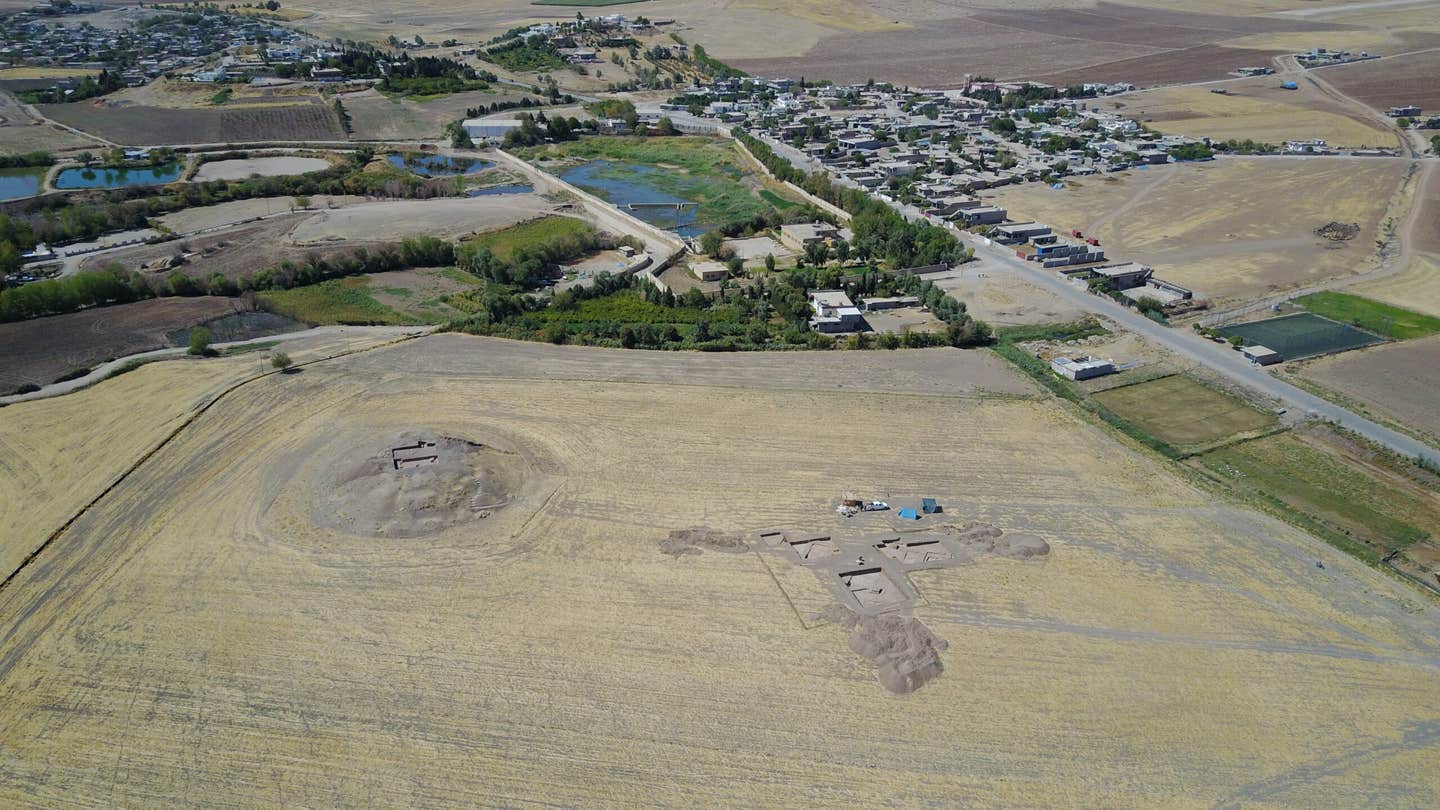
Excavation site Gird-î Kazhaw in the foreground; the modern village of Bestansur in the background. (CREDIT: DFG project Rural Settlements of the Sasanian Period, Tamm/Wicke)
Archaeologists from Germany have returned from northern Iraq without museum-ready artifacts but with rare insight into how faiths once shared the same ground. The work was led by Dr. Alexander Tamm of Friedrich-Alexander-Universität Erlangen-Nürnberg and Prof. Dirk Wicke of the Institute of Archaeological Sciences at Goethe University Frankfurt. Their team spent months excavating Gird-î Kazhaw, a site in the Kurdistan region that has puzzled researchers since its discovery in 2015.
The focus was a large building complex first identified a decade ago. Early clues hinted at a religious structure, but its exact purpose remained uncertain. Five square stone pillars, some coated with white gypsum plaster, stood out on the surface.
Initial surveys suggested the remains could belong to a church, possibly part of a larger monastery. What made the site more intriguing was its location next to a settlement mound and a small Sasanian fortification dating to the fifth or sixth century CE. That fort later became covered by an Islamic cemetery, adding layers of religious history to a single landscape.
Excavations Reveal an Unusual Church Layout
During the latest field season, the ten-member team opened two excavation areas. One focused on the architectural remains near the pillars. The other examined the Islamic cemetery, with close attention to human remains and burial practices. Just beneath the soil, archaeologists uncovered brick walls and floors. The earliest floors were made of compacted earth. Later phases used stone and reused brick.
One of the season’s most striking discoveries came with the identification of additional stone pillars. Their placement suggests a three-nave structure, with a central nave aligned from northwest to southeast. This orientation matches early Christian church design in the region. The scale, however, does not. The central nave alone appears to have measured about 25 meters long and 5 meters wide, which is unusually large for a rural church of this period.
Nearby rooms may have served as monastic spaces, but the researchers caution that this interpretation remains open. More excavation will be needed to confirm how the surrounding buildings functioned and whether a monastery truly existed at the site.
Signs of Christian Worship and Daily Use
Another unexpected find strengthened the case for Christian use. In the same excavation area, the team uncovered a room paved with neatly laid fired bricks. At one end, the floor formed a clear semicircle. Such features often appear in spaces with liturgical functions. Architecture alone can mislead, but material culture provided stronger evidence.
Decorated pottery fragments bearing a Maltese cross were found nearby. Together with the building layout, these objects confirm the structure served as a Christian meeting place.
The dating, likely to the fifth or sixth century CE, fits well with similar early churches found in northern Syria and northern Mesopotamia.
A Neighborhood of Different Faiths
The site’s closeness to the Sasanian fortification makes the discovery especially important. If both structures were in use at the same time, the evidence points to Christians living alongside Zoroastrians, followers of the teachings of Zarathustra and the official religion of the Sasanian state. This challenges older views that religious groups in late antiquity lived apart or in constant conflict.
Later Islamic graves add another chapter to the story. These burials show that the area remained important after the rise of Islam. Determining when local communities converted, and how older traditions faded or adapted, remains a key goal of ongoing research.
These questions align closely with future work planned under the LOEWE Center “Dynamics of Religion,” approved to begin in 2026. Researchers aim to better understand how religious communities formed neighborhoods, shared spaces, and navigated change over centuries.
Looking Beyond Imperial Capitals
The work at Gird-î Kazhaw forms part of a broader project led by Tamm and Wicke on rural settlements in the Shahrizor Plain. Archaeology has long favored imperial capitals and monumental cities. Those centers drove political and cultural life, but they depended on surrounding villages and small towns for food and labor.
"By shifting attention to rural communities, our team hopes to reconstruct everyday life in antiquity. Future seasons at Kazhaw will focus less on walls and more on people. Future studies will include archaeobotany to examine plant use, zoology to understand animal husbandry, and forensic anthropology to assess health and diet," explained Dr. Tamm to The Brighter Side of News.
"Our goal is simple but ambitious: to learn what daily life looked like within these walls. Who lived here, what they ate, how they worked, and how they worshiped all matter," he continued.
At Gird-î Kazhaw, a quiet rural site is now reshaping how historians view coexistence in the ancient Middle East.
Practical Implications of the Research
The findings offer a rare, grounded example of religious coexistence during a time often framed by conflict. They provide historians and educators with concrete evidence that diverse faiths once shared space and daily life.
For modern societies grappling with religious division, such discoveries offer a deeper historical perspective.
The research also shifts archaeological focus toward rural communities, helping future studies better represent how most people lived in the past, not just elites in major cities.
Related Stories
- Earliest known human-animal figurine provides 12,000-year-old glimpse into prehistoric beliefs
- Religion and spirituality linked to lower suicide rates, study finds
- Scientists identify the part of the brain tied to experiencing religion and spirituality
Like these kind of feel good stories? Get The Brighter Side of News' newsletter.
Shy Cohen
Writer