Astronomers discover previously unseen kernel structure inside the Kuiper Belt
A new analysis of Kuiper Belt orbits reveals a compact inner kernel of icy worlds, reshaping ideas about the solar system’s early history.
 Edited By: Joseph Shavit

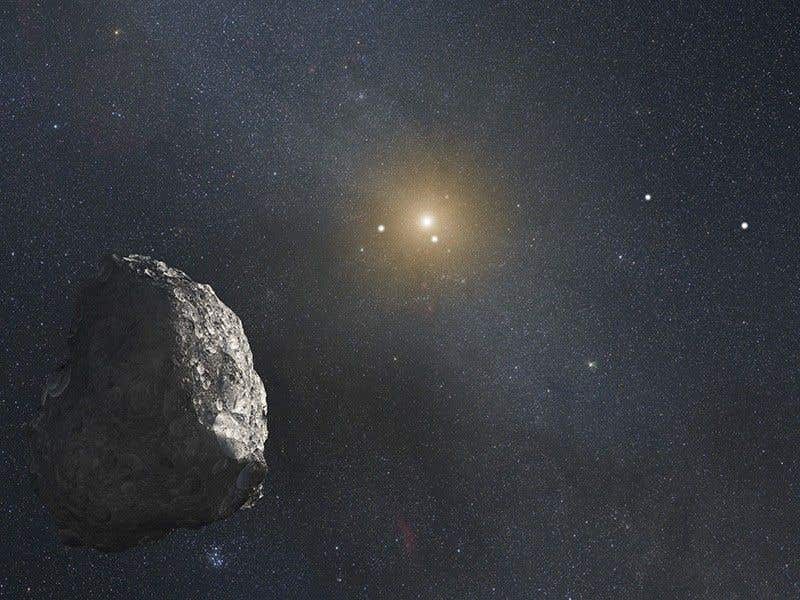
An artist’s illustration of the view from a Kuiper Belt object. (CREDIT: NASA, ESA, and G. Bacon (STScI))
Astronomers at Princeton University have uncovered evidence that the outer solar system is more structured than long believed. Led by astrophysics doctoral student Amir Siraj, the research points to a compact, previously unseen cluster of icy bodies inside the Kuiper Belt. The finding suggests that distant solar system orbits still hold clues about how the planets moved billions of years ago.
The Kuiper Belt lies beyond Neptune and contains countless frozen remnants left over from planet formation. For years, astronomers thought they had identified its main features. One of the most prominent is the “kernel,” a tight grouping of objects on calm, low-tilt orbits about 44 astronomical units from the Sun. An astronomical unit, or AU, is the average distance between Earth and the Sun.
The new study shows that this familiar picture may be incomplete. Using a data-mining technique borrowed from stellar astronomy, Siraj and his colleagues found signs of a second compact structure just inside the known kernel. They call it the “inner kernel,” a group of Kuiper Belt objects clustered around 43 AU.
The result challenges the idea that the Kuiper Belt’s main features were already mapped. It also shows how modern analysis can reveal patterns that were invisible in earlier surveys.
Mining orbits for hidden patterns
The team analyzed the orbits of 1,650 classical Kuiper Belt objects, often shortened to KBOs. Instead of relying on traditional heliocentric orbits, measured relative to the Sun, the researchers recalculated each path using barycentric coordinates. These describe motion relative to the solar system’s center of mass and reduce subtle noise caused by the Sun’s own motion.
They also focused on what astronomers call “free” orbital elements. These include free eccentricity and free inclination, which describe an object’s long-term behavior after removing the small, forced motions caused by the giant planets. By stripping away those effects, the researchers aimed to reveal each object’s true dynamical identity.
To search for structure, the team used a clustering algorithm known as DBSCAN. Rather than grouping data by eye, DBSCAN identifies sets of points that cluster tightly in a multi-dimensional space. In this case, that space was defined by barycentric semimajor axis, free eccentricity, and free inclination.
The method depends on two key settings. One controls how many nearby points are needed to define a cluster, and the other sets how close those points must be. The team tested a wide range of values to make sure any detected pattern was not a numerical accident.
“The kernel was never found alone,” Siraj says. When the algorithm successfully recovered the known kernel, it also flagged another dense group nearby.
The emergence of an inner kernel
Across all successful tests, the same additional cluster appeared. It spans semimajor axes from about 42.4 to 43.6 AU and shows very low free eccentricities and inclinations. These calm orbits resemble those of the cold classical population, a group thought to have formed near its present location.
The researchers named this feature the inner kernel because of its position just inside the known kernel. Statistical checks show that it is compact and well defined. Its semimajor axis distribution peaks near 43 AU and has a narrow spread. Its eccentricity distribution is also tight, indicating orbits that are unusually round.
Depending on how strictly the clustering is defined, the inner kernel contains about 7 to 10 percent of all classical Kuiper Belt objects in the sample. Among cold classical objects, it accounts for roughly 14 to 21 percent.
Figures in the study show the result clearly. When plotted in the refined orbital space, two tight groups appear side by side. One matches the long-known kernel. The other stands out as a distinct feature that had gone unnoticed.
One structure or two?
The discovery raises a difficult question. Are the kernel and inner kernel truly separate structures, or are they parts of one broader feature?
When the clustering settings are loosened slightly, the two groups merge into a single, wider cluster. This sensitivity makes it hard to draw a sharp boundary. The gap between them may be linked to a nearby orbital resonance with Neptune.
One candidate is the 7:4 mean-motion resonance, where Neptune completes seven orbits for every four made by a Kuiper Belt object. Such resonances can clear out certain regions of space or split populations into distinct peaks.
Even so, the two groups differ in meaningful ways. The inner kernel has a colder eccentricity distribution than the outer kernel. That difference could point to a separate origin or a different response to planetary migration.
The team also tested whether any of the objects approach unstable paths. Even when combining free and forced eccentricities, all members of both clusters remain well above the rough instability boundary near 37 AU. Their orbits appear long-lived and secure.
Traces of Neptune’s ancient journey
"If the inner kernel is real, it may preserve a record of how Neptune moved early in the solar system’s history. Many models suggest that Neptune migrated outward through the primordial disk of debris. In some scenarios, that migration happened in jumps rather than smoothly, Siraj explained to The Brighter Side of News.
"Such jumps could trap objects temporarily and leave behind narrow bands of stable orbits. The known kernel has often been explained this way. The inner kernel may reflect another pause or step in Neptune’s migration," he continued.
A collisional origin seems less likely. A major breakup would spread fragments over a wider range of distances than the inner kernel shows. Still, the authors note that more evidence is needed before ruling out any scenario.
The result fits with a growing view of the Kuiper Belt as a fossil record. Its quietest objects have avoided the violent scattering that reshaped other regions. Their orbits and surfaces can still reflect conditions from the solar system’s youth.
Why future surveys matter
The study highlights the importance of precise data. All objects in the sample were observed over multiple oppositions, meaning they were tracked across several years. That reduces the risk that random errors create false patterns.
Even so, the Kuiper Belt remains sparsely sampled. Many small or distant objects are still missing from catalogs due to where telescopes look and how faint these bodies are.
That will change with the start of operations at the Vera C. Rubin Observatory. Its wide-field survey is expected to detect huge numbers of new Kuiper Belt objects and refine existing orbits.
A larger dataset will make it easier to test whether the inner kernel remains distinct or blends into the broader belt. It may also reveal additional structures that no one has yet imagined.
Each new cluster adds a constraint on models of planetary migration. Any successful model must reproduce not just the planets’ present positions, but also the fine structure preserved in distant debris.
A belt richer than expected
The discovery of the inner kernel shows that the Kuiper Belt still holds surprises. As analysis tools improve, astronomers can extract new meaning from data that have existed for years.
Whether the inner kernel stands as a separate structure or becomes part of a redefined kernel, it deepens the story of how the outer solar system took shape. The distant belt is not a simple ring of leftovers. It is a detailed archive of motion, change, and survival.
Research findings are available online in the journal arXiv.
Related Stories
- From gas giants to rocky worlds: Why planets in our solar system differ
- New hydrocarbon discovery unlocks secrets of how Solar Systems form
- Jupiter-sized interstellar visitor may have reshaped our solar system
Like these kind of feel good stories? Get The Brighter Side of News' newsletter.
Joseph Shavit
Writer, Editor-At-Large and Publisher
Joseph Shavit, based in Los Angeles, is a seasoned science journalist, editor and co-founder of The Brighter Side of News, where he transforms complex discoveries into clear, engaging stories for general readers. With vast experience at major media groups like Times Mirror and Tribune, he writes with both authority and curiosity. His writing focuses on space science, planetary science, quantum mechanics, geology. Known for linking breakthroughs to real-world markets, he highlights how research transitions into products and industries that shape daily life.