Astronomers spot ‘jellyfish galaxy’ torn apart 8.5 billion years ago
A newly identified jellyfish galaxy shows clusters were already violently reshaping galaxies 8.5 billion years ago.

 Edited By: Joshua Shavit

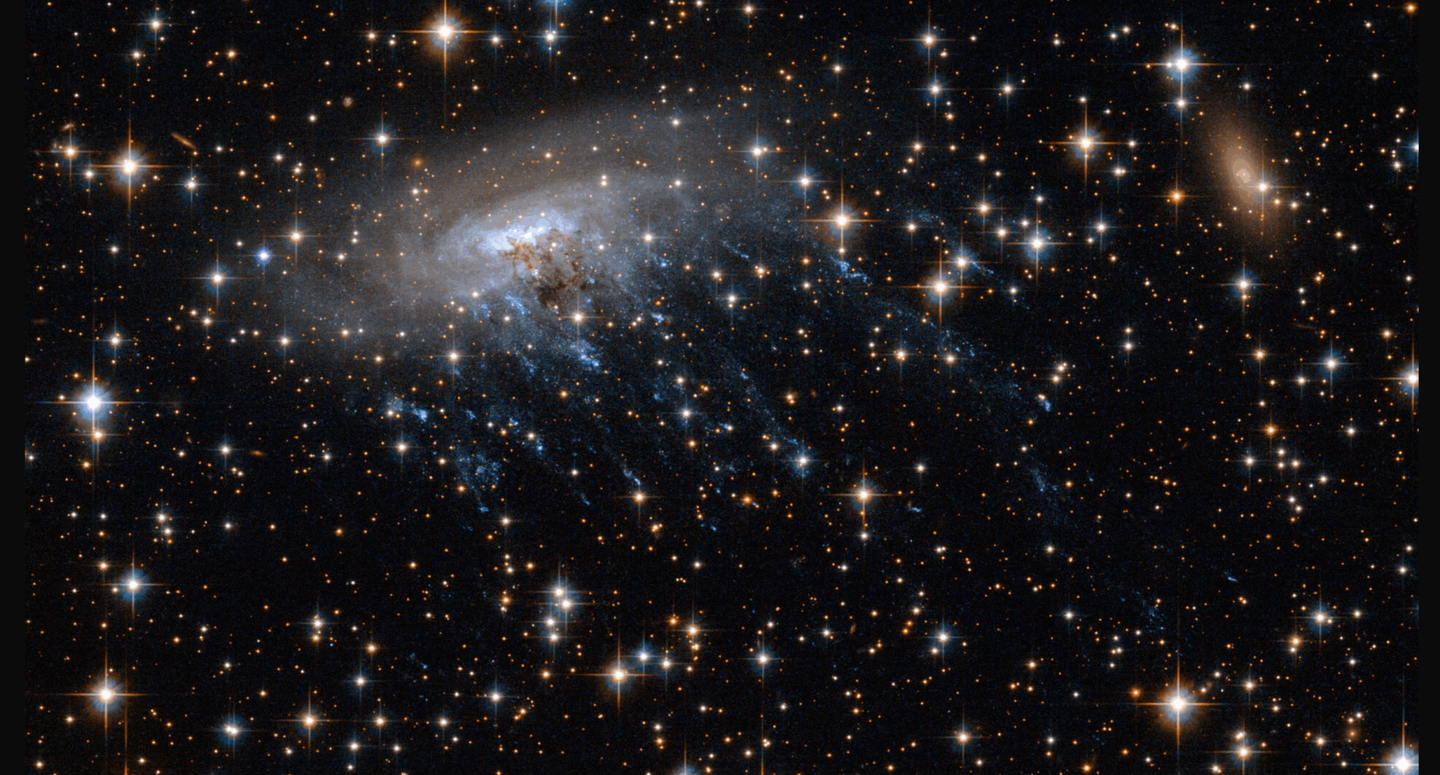
ESO 137-001, a jellyfish galaxy like the one recently observed by astrophysicists at the University of Waterloo. (CREDIT: NASA, ESA)
Long strands of glowing gas stretch behind a distant galaxy, dotted with pockets of newborn stars. The shape looks almost biological, like tentacles drifting through water. Yet this structure formed in one of the most extreme environments in the universe.
Astronomers have identified what may be the most distant known “jellyfish galaxy,” a system caught in the act of being stripped apart by its surroundings about 8.5 billion years ago. The object, cataloged as COSMOS2020-635829, sits at a redshift of 1.156 and appears to be plunging through a dense cluster environment that is tearing gas from its disk.
The discovery comes from a team led by researchers at the University of Waterloo, who analyzed deep observations from the James Webb Space Telescope alongside spectroscopy from the Gemini Observatory. Their findings suggest that galaxy clusters were already harsh environments much earlier in cosmic history than many astronomers expected.
“We were looking through a large amount of data from this well-studied region in the sky with the hopes of spotting jellyfish galaxies that haven’t been studied before,” said Dr. Ian Roberts, a Banting Postdoctoral Fellow at the Waterloo Centre for Astrophysics. “Early on in our search of the JWST data, we spotted a distant, undocumented jellyfish galaxy that sparked immediate interest.”
A violent environment in the young universe
Galaxies do not evolve in isolation. For decades, astronomers have known that systems living in crowded clusters tend to stop forming stars sooner than galaxies drifting alone in space. That process, called environmental quenching, is often linked to the loss of cold gas, the raw material needed to build new stars.
One suspected mechanism is ram-pressure stripping. As a galaxy moves through hot gas that fills a cluster, pressure acts like a headwind, pushing the galaxy’s own gas backward and sometimes completely out of the system. Nearby examples often show dramatic one-sided tails, which inspired the nickname jellyfish galaxies.
Clear evidence of this process at large cosmic distances has been scarce. Detecting faint gas structures requires both sensitivity and sharp resolution, conditions that only recently became possible with instruments like JWST.
COSMOS2020-635829 appears to provide that missing piece.
The galaxy itself has a stellar mass of roughly 10¹⁰ solar masses and an intense star-formation rate near 100 solar masses per year. High-resolution imaging shows a fairly normal disk, but bright blue knots trail to one side. These knots contain very young stars, likely formed from gas that has already been stripped from the main galaxy.
A tail confirmed in gas
To test whether the visual features truly came from ram-pressure stripping, the researchers turned to spectroscopy using the Gemini Multi-Object Spectrograph integral field unit. They focused on the [O II] emission line, a common tracer of ionized gas.
The results revealed gas emission extending about 20 kiloparsecs beyond the galaxy’s disk along the same direction as the visible tail. A smooth velocity gradient connects this gas to the rotating galaxy, confirming that the material belongs to the system rather than a background source.
Maps of the emission show a diffuse plume trailing south of the galaxy, with brightness steadily declining away from the disk. The structure lacks the ring-like pattern expected from certain collision scenarios, which strengthens the case for ram-pressure stripping.
The team still considered alternative explanations, including the possibility that the galaxy could be a collisional ring system. However, several observations argue against that idea. Ionized gas peaks at the galaxy center rather than in a ring, and the morphology does not resemble classic ring galaxies such as Hoag’s Object. Researchers concluded that ram pressure remains the most plausible driver, though they cannot fully rule out other processes.
Star formation outside the galaxy
Four compact regions embedded in the tail show particularly strong blue light. Using spectral energy distribution modeling with data from JWST, the Hubble Space Telescope, and Subaru, the team estimated their properties.
Each knot contains about 10⁸ solar masses of stars and has been forming stars within the past 100 million years. Star-formation rates are roughly a few tenths of a solar mass per year. Together, the tail regions account for about 1 percent of the main galaxy’s stellar mass and star-formation activity.
These numbers are broadly consistent with massive star-forming knots seen in nearby jellyfish galaxies once cosmic evolution is considered. Star formation rates in galaxies were higher at redshift 1 than they are today, which may explain the somewhat elevated values.
The fate of these stripped regions remains uncertain. Some simulations suggest that stars formed within about 20 kiloparsecs of a galaxy may eventually fall back into the disk. Other scenarios allow them to become independent objects or dissolve into diffuse intracluster light, the faint glow that fills galaxy clusters.
Rethinking cluster evolution
Perhaps the most significant implication involves the environment itself. Astronomers previously thought that clusters at this epoch were still assembling and might not yet have conditions strong enough to strip galaxies efficiently.
Instead, the observations indicate that dense intracluster gas was already capable of exerting substantial ram pressure.
“The first is that cluster environments were already harsh enough to strip galaxies, and the second is that galaxy clusters may strongly alter galaxy properties earlier than expected,” Roberts said. “Another is that all the challenges listed might have played a part in building the large population of dead galaxies we see in galaxy clusters today. This data provides us with rare insight into how galaxies were transformed in the early universe.”
Estimates based on X-ray observations of nearby overdensities suggest intracluster gas densities around 10⁻²⁷ to 10⁻²⁶ grams per cubic centimeter. Combined with galaxy velocities of several hundred to a thousand kilometers per second, those values produce ram-pressure forces comparable to what astronomers measure in nearby clusters.
If confirmed, this would push the known operation of ram-pressure stripping back to earlier cosmic times, closer to the period sometimes called Cosmic Noon, when star formation across the universe peaked.
A rare window into early quenching
Evidence for stripping at redshifts above 1 has been limited to a handful of candidate systems. Some molecular gas tails have been reported in a protocluster at redshift 2.51, but direct optical emission signatures remain rare.
COSMOS2020-635829 stands out because both the gas and the newly formed stars in the tail appear connected to the main galaxy. That combination makes it one of the strongest known candidates for a high-redshift jellyfish galaxy.
The researchers have requested additional observing time with JWST to examine the system in more detail, including searches for other gas phases that could confirm the stripping scenario.
One galaxy alone cannot rewrite models of cosmic evolution. Still, it offers a valuable test case.
Research findings are available online in The Astrophysical Journal.
The original story "Astronomers spot 'jellyfish galaxy' torn apart 8.5 billion years ago" is published in The Brighter Side of News.
Related Stories
- JWST finds a surprise flood of organic molecules in a hidden galaxy
- JWST confirmed the most distant galaxy ever observed at 13.5 billion light years away
- JWST found a 'dead' galaxy that quit making stars billions of years ago
Like these kind of feel good stories? Get The Brighter Side of News' newsletter.
Joseph Shavit
Writer, Editor-At-Large and Publisher
Joseph Shavit, based in Los Angeles, is a seasoned science journalist, editor and co-founder of The Brighter Side of News, where he transforms complex discoveries into clear, engaging stories for general readers. With vast experience at major media groups like Times Mirror and Tribune, he writes with both authority and curiosity. His writing focuses on space science, planetary science, quantum mechanics, geology. Known for linking breakthroughs to real-world markets, he highlights how research transitions into products and industries that shape daily life.