BIOPREVENT AI tool predicts serious transplant complications months before symptoms arise
A Day 90 blood test plus machine learning may flag transplant patients at higher risk for chronic GVHD months before symptoms.

 Edited By: Joseph Shavit

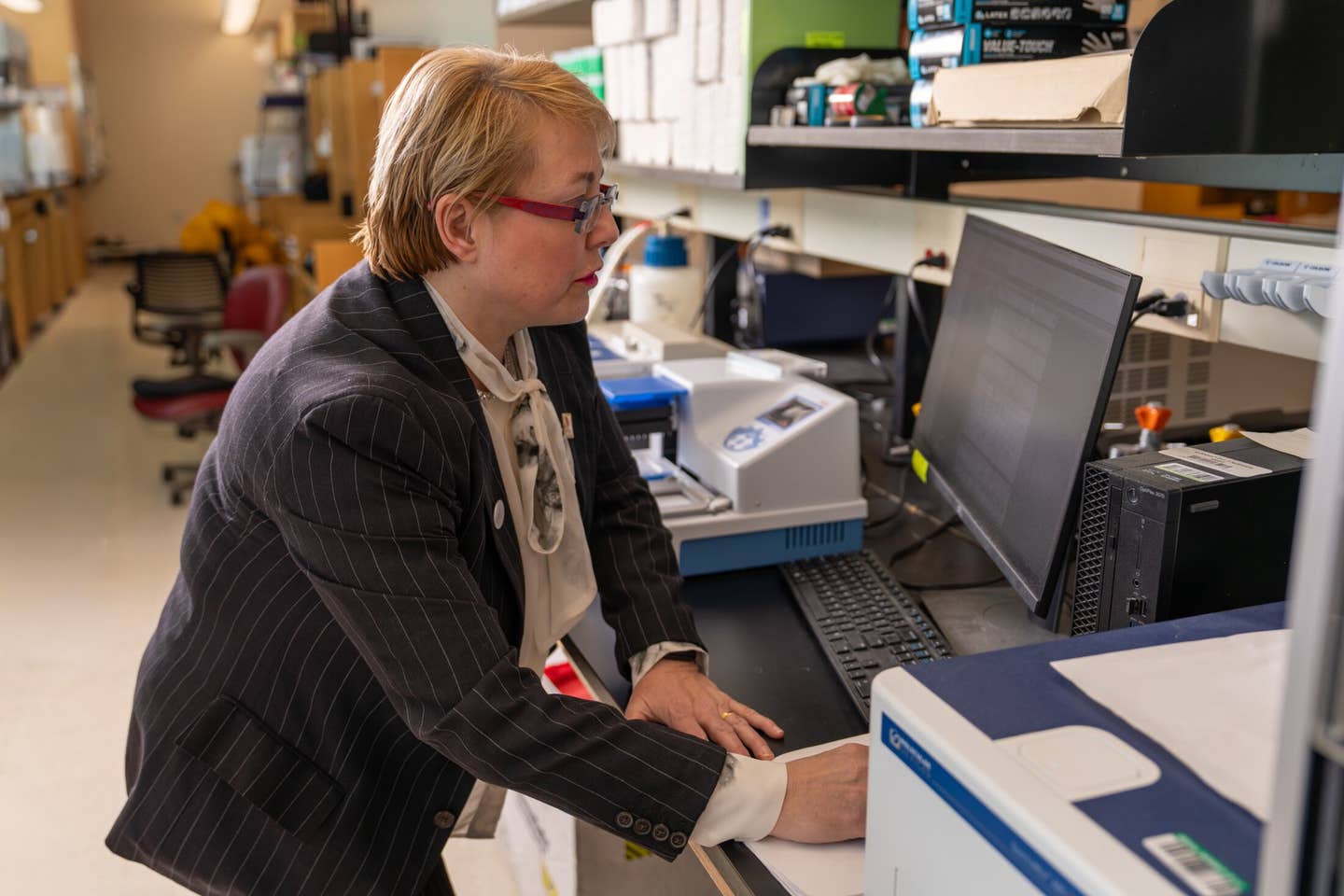
Sophie Paczesny, M.D., Ph.D., said her team made their new tool, BIOPREVENT, freely available so that other researchers and clinicians could test it and learn from it. (CREDIT: Clif Rhodes)
More than half of transplant recipients in a large analysis developed chronic graft-versus-host disease, and 15% died from causes other than cancer relapse. Those numbers capture the uneasy truth of allogeneic hematopoietic cell transplantation. The cure can come with a long, uncertain tail.
Chronic graft-versus-host disease, or cGVHD, happens when donor immune cells attack the patient’s healthy tissues. It can injure the skin, eyes, mouth, joints, and lungs. Moreover, it remains a leading cause of debilitating illness and nonrelapse mortality after transplant.
A research team led by Sophie Paczesny, M.D., Ph.D., at MUSC Hollings Cancer Center, worked with Michael Martens, Ph.D., and Brent Logan, Ph.D., at the Center for International Blood and Marrow Transplant Research at the Medical College of Wisconsin. The team set out to catch that danger earlier.
Their new work in the Journal of Clinical Investigation describes BIOPREVENT, a machine learning tool designed to estimate a patient’s future risk of developing cGVHD and of dying without relapse. They used blood biomarkers and routine clinical factors.
The quiet months after discharge
cGVHD usually gets diagnosed when symptoms surface across organs. Yet the study argues that the tissue disruptions begin far earlier, soon after donor cells enter the body. That creates a window when a patient may feel fine, while biology starts shifting in the background.
“By the time chronic GVHD is diagnosed, the disease process has often been unfolding for months, quietly hurting the body,” Paczesny said. “We wanted to know whether we could detect warning signs earlier, before patients feel sick, and soon enough for clinicians to intervene, before the damage becomes irreversible.”
The researchers focused on the Day 90 to 100 period after transplant, a common checkpoint in follow-up care. Their idea was simple in concept: if the blood already carries a signal, a clinician might spot risk before the first stiff joint, dry eye, or skin change forces the diagnosis.
Seven proteins, nine clinical details
The team analyzed 1,310 transplant recipients drawn from four multicenter cohorts: BMTCTN 0201 and 1202, the Dana-Farber Cancer Institute cohort, and a combined pediatric and adult cohort from trial NCT02194439. Everyone included had a blood sample available at Day 90 or 100.
In this group, 52% developed any cGVHD, 37% developed moderate to severe cGVHD, and 15% experienced nonrelapse mortality.
From each Day 90/100 sample, the researchers measured seven previously validated plasma proteins. Some had already been linked to future cGVHD risk in earlier work led by Paczesny, including CXCL9, MMP3, and DKK3. The paper also highlights IL1RL1, previously called ST2, because earlier findings tied a one “logn” increase in IL1RL1 to a 1.6 to 2.0 times higher risk of nonrelapse mortality.
They paired those biomarkers with nine clinical variables. The paper emphasizes transplant features like graft source. It also focuses on details such as age, primary disease, GVHD prophylaxis, and prior acute GVHD. The researchers discuss the value of standardized registry information submitted to the Center for International Blood and Marrow Transplant Research.
Then they asked a blunt question: can machine learning make these early signals more useful than standard approaches?
When machine learning helps, and when it doesn’t
The investigators compared a wide range of methods, from penalized Cox regression to tree-based approaches and deep learning models. They split the dataset into a 75% training set and a 25% validation set. To judge performance, they used time-varying area under the curve measurements from Days 180 to 540 after transplant.
Across the validation set, models that combined biomarkers with clinical data beat models using clinical factors alone for predicting cGVHD. The improvement looked especially strong for nonrelapse mortality.
One model type stayed near the top across timepoints: Bayesian additive regression trees, or BART. The team used BART as the basis for the BIOPREVENT models.
Deep learning did not deliver an edge here. The authors say the neural network approaches performed similarly to, or worse than, other methods. They suggest the sample size may have been too small for deep learning to learn reliably.
The paper also shows that different outcomes leaned on different predictors. For cGVHD risk, variables with higher importance in the BART model included primary disease, graft source, GVHD prophylaxis, age, conditioning intensity, female-to-male sex mismatch, and biomarkers such as MMP3 and CXCL9. For nonrelapse mortality, IL1RL1 rose to the top, along with age, primary disease, GVHD prophylaxis, HLA match, prior acute GVHD, conditioning intensity, and sCD163.
Turning predictions into groups clinicians can use
BIOPREVENT aims to separate patients into higher and lower risk categories, not just spit out abstract probabilities.
For cGVHD, the authors report an “optimal” Day 360 cutpoint of 0.45 for the predicted cumulative incidence. At or above that threshold, the Day 360 cumulative incidence of cGVHD was 58.0%, compared with 32.7% below it.
For nonrelapse mortality, the reported cutpoint was 0.08. Patients at or above that predicted incidence had a Day 360 nonrelapse mortality of 13.9%, versus 3.5% in the lower-risk group.
The team also measured practical classification tradeoffs. At Day 360, the cGVHD cutpoint produced sensitivity and specificity of 64% each, with a positive predictive value of 58% and a negative predictive value of 56%. For nonrelapse mortality, sensitivity was 70% and specificity 69%, while the positive predictive value was 14% and the negative predictive value 81%.
The paper notes an important wrinkle: even a well-calibrated model can misclassify certain subgroups when you force a single threshold. In their analysis, bone marrow graft recipients had a higher false-negative rate than peripheral blood graft recipients. The authors connect this to lower baseline cGVHD incidence and fewer cases above the cutpoint.
Practical implications of the research
BIOPREVENT is now available as a public web application. Clinicians can enter nine clinical variables and seven biomarker values from Day 90/100 and receive personalized estimates for cGVHD and nonrelapse mortality through Day 540, roughly 18 months after transplant. The study frames it as a research and risk assessment support tool, not a treatment guide.
The authors argue that earlier risk estimates could help target closer monitoring and shape future trials of preemptive approaches. They also describe how enriching trials with high-risk patients could reduce required sample sizes, because event rates rise in that subgroup.
At the same time, the study lays out limits that matter for real-world use. The cohorts only provided one biomarker timepoint because later samples were not available. The model only included seven validated plasma biomarkers. The authors say adding cellular measurements, like certain T-cell subsets, might improve accuracy, though those measurements often come with low throughput and limited biobank availability.
Some potentially important clinical variables, including late acute GVHD and immunosuppression status at sampling, could not be included because the datasets were retrospective and deidentified. Finally, the study included only 27 patients who received posttransplant cyclophosphamide as GVHD prophylaxis. So the authors say interpretation for that subgroup remains uncertain and needs validation in a larger sample.
Even with those caveats, the work makes a clear bet: the biology of cGVHD and transplant-related death may be readable earlier than the clinic usually allows, if the field learns how to listen.
Research findings are available online in the Journal of Clinical Investigation.
The original story "BIOPREVENT AI tool predicts serious transplant complications months before symptoms arise" is published in The Brighter Side of News.
Related Stories
- Sugar-coated stem cells heal damaged livers — replacing transplants
- Scientists convert type A kidney to type O for first human transplant
- Israeli scientists to perform the world's first human spinal cord transplant surgery
Like these kind of feel good stories? Get The Brighter Side of News' newsletter.
Shy Cohen
Writer