Bull sharks have friends, and they choose them carefully
New research from Fiji’s Shark Reef Marine Reserve shows bull sharks have preferred companions, avoided rivals, and complex social networks.

 Edited By: Joseph Shavit

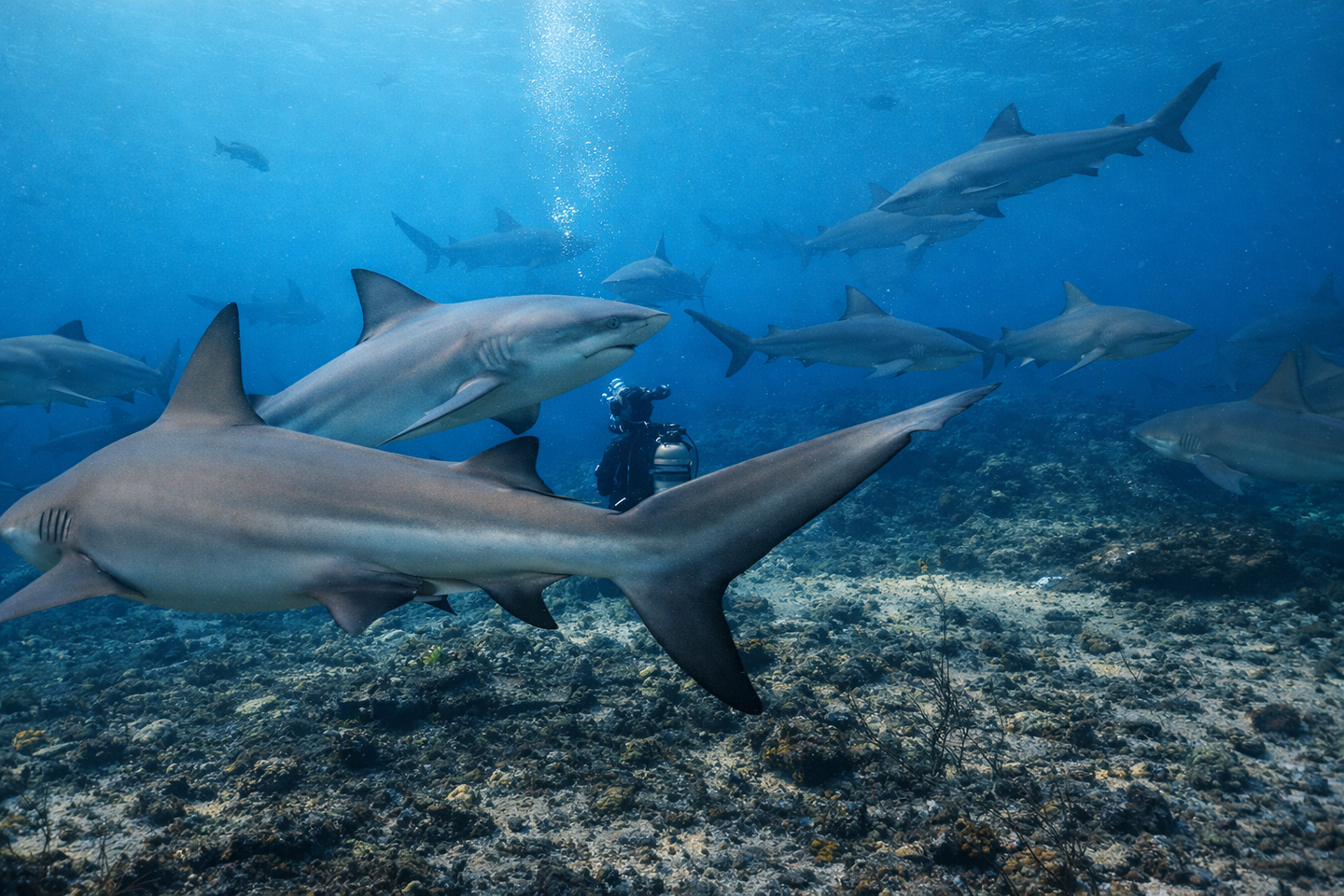
Six years of data from Fiji’s Shark Reef reveal that bull sharks choose social partners, form bonds, and actively avoid certain individuals. (CREDIT: Mike Neumann)
Off the southern coast of Fiji's main island, a group of bull sharks returns to the same reef, week after week, year after year. For a quarter century, divers at the Shark Reef Marine Reserve have watched these animals circle during provisioned dives, close enough to study, predictable enough to learn.
What researchers have now documented from six years of that observation is something the popular image of sharks never quite accounted for: these animals are not indifferent to who is nearby. They have preferences. Some individuals they seek out. Others they avoid entirely.
The study, published in Animal Behaviour and led by Natasha D. Marosi, a researcher at the University of Exeter and founder of the Fiji Shark Lab, tracked 184 bull sharks across three age groups and found a social structure that looks, in certain ways, like something you might recognize from your own life.
"As humans we cultivate a range of social relationships, from casual acquaintances to our best friends, but we also actively avoid certain people," Marosi said, "and these bull sharks are doing similar things."
Not Just Showing Up at the Same Place
The distinction that drives this research is subtle but important. Animals gathering near the same food source, or seeking the same temperature band in the water, are not necessarily being social. Seabirds mob a school of fish. Wildebeest drink from the same river.
That's aggregation, not friendship. What this team set out to measure was something more specific: whether individual sharks were making active choices about who to swim near and interact with, rather than simply occupying the same water at the same time.
They examined two levels of behavior. The broad scale tracked which sharks spent time within one body length of each other across 385 sampling dives spanning five years. The fine scale went closer, using video to document specific behaviors between pairs of individuals: leading, following, swimming side by side in parallel, turning back toward a companion.
Both layers told the same story. The sharks were not associating at random. Some pairs appeared together far more often than chance would predict. Others, despite repeated opportunities, showed no meaningful interaction at all. When the researchers ran statistical comparisons against thousands of randomly permuted versions of their data, the real network stood out clearly as non-random.
Professor Darren Croft, from Exeter's Centre for Research in Animal Behaviour, put it plainly: "Contrary to commonly held perceptions of sharks, our study shows they have relatively rich and complex social lives."
Who Socializes With Whom
The population at Shark Reef skews heavily female, roughly 85 percent. That demographic reality shapes the social network, but it doesn't explain all of it. Female sharks showed a clear preference for associating and actively interacting with other females. Males, by contrast, tended to seek out female company over associating with each other.
Males also maintained a larger number of social connections than females on average, a pattern the researchers think may reflect a survival strategy. Bull shark females are physically larger than males. One potential benefit for a smaller male, as Marosi noted, is that being more broadly integrated into the social network may buffer him from aggressive encounters with larger individuals.
Age shaped the network in a different way. Adult sharks, those in their reproductive prime, formed the dense social core. They associated most often with each other, interacted most frequently, and held the most central positions in the network by almost every measure.
Sub-adult sharks, younger animals that rarely visit the reserve and normally occupy nearshore habitats, were peripheral when they did appear. The oldest sharks, post-reproductive females past their prime years, trended toward something the researchers describe as social withdrawal. They were present but largely disconnected.
"Our results show that older sharks tend to be less social," Marosi said. "These older individuals have many years of experience honing their skill sets, hunting and mating, and sociality may not be as integral to their survival as it is for an individual in their prime."
The occasionally present sub-adults present an interesting exception. A handful of bolder young sharks have established ties with some adults, and the researchers suggest those older individuals may be acting as social facilitators, providing a path into the network that would otherwise be closed to a smaller, younger animal navigating a reef full of larger conspecifics.
Size, Familiarity, and the Question of Learning
One of the more nuanced findings involved body size. At the broad level, size didn't predict who spent time near whom. Sharks of different lengths mixed freely. But at the finer scale of directed social interactions, a modest but statistically significant tendency emerged: sharks preferred to interact with partners closer to their own size. The effect was real, but weaker than the influence of sex or age.
The reserve's 25-year history as a provisioned dive site may have contributed meaningfully to what the researchers observed. When the same animals return to the same location repeatedly, across years, something resembling familiarity can develop.
Researchers watching the SRMR have documented what appears to be social learning in action: newer sharks observing veteran individuals approach divers for feeding, then replicating those behaviors after a period of proximity. Whether that constitutes social learning in the formal sense is still being examined, but the behavioral sequences are suggestive.
"We are only just beginning to really understand the social lives of many shark species," said Croft. "Just like other animals, they likely gain benefits from being social; this may include learning new skills, finding food and potential mates while avoiding confrontations."
What This Means Beyond the Reef
Dr. David Jacoby of Lancaster University's Lancaster Environment Centre noted the unusual opportunity the site provides. "This study capitalizes on data and knowledge from one of the longest running shark ecotourism dive sites in the world," he said. "This offered a unique opportunity to observe the detailed behavior of these individuals over many years, as they grow, develop and manage their social relationships."
The findings carry weight beyond behavioral science. Bull sharks occupy keystone positions in coastal marine ecosystems. Changes in their populations don't stay contained; they ripple outward through food webs and habitats, including seagrass beds and reef communities. Fiji Shark Lab is currently working with the Ministry of Fisheries, Fiji, to apply the study's findings to conservation efforts.
Understanding that these animals have social bonds, preferred partners, and age-structured network roles adds a layer of complexity to how their populations should be managed. If removing individuals disrupts social networks that transmit foraging information or support younger sharks learning to navigate their environment, conservation policy that treats bull sharks as isolated units rather than connected members of a social system may be leaving something important out of the calculation.
The study was funded by Fiji Shark Lab, the Hai Stiftung Shark Foundation, and the Waitt Foundation.
Practical Implications
The documentation of active social preferences in a large, free-ranging marine predator has direct relevance for how marine protected areas are designed and how shark tourism is managed. Provisioned dive sites like Shark Reef have long been debated for their potential to alter natural shark behavior.
This study suggests something more nuanced: rather than simply concentrating animals around food, provisioning may be creating the conditions under which genuine social bonds form and persist.
If those bonds contribute to fitness, through shared information, reduced aggression, or facilitated learning, then the conservation case for protecting not just individual animals but stable social aggregations becomes considerably stronger. The researchers are calling for sociality to be integrated into conservation frameworks for bull sharks, and the argument applies more broadly.
For a species already vulnerable to overfishing, habitat loss, and shifting ocean conditions, the social fabric may be one more thing worth protecting.
Research findings are available online in the journal Animal Behaviour.
The original story "Bull sharks have friends, and they choose them carefully" is published in The Brighter Side of News.
Related Stories
- Global first: A massive sleeper shark was filmed in cold Antarctic waters
- Greenland sharks may hold key to humans living for centuries
- Filmed for the first time: Killer whales attack and kill great white sharks
Like these kind of feel good stories? Get The Brighter Side of News' newsletter.
Hannah Shavit-Weiner
Medical & Health Writer
Hannah Shavit-Weiner is a Los Angeles–based medical and health journalist for The Brighter Side of News, an online publication focused on uplifting, transformative stories from around the globe. Passionate about spotlighting groundbreaking discoveries and innovations, Hannah covers a broad spectrum of topics—from medical breakthroughs and health information to animal science. With a talent for making complex science clear and compelling, she connects readers to the advancements shaping a brighter, more hopeful future.