Cassini-Huygens mission finds lopsided shift in Saturn’s magnetic bubble
A new study finds Saturn’s magnetic cusp is skewed toward dusk, changing how scientists view giant planet magnetospheres.

 Edited By: Joseph Shavit

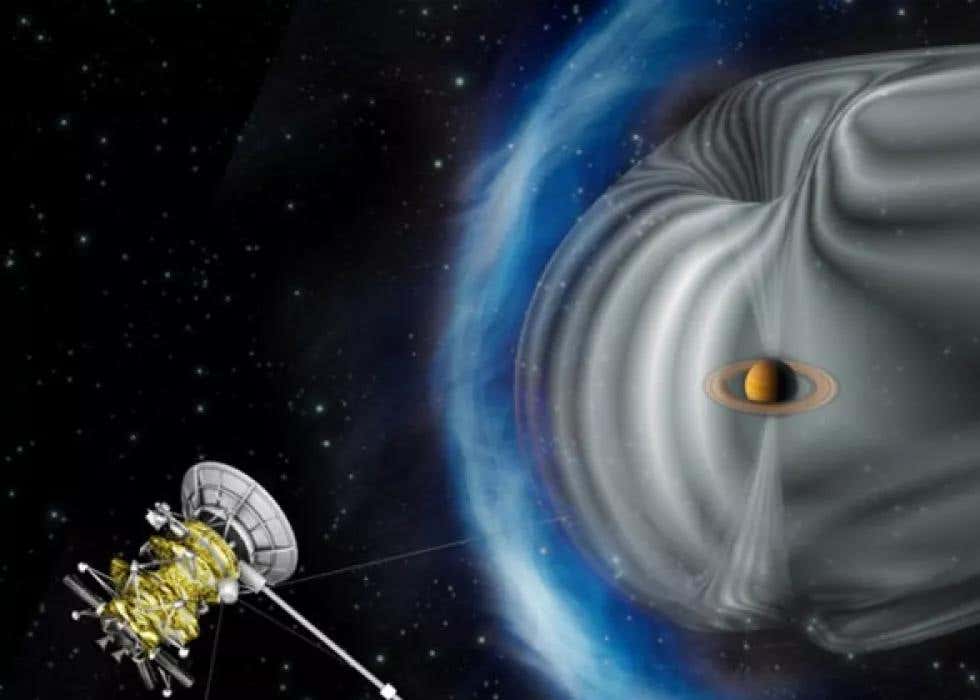
Artist’s impression shows Cassini exploring the magnetic environment of Saturn. (CREDIT: NASA/JPL-Caltech)
Saturn’s magnetic shield does not sit where many scientists would expect.
After combing through years of data from the Cassini spacecraft, researchers found that a key opening in Saturn’s magnetosphere, the region where solar wind particles can slip into the planet’s atmosphere, is pushed well away from the noon position seen at Earth. Instead, it tends to sit in the afternoon sector, usually between 13:00 and 15:00 local time, and sometimes stretches as far as 20:00. That skew, the team says, points to a basic difference in how giant planets work.
The finding comes from a study in Nature Communications based on Cassini-Huygens mission data collected between 2004 and 2010. The researchers argue that Saturn’s rapid rotation, combined with the heavy plasma supplied largely by its moon Enceladus, reshapes the planet’s magnetic environment in a way that sets it apart from Earth’s more solar-wind-driven system.
At Earth, the cusp of the magnetosphere usually lines up near local noon. That is where magnetic field lines bend in a way that allows charged solar particles to funnel into the upper atmosphere. Saturn does not follow that pattern. Its cusp is dragged toward dusk, which means the geometry of its near-space environment is not simply a larger version of Earth’s.
“This study also provides critical evidence for a long-held theory,” Professor Andrew Coates of University College London said in the source material, “that the rapid spin of massive planets like Saturn with active moons replaces the solar wind as the dominant force shaping magnetospheres.”
Cassini’s long look at a hard-to-see boundary
The study draws on six years of observations from two Cassini instruments, the Magnetometer and the Cassini Plasma Spectrometer. The team searched for moments when the spacecraft passed through Saturn’s cusp, using telltale clues such as magnetosheath-like electron energy signatures. In total, they identified 67 cusp events between 2004 and 2010.
That number mattered because Saturn’s cusp is not easy to map. The planet’s magnetosphere is vast, extending more than 10 times wider than Saturn itself, and the spacecraft’s orbit did not sample every region equally. To deal with that, the researchers normalized the observations by Cassini’s dwell time at different local times, helping them separate real structure from orbital bias. The result was a statistical picture of Saturn’s cusp that looked strikingly different from Earth’s.
On Earth, the peak occurrence rate of the cusp stays centered around 11:00 to 13:00 local time. At Saturn, the peak sits later, at 13:00 to 15:00, with some cusp detections even appearing in the post-dusk sector. In one comparison highlighted in the paper, Cassini recorded 17 cusp events between 13:00 and 16:00 local time over 36,626 minutes of dwell time, compared with only four events between 8:00 and 11:00 over 37,379 minutes.
That is not a subtle nudge. It is a system-wide lean.
Why Saturn’s magnetic bubble behaves differently
The researchers tie the asymmetry to two features of Saturn. One is speed. A Saturn day lasts about 10.7 hours, far shorter than Earth’s 24-hour day. The other is mass loading from ionized material, especially water vapor from Enceladus, that becomes part of Saturn’s magnetosphere and gets pulled along as the planet spins.
Together, those factors seem to drag magnetic field lines and reshape the balance of forces at the magnetopause, the boundary where the solar wind presses against the planet’s magnetic field. Simulations in the study suggest Saturn’s magnetopause is more expanded on the morning side than on the afternoon side. Because the cusp is anchored to that structure, its position shifts duskward as well.
Lead author Dr Yan Xu said, “By combining Cassini observations with simulations, we found that Saturn's rapid rotation and the plasma from its moon Enceladus together shape the asymmetric global distribution of the cusps.”
The study also suggests that magnetic reconnection at Saturn differs from the better-known terrestrial pattern. At Earth, reconnection is strongly governed by the north-south component of the interplanetary magnetic field. At Saturn, the simulations point to reconnection happening mainly at high latitudes and being suppressed at lower latitudes, a setup that more closely resembles Jupiter’s environment.
More like Jupiter than Earth
That comparison to Jupiter is one of the paper’s bigger implications.
The authors say Saturn’s cusp distribution is consistent with the dusk-side cusp reported at Jupiter, hinting that rapidly rotating giant planets may share a common magnetospheric regime. In that regime, internal dynamics and internal plasma sources play a stronger role than the solar wind in shaping the overall structure. That is a major departure from the Earth-centered model many people know best.
Dr Licia Ray of Lancaster University put it simply: “This result allows us to move forward with new and improved theories on how planetary magnetospheres interact with the solar wind.” She added that the afternoon cusp locations matter for interpreting Saturn’s bright aurora and for predicting where magnetic reconnection, which can accelerate particles to very high energies, is likely to occur.
That matters beyond Saturn. Planetary magnetospheres shape auroras, particle acceleration, and the broader near-space environment around worlds with magnetic fields. The source material also notes that comparative studies like this one can help scientists think about other planetary systems, including exoplanets.
There are still limits to the result. The researchers note that more simulations are needed to confirm parts of the interpretation. They also excluded data collected after 2011 because the CAPS instrument, which provided the clearest evidence for cusp identification, was no longer available in the same way. The authors further say a comprehensive global observational picture of cusp regions at giant planets is still lacking, both at Saturn and Jupiter.
A timely result for future missions
The timing of the study is notable because Enceladus has become a prime target for future exploration. The moon’s icy plumes, fed by a subsurface ocean, have made it one of the most intriguing places in the solar system for questions about habitability.
Coates said, “A better understanding of Saturn’s environment is especially urgent now as plans for our return to Saturn and its moon Enceladus start to be developed.”
Cassini ended its mission in 2017. Yet this study shows that the spacecraft is still changing how scientists think about the Saturn system, not by adding another pretty image, but by exposing a magnetic structure that refuses to behave like Earth’s.
Practical implications of the research
The study gives scientists a better map of where solar wind particles can enter Saturn’s magnetic environment, which affects models of auroras, particle acceleration, and magnetopause reconnection.
It also provides a stronger framework for planning future missions to Saturn and Enceladus, where understanding the surrounding space environment will matter for both instrument design and interpretation of results.
More broadly, the work strengthens the case that fast-spinning giant planets follow different magnetospheric rules from Earth, a point that could shape how researchers study Jupiter and even magnetized worlds beyond the solar system.
Research findings are available online in the journal Nature Communications.
The original story "Cassini-Huygens mission finds lopsided shift in Saturn’s magnetic bubble" is published in The Brighter Side of News.
Related Stories
- JWST just helped solve Saturn's mysterious spin problem
- Saturn’s rings and moon Titan formed through ancient moon collisions
- James Webb Space Telescope finds strange beads and patterns in Saturn’s sky
Like these kind of feel good stories? Get The Brighter Side of News' newsletter.
Joshua Shavit
Writer and Editor
Joshua Shavit is a NorCal-based science and technology writer with a passion for exploring the breakthroughs shaping the future. As a co-founder of The Brighter Side of News, he focuses on positive and transformative advancements in technology, physics, engineering, robotics, and astronomy. Joshua's work highlights the innovators behind the ideas, bringing readers closer to the people driving progress.