Earth’s core is leaking vast amounts of gold through the mantle, study finds
New isotope evidence shows gold and precious metals slowly leaking from Earth’s core into the mantle and crust.

 Edited By: Joseph Shavit

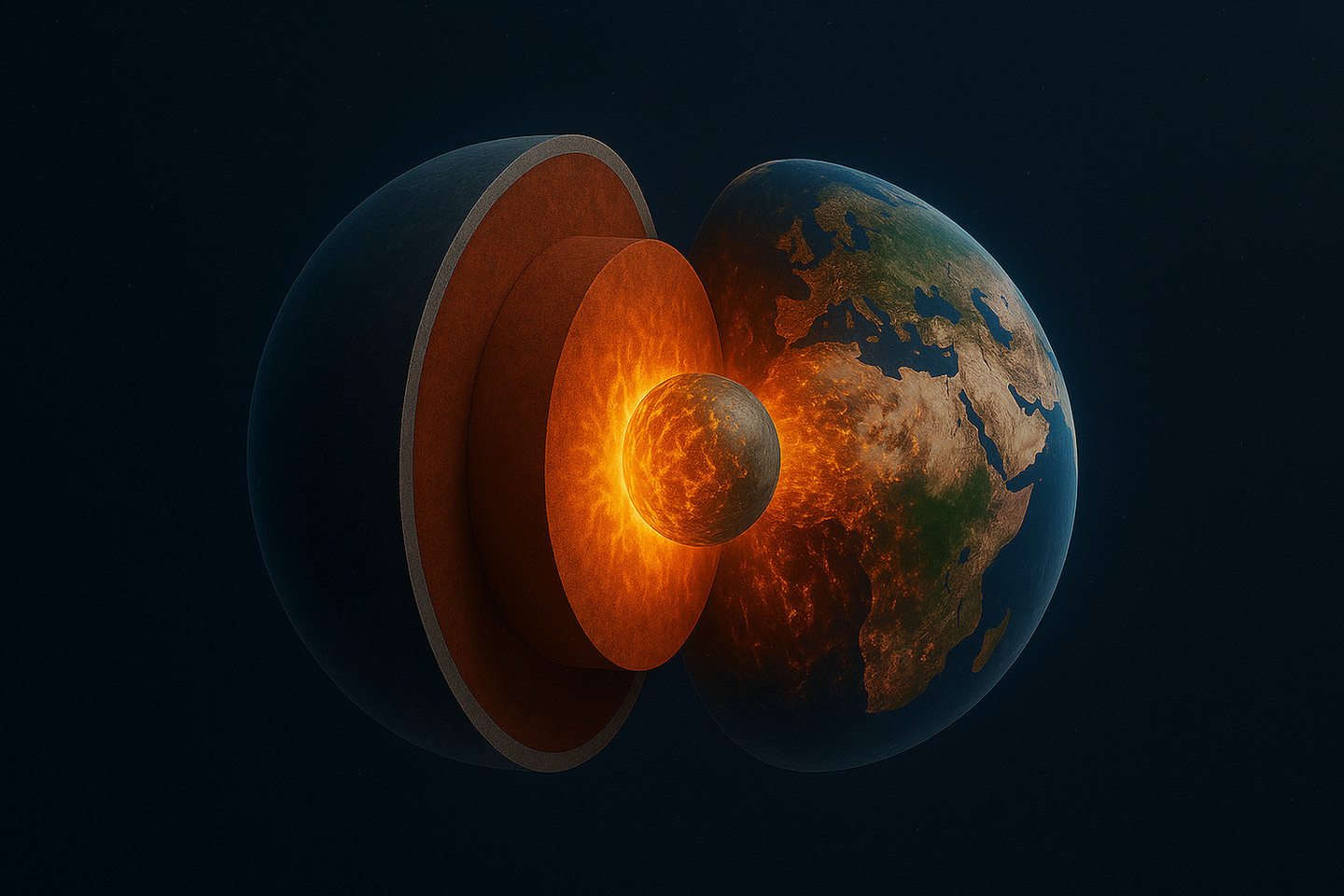
Graphic representation of Earth’s shell structure showing the super-heated metallic inner core in the centre, followed by the solid outer core, the rocky mantle and the thin crust towards the surface. New research from the University of Göttingen demonstrates that some precious metal-rich material from the core is leaking into the Earth’s mantle above. (CREDIT: University of Göttingen (OpenAI))
Researchers at Göttingen University have uncovered new evidence that some of Earth’s most precious metals began their journey far deeper than once thought. Working with volcanic rocks from ocean islands, the team shows that gold and related metals can leak from Earth’s core, move through the mantle, and eventually reach the crust.
The study, published in Nature, was led by geochemists Nils Messling and Matthias Willbold. Their work focuses on tiny chemical differences locked inside volcanic rocks formed far below the surface. These differences help trace where the material came from and how it moved through the planet.
“When the first results came in, we realized that we had literally struck gold!” Messling said. “Our data confirmed that material from the core, including gold and other precious metals, is leaking into the Earth’s mantle above.”
Although gold can be mined in Earth’s crust, that supply represents only a small fraction of the planet’s total store. Scientists estimate that more than 99 percent of Earth’s gold lies in the metallic core. If spread evenly, it could coat all land surfaces with a thick layer of metal.
This uneven distribution formed early. As the young planet melted, heavy elements such as iron and gold sank inward during a process known as the iron catastrophe. Later meteor impacts added more metals to the crust. Untangling which metals came from space and which escaped from the core has remained a long-standing challenge.
Tracking the Core’s Chemical Fingerprints
To solve this puzzle, the Göttingen team turned to isotopes of ruthenium. Isotopes are versions of an element with different neutron counts. Ruthenium is especially useful because most of it moved into the core early in Earth’s history, leaving only trace amounts in the mantle.
"Crucially, the isotopic makeup of ruthenium in the core differs slightly from that found near the surface. Until recently, those differences were too small to detect. Our new analytical methods changed that," Messling shared with The Brighter Side of News.
"Using these techniques, our team analyzed volcanic rocks from the Hawaiian Islands. We found elevated levels of ruthenium-100, an isotope linked to Earth’s core. This signature was stronger than anything seen in the surrounding mantle," he continued.
The finding implies that other core-loving elements behave the same way. Along with ruthenium, metals such as platinum, palladium, rhodium, and gold appear to follow this slow upward path. The process is not fast, and it does not create new mining opportunities. Instead, it reveals an active connection between Earth’s deepest layers.
“Our findings not only show that the Earth’s core is not as isolated as previously assumed,” Willbold said. “We can now also prove that huge volumes of superheated mantle material originate at the core-mantle boundary and rise to the Earth’s surface.”
Why Volcanic Islands Matter
Ocean islands such as Hawaii, Iceland, and the Galápagos form far from tectonic plate boundaries. Their lavas, known as ocean island basalts, come from hot mantle plumes that rise from deep within the planet. These plumes provide a natural window into Earth’s interior.
Some of these basalts also carry unusual tungsten isotope signatures. These signals date back to the first 60 million years of Solar System history. At that time, radioactive hafnium decayed into tungsten, locking in chemical clues from Earth’s earliest moments.
In several cases, these tungsten signals appear alongside high ratios of helium-3 to helium-4. Helium-3 is rare at the surface but common in deep, ancient reservoirs. Together, these markers have long hinted that some mantle plumes tap material influenced by the core.
Ruthenium isotopes now strengthen that link. By comparing samples from hotspots around the world, the team found that Hawaii shows the clearest core signal. Other regions showed weaker or no signs, suggesting that only some plumes sample this deep source.
How Much Core Material Is Needed
Models suggest that adding less than a quarter of one percent of core material to mantle rock can explain the observed isotope patterns. That small amount is enough to shift tungsten and ruthenium signatures without dramatically changing overall chemistry.
Other explanations, such as recycled crust or trapped meteorite remnants, do not fit the combined data. These alternatives fail to reproduce the specific isotope mix seen in Hawaiian lavas.
Taken together, the evidence points to a slow but persistent exchange between Earth’s core and mantle. The metals do not surge upward. They ride with rising plumes over immense spans of time.
Practical Implications of the Research
This research reshapes how Earth’s interior is understood. It shows that the core and mantle interact more than once believed. That insight helps scientists build better models of how planets cool, mix, and evolve over billions of years.
For researchers, the findings provide a new tool for studying deep planetary processes. Isotopes like ruthenium offer a way to trace ancient events that no rock record could otherwise preserve.
For humanity, the value lies in knowledge rather than resources. Understanding how Earth works from the inside out improves insight into volcanic activity, planetary formation, and the behavior of other rocky worlds beyond Earth.
Research findings are available online in the journal Nature.
Related Stories
- Star flares blast out massive amounts of gold across the galaxy
- China discovered the world's largest gold deposit, alarming markets
- Revolutionary new process literally turns e-waste into gold
Like these kind of feel good stories? Get The Brighter Side of News' newsletter.
Joshua Shavit
Writer and Editor
Joshua Shavit is a NorCal-based science and technology writer with a passion for exploring the breakthroughs shaping the future. As a co-founder of The Brighter Side of News, he focuses on positive and transformative advancements in technology, physics, engineering, robotics, and astronomy. Joshua's work highlights the innovators behind the ideas, bringing readers closer to the people driving progress.