Earth’s magnetic poles once took 70,000 years to reverse
A deep-sea sediment record shows one geomagnetic reversal lasted 70,000 years, reshaping assumptions about Earth’s magnetic field.

 Edited By: Joshua Shavit

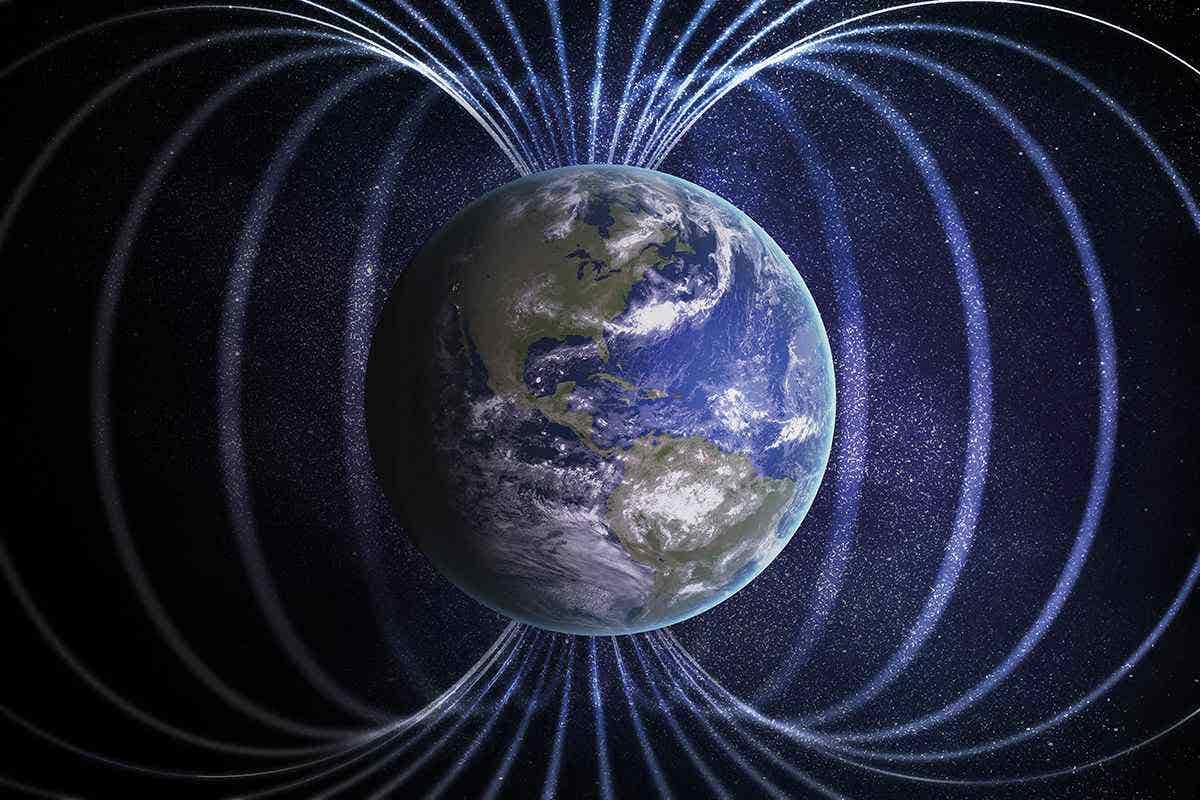
Ancient sediments reveal Earth’s magnetic poles once took 70,000 years to reverse, far longer than scientists expected. (CREDIT: Wikimedia / CC BY-SA 4.0)
Earth’s magnetic field does not simply switch direction like a flipped light switch. It weakens, wanders, and reorganizes itself over thousands of years before settling again. For decades, researchers believed most of these geomagnetic reversals followed a fairly consistent timeline, usually wrapping up within about 10,000 years.
Evidence from sediments buried deep beneath the North Atlantic now suggests that assumption may be too simple.
A newly analyzed record indicates that one ancient magnetic reversal stretched for roughly 70,000 years, far longer than scientists had previously documented. The findings point to a magnetic system that behaves with more variability and complexity than once thought, with possible consequences for Earth’s atmosphere and life during those unstable periods.
The research was led by Yuhji Yamamoto of Kochi University in Japan, with collaborators including University of Utah geoscientist Peter Lippert.
Sediments that captured a rare moment
The discovery traces back to a 2012 drilling expedition off Newfoundland, part of the Integrated Ocean Drilling Program’s Expedition 342. Scientists extracted sediment cores from as deep as 300 meters below the seafloor, targeting deposits from the Eocene Epoch, roughly 56 to 34 million years ago.
Those sediments accumulated slowly, about 2.4 centimeters per thousand years, creating layered archives of environmental history. Tiny magnetic minerals within the layers, largely biogenic magnetite produced by microorganisms, preserve the direction of Earth’s magnetic field at the time they formed.
Lippert explained the appeal of such records.
“As paleomagnetists, our job was to measure the direction and the intensity of the magnetization that’s preserved in those cores,” he said. “We don’t know what triggers a reversal. Individual reversals don’t last the same amount of time, so that creates this unique barcode.”
One section stood out immediately. Instead of a sharp transition between opposite magnetic orientations, the team saw a thick interval where the magnetic signal shifted gradually across many centimeters of sediment.
“Yuhji noticed… this one part of the Eocene had really stable polarity in one direction and really stable polarity in another direction,” Lippert said. “But the interval between them… was spread out over many, many centimeters.”
That observation prompted closer sampling, taken just a few centimeters apart, to capture the transition in high resolution.
A reversal that lingered for tens of thousands of years
Detailed analysis revealed two geomagnetic reversals recorded in the cores around 40 million years ago. One lasted about 18,000 years. The other persisted for approximately 70,000 years, with an uncertainty of about 6,000 years.
Both durations exceed the commonly cited 10,000-year benchmark derived from younger records.
Researchers identified distinct phases within the longer event, including precursor changes, a main transition, and multiple rebound periods where the field partially recovered before shifting again. Throughout the transition, magnetic intensity remained unusually low, a hallmark of reversal intervals.
Earth’s magnetic field originates in the churning liquid iron-nickel outer core, a process known as the geodynamo. Numerical simulations of that system have long suggested that reversal durations could vary widely, sometimes reaching more than 100,000 years. Until now, geological evidence for such prolonged events had been limited.
The new findings bring observational data closer to what models predicted, though uncertainties remain because computer simulations cannot perfectly replicate conditions inside Earth’s core.
A weaker shield against space radiation
Geomagnetic reversals matter because the field acts as a protective barrier against charged particles from the Sun and cosmic sources. When the field weakens during transitions, more radiation can reach Earth’s atmosphere and surface.
Lippert described the potential consequences.
“The amazing thing about the magnetic field is that it provides the safety net against radiation from outer space, and that radiation is observed and hypothesized to do all sorts of things,” he said. “If you are getting more solar radiation coming into the planet, it’ll change organisms’ ability to navigate.”
He added that extended weak-field periods could expose the planet to higher radiation levels for longer durations.
“It’s basically saying we are exposing higher latitudes in particular, but also the entire planet, to greater rates and greater durations of this cosmic radiation and therefore it’s logical to expect that there would be higher rates of genetic mutation. There could be atmospheric erosion.”
The study suggests such prolonged transitional periods may have influenced atmospheric chemistry, surface processes, and biological evolution during the Eocene.
Rethinking magnetic behavior over deep time
About 540 geomagnetic reversals have occurred over the past 170 million years. Yet the widely cited 10,000-year duration estimate comes from only a handful of well-documented events, representing less than 2 percent of known reversals.
That limited sample may have skewed expectations.
The new sediment record shows that reversals can follow the same general pattern seen in younger events while lasting much longer. Scientists also note that magnetic behavior during the Eocene may have differed from today, potentially involving more complex field configurations.
Many questions remain unresolved, including what controls the duration of reversals and why some become prolonged. More advanced geodynamo models and additional geological records will be needed to clarify the physics behind these events.
Research findings are available online in the journal Nature Communications Earth & Environment.
The original story "Earth’s magnetic poles once took 70,000 years to reverse" is published in The Brighter Side of News.
Related Stories
- Earth’s magnetic field funneled atmospheric elements to the Moon over billions of years
- Earth’s magnetic field flipped wildly 565 million years ago and life changed forever
- Earth’s magnetic field is shifting — and satellites are feeling it
Joseph Shavit
Writer, Editor-At-Large and Publisher
Joseph Shavit, based in Los Angeles, is a seasoned science journalist, editor and co-founder of The Brighter Side of News, where he transforms complex discoveries into clear, engaging stories for general readers. With vast experience at major media groups like Times Mirror and Tribune, he writes with both authority and curiosity. His writing focuses on space science, planetary science, quantum mechanics, geology. Known for linking breakthroughs to real-world markets, he highlights how research transitions into products and industries that shape daily life.