Every building block of DNA and RNA has been found on an asteroid
All five nucleobases needed to build DNA and RNA have now been confirmed in samples from asteroid Ryugu.

 Edited By: Joshua Shavit

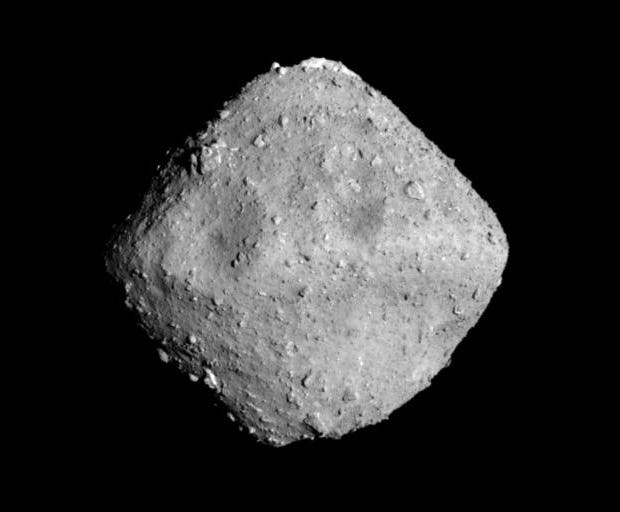
The asteroid Ryugu, as seen by Japan’s Hayabusa2 spacecraft on June 26, 2018. (CREDIT: JAXA)
A rock measuring 900 meters is on a journey through our solar system, providing what is arguably one of the strongest pieces of evidence yet that life originated from outside of planet Earth.
Scientists from a Japanese research group published their findings in the journal Nature Astronomy. They verified, through analyses of material taken from the asteroid Ryugu, that all five nucleobases—the molecular components that contain the genetic information of both DNA and RNA—exist in all samples from Ryugu.
This was not totally unexpected. Over two years ago, when uracil was discovered in one of the Ryugu samples, a more complete picture began to emerge. Now, there is confirmation of five nucleobases in total: adenine, guanine, cytosine, thymine, and uracil. These originated from less than one teaspoon of asteroidal material that has traveled over 300 million kilometers to Earth.
According to Prof. Toshiki Koga, from the Japan Agency for Marine-Earth Science and Technology and the senior author of this study, the existence of these nucleobases means that “primitive asteroids may be capable of synthesizing and preserving molecules necessary for the chemistry associated with the origin of life.”
Sample Collection and Contamination Challenges
The meteorite samples were collected as a result of a project that began in 2014. Hayabusa2 landed on the carbonaceous asteroid Ryugu twice, collecting two samples weighing 5.4 grams and returning them to Earth in December 2020. These specimens had not been exposed to Earth’s atmosphere and represent some of the most unique and pristine examples of extraterrestrial material that scientists are investigating today.
The pristine nature of these specimens is extremely significant. Although meteors typically travel through space and fall onto Earth, they often lie around for long periods of time before being collected. Some have been shown to contain nucleobases.
The Murchison meteorite (Australia), discovered in 1969, and the Orgueil meteorite (France), discovered in 1864, have both been analyzed for nucleobases. However, because meteors travel through Earth’s atmosphere, where they can become contaminated while falling, and then remain on Earth, where they can absorb contaminants, it is often difficult to determine whether the nucleobases found in a meteorite are truly of extraterrestrial origin.
In contrast, the samples taken from Ryugu were not affected by Earth’s atmosphere or ground contamination. They traveled directly from space to Earth.
Patterns Appearing Across the Solar System with Respect to Nucleobases
The current analysis involved two aggregate sample volumes from different touchdown sites on Ryugu. Researchers used multiple detection methods to verify the results. The same compounds were also discovered in the Orgueil meteorite, which served as a reference material for comparison.
Ryugu is not the only asteroid to show evidence of nucleobases. Samples returned by NASA’s OSIRIS-REx mission from the asteroid Bennu also revealed nucleobases within Bennu’s material. Scientists have now found all five canonical nucleobases in material from two separate asteroids. These samples were collected independently by two different space agencies using two separate spacecraft.
Each of the samples had different distributions of nucleobases, which provides additional information. The total nucleobase amounts found in Bennu samples were higher than those found in Ryugu samples. The Orgueil meteorite predominantly contained pyrimidine nucleobases, such as uracil. In contrast, the Murchison meteorite primarily contained purine nucleobases.
Each nucleobase distribution reflects the unique chemical evolution of its parent body. It also reflects the amount of water flow, the temperature the source body experienced, and the other molecules present within it.
Correlations and Chemical Pathways
When comparing these differences across samples, researchers found a strong correlation among them. The presence of five nucleobases in multiple meteorite samples shows that such materials may have been available from multiple sources throughout the solar system.
The discovery of nucleobases on Ryugu does not provide evidence for the existence of life on, or arising from, Ryugu. However, it does indicate that non-biological pathways for abiogenesis could occur throughout the solar system.
The authors note that amino acids and sugars showed similar spatial distribution patterns when compared to ammonia concentrations. The data also indicate that the ratios of purines to pyrimidines in meteorites from the three sources were closely correlated with their ammonia concentrations, with an R² value of 0.89.
Dr. Koga, a co-author of this study from the University of Hawaii, states that there is no known mechanism to explain the observed relationship between nucleobase ratios and ammonia concentration. This may suggest an unknown pathway for the formation of nucleobases in pre-solar meteorite materials.
Independent Perspectives and Study Limits
Dr. Morgan Cable, a researcher at Victoria University of Wellington in New Zealand who was not involved in this research, described the finding as “novel.” She added that it provides further evidence for understanding how biomolecules were formed and how the preconditions required for life on Earth developed.
The authors of the study, along with independent researchers, clearly outline what their findings do not demonstrate. They do not conclude that the presence of all five nucleobases detected from Ryugu supports the existence of a former organism. None of the authors make such a claim.
Ryugu is a cold, airless object with no liquid water. The presence of nucleobases demonstrates that abiotic chemistry capable of forming nucleobases exists widely throughout the solar system. This process does not require biological activity and can occur over millions of years of geologic processes.
“This research does not support the idea of the origin of life happening in space,” states Dr. Cesar Menor-Salvan, an astrobiologist at the University of Alcala, Spain, who was not associated with this study. The work conducted on Ryugu, along with data from the Bennu mission, provides insight into what types of organic matter can develop in non-biological conditions.
Requirements For Life and Chemical Delivery
While the distinction may seem minor, it is important to understand that life requires more than nucleobases. It also requires a defined molecular structure that includes sugars and phosphates, along with an environment capable of sustaining replication over time.
Asteroids like Ryugu may deliver not only genetic materials but also the base chemicals, or “genetic vocabulary,” necessary for genetic systems. These materials could have been delivered to early-formed planets through collisions and impacts.
Asteroid Chemistry Will Last For Billions of Years
The samples obtained from Ryugu contained more than nucleobases. They also included vitamin B3 (niacin), amino acids, urea, and ethanolamine, among other compounds.
The presence of slightly modified structural isomers of standard nucleobases provides additional evidence that these compounds formed through non-biological reaction pathways. This suggests they were present before Ryugu formed, rather than resulting from contamination.
The relative ratios of purines and pyrimidines in the Ryugu samples demonstrate that asteroid chemistry does not follow the same rules as biological systems.
Long-Term Chemical Processes in Space
The Ryugu samples also contained compounds that likely formed under conditions of high-energy radiation. Laboratory studies show that these compounds can produce amino acids and sugars from simple nitrogen-containing molecules.
It is likely that short-lived radioactive species in Ryugu’s parent body created similar chemical environments over long periods of time. These conditions could have persisted for billions of years.
What This All Means
The results from Ryugu provide support for a long-standing hypothesis in origins-of-life research. This hypothesis suggests that prebiotic chemicals were delivered to Earth through comet and asteroid impacts during a period of intense bombardment around 4 billion years ago.
For this idea to hold, prebiotic chemicals must be formed through non-biological processes and remain stable over long periods. The findings from Ryugu support both conditions.
The observed relationship between nucleobase production and ammonia gives researchers a new direction for laboratory experiments. It may help explain how different chemical environments produce different genetic building blocks.
Comparisons with samples from other asteroids, and eventually comets, will expand this understanding. For the general public, the key takeaway is straightforward. The same types of molecules that carry genetic instructions for life on Earth have been preserved in asteroid material for most of the solar system’s history, waiting to be discovered.
Research findings are available online in the journal Nature Astronomy.
The original story "Every building block of DNA and RNA has been found on an asteroid" is published in The Brighter Side of News.
Related Stories
- Asteroid Ryugu fragments carry a magnetic record from the birth of the solar system
- Historical first: Scientists discover the ingredients of life on asteroid
- New hydrocarbon discovery unlocks secrets of how Solar Systems form
Like these kind of feel good stories? Get The Brighter Side of News' newsletter.
Joseph Shavit
Writer, Editor-At-Large and Publisher
Joseph Shavit, based in Los Angeles, is a seasoned science journalist, editor and co-founder of The Brighter Side of News, where he transforms complex discoveries into clear, engaging stories for general readers. With vast experience at major media groups like Times Mirror and Tribune, he writes with both authority and curiosity. His writing focuses on space science, planetary science, quantum mechanics, geology. Known for linking breakthroughs to real-world markets, he highlights how research transitions into products and industries that shape daily life.