Fossilized dinosaur vomit reveals new pterosaur species in Brazil
A rare tropical filter-feeding pterosaur, Bakiribu waridza, was discovered in fossilized predator vomit in Brazil.

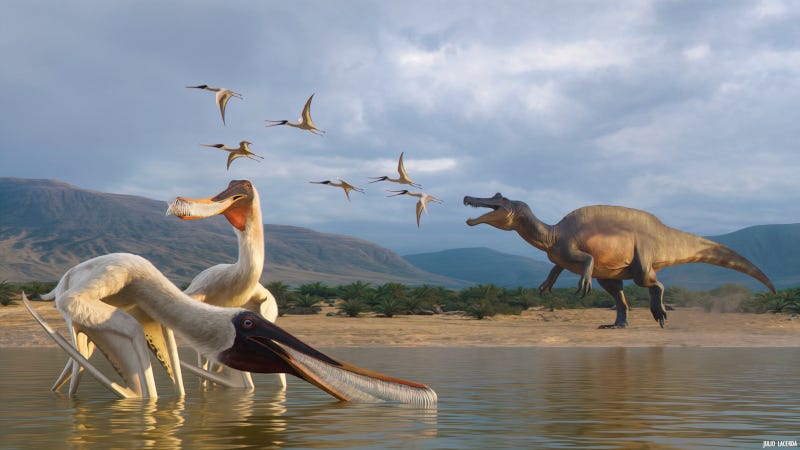
In the foreground, two Bakiribu waridza feed in a lake environment while, in the background, Irritator pursues other specimens. (CREDIT: Julio Lacerda)
In northeastern Brazil, a fossil that had quietly sat in a museum for decades has now rewritten a small part of the history of life on Earth. Scientists discovered a new species of flying reptile preserved in what they call a regurgitalite, fossilized vomit from a prehistoric predator. The find is remarkable, not just for its unusual preservation, but for what it reveals about the diets and ecosystems of the Early Cretaceous period.
The species, named Bakiribu waridza, belonged to a group of pterosaurs known for filter-feeding. Unlike the fierce, sharp-toothed predators usually associated with these flying reptiles, Bakiribu had long jaws lined with closely packed, brush-like teeth. These were designed to strain tiny aquatic creatures, such as crustaceans and small fish, from water. Essentially, it fed much like a modern flamingo.
“This was very unexpected, because fossils from the Araripe region have been studied for decades and almost 30 types of pterosaurs had already been found,” said Rubi Vargas Pêgas, a postdoctoral researcher at the Museum of Zoology of the University of São Paulo. “None of them were filter feeders. We didn’t expect to find a new family for that region.”
The Fossil’s Remarkable Story
The regurgitalite contained the remains of two small pterosaurs about the size of seagulls and four fish. Scientists believe a large predator, likely a spinosaurid such as Irritator challengeri, devoured them. Later, the predator regurgitated the bones that were hardest to digest, preserving them in a way that allowed fossilization. A less likely candidate could have been a massive pterosaur like Tropeognathus mesembrinus, which had a wingspan of about eight meters.
The fossil shows that all of the bones were aligned in the same direction. “Today’s fish-eating birds swallow animals whole by the head to avoid choking on fins,” explained paleontologist Aline M. Ghilardi, a professor at the Federal University of Rio Grande do Norte and coordinator of the study. “The predator that ate Bakiribu and the fish probably did so the same way.”
The regurgitalite also shows signs of wear from gastric acids, further confirming it came from a predator’s stomach. The combination of small pterosaurs and freshly swallowed fish offers an extraordinary snapshot of a single prehistoric meal, frozen in time.
An Unexpected Addition to Tropical Fossils
Bakiribu waridza belongs to the Ctenochasmatidae family of pterosaurs, previously known only from Europe, East Asia, and southern South America. Within the evolutionary tree, this species is positioned between the more recent Argentine species Pterodaustro guinazui and the older European genus Ctenochasma.
The fossil was discovered in the collection of the Câmara Cascudo Museum at UFRN, in a region not typically associated with the Araripe Basin. Scientific initiation student William Bruno de S. Almeida was examining fish fossils under the supervision of Ghilardi when he noticed the unusual pterosaur remains.
“Fish are very abundant in the Araripe fossil record,” Pêgas told The Brighter Side of News. “That may be why no one realized that among them was an animal that was still unknown.”
Once identified as a new species, a team of experts worked quickly to study and publish the finding in Scientific Reports. The rock containing the fossil consists of two mirrored parts. One part was donated to the Plácido Cidade Nuvens Museum of Paleontology at the Regional University of Cariri to ensure its preservation in its place of origin.
“We incorporated an ethical and decolonial bias into this work,” Ghilardi said. “The transfer ensures the preservation of the piece in its territory of origin.”
Understanding Filter-Feeding Pterosaurs
Filter-feeding pterosaurs like Bakiribu are rare in the fossil record. Most pterosaurs had sharp teeth adapted for catching larger prey. The dense, bristle-like teeth of Bakiribu suggest it specialized in catching smaller organisms from freshwater habitats, a surprising find for the tropical Araripe Basin.
The jaws and tooth spacing differ from other members of the Ctenochasmatidae family, confirming it is a new species and not a regional variant. The discovery broadens understanding of pterosaur evolution, showing that similar feeding strategies arose independently in different parts of the world.
By studying microscopic features of teeth, including dentine and pulp cavities, scientists could confirm the fossil’s unique adaptations. These tiny details provide strong evidence of specialized feeding habits and a distinct evolutionary lineage.
Insights Into Prehistoric Ecosystems
The fossil offers an unprecedented glimpse into predator-prey dynamics of the Early Cretaceous. The alignment of bones shows how predators consumed and processed their meals. It also highlights how ecological niches were filled in ancient tropical environments, showing the diversity of life millions of years ago.
The Araripe Basin has long been known for its exceptional fossil preservation, but Bakiribu demonstrates that even well-studied collections can hold surprises. Nearly 30 pterosaur species had been recorded from the region before, but none showed adaptations for filter feeding. The find emphasizes the importance of examining older collections with modern techniques.
Looking Back to Move Forward
This discovery underscores how museum collections can continue to reveal secrets long after their specimens are collected. Fossils like the regurgitalite allow researchers to reconstruct moments of ancient life with remarkable clarity. Each find fills gaps in the evolutionary history of flying reptiles and helps scientists better understand how ecosystems functioned in prehistoric times.
Even small, overlooked specimens can contain enormous scientific value. As paleontologists continue to explore both collections and field sites, more discoveries like Bakiribu may await, offering further insight into the diversity and adaptation of ancient life.
Practical Implications of the Research
The discovery of Bakiribu waridza helps scientists better understand how filter-feeding adaptations evolved among pterosaurs and highlights ecological diversity in tropical environments. It also reinforces the importance of revisiting museum collections, suggesting that many significant fossils may still be waiting to be studied.
This research can inform future paleontology methods, conservation priorities for fossil sites, and public education about evolutionary biology.
Research findings are available online in the journal Nature.
Related Stories
- Fossils show giant sharks evolved far earlier than expected
- Incredible bonebed discovery finds large dinosaur fossils nearly stacked on top of each other
- Dinosaurs thrived until the end: New Mexico fossils rewrite extinction story
Like these kind of feel good stories? Get The Brighter Side of News' newsletter.

Rebecca Shavit
Writer
Based in Los Angeles, Rebecca Shavit is a dedicated science and technology journalist who writes for The Brighter Side of News, an online publication committed to highlighting positive and transformative stories from around the world. Her reporting spans a wide range of topics, from cutting-edge medical breakthroughs to historical discoveries and innovations. With a keen ability to translate complex concepts into engaging and accessible stories, she makes science and innovation relatable to a broad audience.