Gamma Cassiopeiae may be hiding a magnetic white dwarf companion
Gamma Cassiopeiae’s long-standing X-ray mystery now points to a magnetic white dwarf companion.

 Edited By: Joshua Shavit

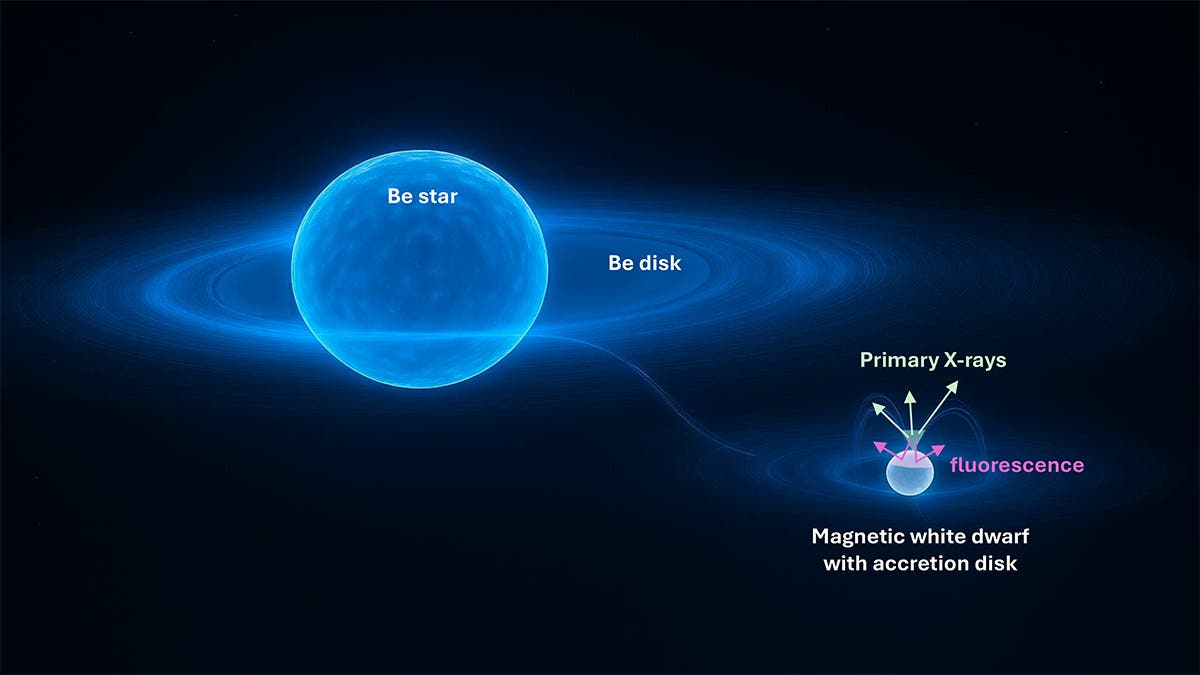
XRISM observations suggest Gamma Cassiopeiae’s strange X-rays come from an accreting white dwarf companion. (CREDIT: University of Liège / Y.Nazé)
Visible without a telescope, γ Cassiopeiae has stood out for decades because it behaves unlike an ordinary massive star. Its X-rays are far too intense, far too hot, and far too erratic. Now, a team led by astronomers at the University of Liège says those X-rays do not come from the star itself. They come from a white dwarf circling it.
The finding, published in Astronomy and Astrophysics, could do more than explain one strange object. It may also confirm a long-predicted class of binary star systems that had remained frustratingly hard to pin down.
γ Cas was the first Be star identified, back in 1866 by Italian astronomer Angelo Secchi. Be stars spin rapidly and throw off material that forms a disc around them. But in 1976, astronomers noticed something odd: γ Cas was emitting X-rays about 40 times stronger than similar massive stars, with plasma heated to more than 100 million degrees.
That made it an outlier. Later observations found around two dozen similar objects, now known as γ Cas analogues.
A long-running argument
For years, astronomers argued over what was driving that emission. One idea blamed magnetic activity near the Be star and its disc. Another pointed to a companion object. Candidates included a stripped star, a neutron star, or a white dwarf pulling in material.
“Several scenarios had been proposed to explain this emission,” said Yaël Nazé, an astronomer at ULiège. “One of them involved local magnetic reconnection between the surface of the Be star and its disc. Others suggested X-rays to be linked to a companion, whether a star stripped of its outer layers, a neutron star, or an accreting white dwarf.”
Previous work by the Liège team had already argued against the stripped-star and neutron-star ideas. That left two main possibilities standing: magnetic interactions near the Be star, or an accreting white dwarf. The trouble was that no observation had clearly separated the two.
So the team turned to Resolve, the high-precision spectrometer aboard the Japanese XRISM telescope.
They observed γ Cas three times, in December 2024, February 2025, and June 2025, timing the campaign to cover the system’s 203-day orbit. That let them watch how the X-ray signatures shifted as the two objects moved.
Following the wrong star
The crucial clue came from iron lines in the X-ray spectrum.
The researchers found that the high-temperature plasma signatures changed velocity from one observation to the next. But they were not moving with the Be star. They were moving with the compact companion.
“The spectra revealed that the signatures of the high-temperature plasma change velocity between the three observations, following the orbital motion of the white dwarf rather than that of the Be star,” Nazé said. “This shift was measured with high statistical reliability. It is, in fact, the first direct evidence the the ultra-hot plasma responsible for the X-rays is associated with the compact companion, and not with the Be star itself.”
That shift mattered. Across key observing phases, the velocity change in the ionised iron lines was measured at minus 87 ± 30 kilometers per second. The fluorescence complex shifted by minus 148 ± 28 kilometers per second. By contrast, the Be star’s own expected velocity change over the same range was only about plus 7 kilometers per second.
In other words, the X-ray source was moving with the unseen companion, not with the bright star everyone could see.
The line widths added another layer to the case. The fluorescent lines were broadened by about 200 ± 30 kilometers per second. That is too narrow for a non-magnetic white dwarf with a fast inner accretion disc, which should produce lines thousands of kilometers per second wide. Instead, the data fit a magnetic white dwarf better, one whose magnetic field truncates the disc and channels material toward its poles.
A missing population comes into view
That matters well beyond γ Cas itself.
Astronomers have long predicted that many Be stars should have white dwarf companions. Models have estimated that 50 to 70 percent of Be binaries could host them. Yet the evidence for these systems has remained murky, debated, or incomplete.
This study points to γ Cas and its analogues as members of that missing population: Be stars paired with white dwarfs.
Still, the story is not fully tidy. The observed systems do not match theory as neatly as expected. The γ Cas phenomenon appears mostly in massive early-type Be stars, and affects only about 10 percent of them. Models, by contrast, predicted a higher proportion and tied many Be-white dwarf systems to lower-mass Be stars.
That mismatch suggests something in binary evolution models may need revision, especially the way mass transfer between stars is handled.
“Solving this mystery therefore opens up new avenues of research for the years to come,” Nazé said. “Understanding the evolution of binary systems is crucial for comprehending, for example, gravitational waves, as it is indeed massive binaries that emit them at the end of their lives.”
The study also leaves some open questions. The team notes that more work is needed to explain links between X-ray changes and optical or ultraviolet variations, and to understand why X-rays can persist even when the Be disc largely fades.
Research findings are available online in the journal Astronomy and Astrophysics.
The original story "Gamma Cassiopeiae may be hiding a magnetic white dwarf companion" is published in The Brighter Side of News.
Related Stories
- Astronomers watch a supermassive black hole X-ray flare ignite an ultra-fast galactic wind
- New X-ray scans track violent solar winds threatening Earth’s satellites
- A sleeping black hole just woke up - erupting powerful x-ray bursts
Like these kind of feel good stories? Get The Brighter Side of News' newsletter.
Joseph Shavit
Writer, Editor-At-Large and Publisher
Joseph Shavit, based in Los Angeles, is a seasoned science journalist, editor and co-founder of The Brighter Side of News, where he transforms complex discoveries into clear, engaging stories for general readers. With vast experience at major media groups like Times Mirror and Tribune, he writes with both authority and curiosity. His writing focuses on space science, planetary science, quantum mechanics, geology. Known for linking breakthroughs to real-world markets, he highlights how research transitions into products and industries that shape daily life.