Getting pregnant in space isn’t that easy, study finds
Sperm can still swim in space, but they lose direction. That shift may reshape how reproduction works beyond Earth.

 Edited By: Joseph Shavit

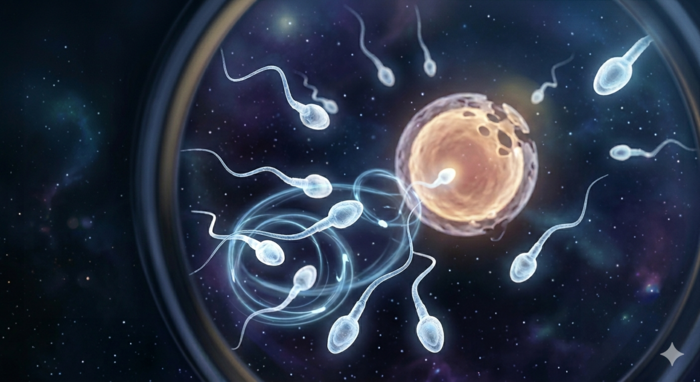
Microgravity disrupts sperm navigation and fertilization, raising new questions about reproduction in space. (CREDIT: AI-generated image / CC BY-SA 4.0)
Getting to Mars is difficult. Conceiving a child there could be even tougher than expected.
A recent study led by researchers from University of Adelaide has demonstrated that simulated microgravity conditions can have an adverse effect on sperm navigating through the reproductive tracts of multiple mammalian species, including humans. Even when those sperm are able to swim normally, the effect still occurs.
The research, published in the journal Communications Biology, represents the first time that sperm have been tested for their ability to navigate through a space that simulates a microgravity environment.
The results of this study represent an unusual convergence of two fields, reproductive biology and space medicine. They raise significant questions regarding the potential for the establishment of long-term human settlements on either the Moon or Mars.
When Directional Navigation Is Lost By Sperm
Using a machine called a 3D Clinostat, which simulates the near-zero gravity of space by continuously rotating biological samples in order to cause the cells to lose their sense of orientation, the team at Adelaide University placed sperm samples from mice, humans, and pigs into microchannel mazes. These mazes were designed to closely replicate the female reproductive tract. The sperm were then recorded for their ability to successfully navigate from one end of the maze to the other.
Under simulated microgravity conditions, sperm from all three species experienced significant reductions in their ability to successfully make their way through the testing channels. What was surprising about the results was that, although the sperm maintained similar swimming abilities (speed, movement patterns, mechanics of sperm), their directionality had been affected by the simulated microgravity condition.
According to Nicole McPherson, senior author of the study and researcher at the Robinson Research Institute, this research represents the first evidence that gravity assists in the ability of sperm to move through a tubule such as the female reproductive tract. If the sperm are unable to find their way to the egg, they are not getting lost due to having less motility than they were previously. It will be due to something else.
Gravitational Forces
Researchers believe that sperm can use gravitational forces as part of the signal used to keep them in contact with the walls of the female reproductive tract. Thus, sperm can develop a preferred path to the egg due to remaining on that wall surface. Without a gravity force to help maintain this contact, the signal will be absent.
One possibility was to use progesterone (the hormone secreted by the cells surrounding the oocyte) to chemically attract sperm to the location of fertilization. High concentrations of progesterone partially restored the ability of human sperm to navigate. When treated with high doses of progesterone, sperm were rescued to levels comparable to those observed under normal gravity conditions.
However, according to Dr. McPherson, future studies are needed to determine how best to use progesterone. The progesterone concentrations detected were much higher than what the body normally produces in the region surrounding an oocyte.
What Happens To The Embryo
Navigation was not all that was studied. The team also studied how microgravity affects fertilization, and how microgravity affects embryonic development within the first hours of embryo development.
Microgravity during fertilization was simulated for mouse eggs. At four hours after fertilization, those eggs had a greater than thirty percent lower fertilization rate than eggs fertilized normally. The same reduction in fertilization occurred in pig models.
After fertilization, embryos cultured under normal gravity developed into blastocysts, the first stage of cellular development before implantation. However, when embryos were exposed to microgravity for the first 24 hours post-fertilization, more significant effects were observed compared to those exposed for only 4 hours.
There was evidence of delayed cell divisions, fewer total cells, and fewer overall blastocyst formations from embryos exposed to microgravity for 24 hours. In general, the first 24 hours after fertilization involve a cascade of genetic and epigenetic changes that need to occur for normal development. Microgravity appears to impede the cascade of genetic and epigenetic changes necessary for normal development. It also compounds that effect with time.
Analysis of the data revealed an unexpected finding. Sperm that navigated the channel in microgravity successfully and fertilized an egg resulted in embryos with more epiblast cells than sperm that did not travel through the channel in microgravity.
Researchers suggest that this may indicate a selective pressure of microgravity. Specifically, it may exclude sperm with less functionality and allow those with greater functionality to fertilize the egg. Whether this selective advantage has any significance in practice remains an open question.
Current Research
The research represents a collaboration with the Andy Thomas Centre for Space Resources at Adelaide University, which focuses on the effects of long-term living off the Earth. Moreover, current research is investigating how the effects of varying levels of gravity, specifically the partial gravity of lunar gravity at approximately one-sixth of Earth and Mars gravity at approximately one-third of Earth, affect reproductive processes.
A key question that will drive future research is whether there will be a gradual degradation of reproductive function as gravity decreases. Alternatively, there may be a threshold where the body will no longer be able to adapt to the lower level of gravity.
"Understanding how microgravity affects reproduction will be critical as we move toward becoming a multi-planetary or space-faring species," said John Culton, an Associate Professor and Director of the Andy Thomas Centre for Space Resources.
Practical Implications
In addition to human reproduction, the future practical implications of this research include the fact that any extensive, long-term human settlement will have to support food production through animal husbandry. Therefore, reproductive biology in altered gravity is a far-reaching concern beyond simply the health of the crew.
The research demonstrates an alternative, but not a definitive guide for future research. It does indicate that reproduction in space can occur, at least in part. Although there was evidence of successful embryo formation, despite compromised conditions, Dr. McPherson stated that this should provide cautious optimism for the future of human reproduction in space.
The gaps in sperm navigation, fertilization, and embryo quality are measurable, real, and consistent across species. Therefore, closing those gaps, via hormonal support, timing protocols, engineered gravity systems, and related approaches, will necessitate a significant amount of additional research before any of these practices become standard on Earth.
Research findings are available online in the journal Communications Biology.
The original story "Getting pregnant in space isn't that easy, study finds" is published in The Brighter Side of News.
Related Stories
- Human sperm RNA changes with age, study finds
- Groundbreaking male birth control pill stops sperm in their tracks
- Scientists are close to creating human sperm cells in a test tube
Like these kind of feel good stories? Get The Brighter Side of News' newsletter.
Mac Oliveau
Writer
Mac Oliveau is a Los Angeles–based science and technology journalist for The Brighter Side of News, an online publication focused on uplifting, transformative stories from around the globe. Passionate about spotlighting groundbreaking discoveries and innovations, Mac covers a broad spectrum of topics including medical breakthroughs, health and green tech. With a talent for making complex science clear and compelling, they connect readers to the advancements shaping a brighter, more hopeful future.