Global first: A massive sleeper shark was filmed in cold Antarctic waters
A massive sleeper shark filmed near Antarctica is forcing scientists to rethink where sharks can survive.

 Edited By: Joseph Shavit

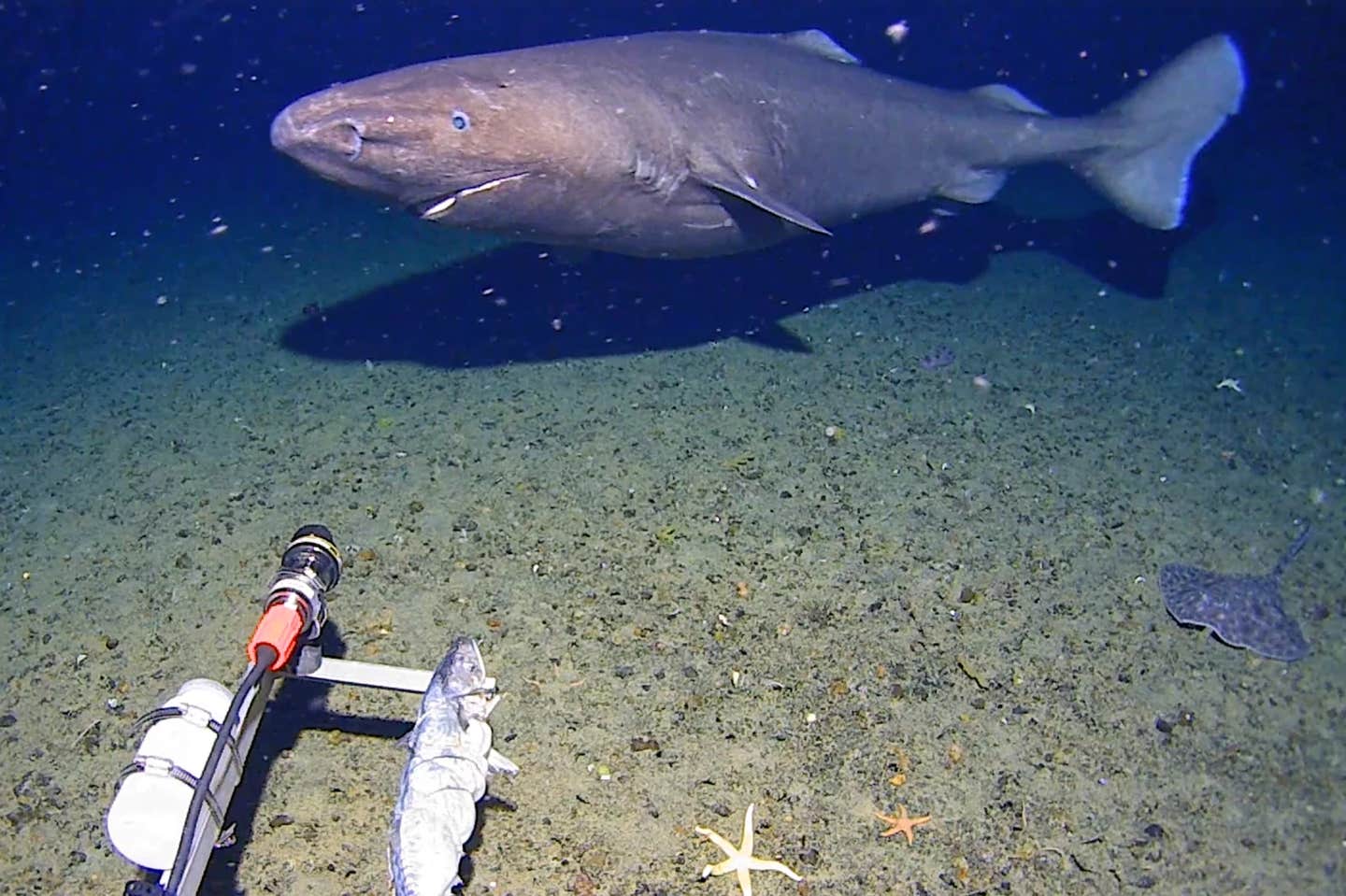
University of Western Australia researchers found a sleeper shark swimming into the spotlight of a video camera in Antarctica in January 2025. (CREDIT: University of Western Australia)
A bulky shape drifted through dim water nearly half a kilometer below the Antarctic surface, moving slowly over a pale seabed. At first glance, it looked like something familiar. Then the realization landed. It was a shark, filmed in a place where many scientists assumed sharks did not live at all.
The encounter happened in January 2025, when a deep-sea camera recorded a sleeper shark near the South Shetland Islands, off the Antarctic Peninsula. The animal measured an estimated 3 to 4 meters long, roughly 10 to 13 feet. Water temperatures at that depth hovered just above freezing.
Alan Jamieson, founding director of the Minderoo-UWA Deep-Sea Research Centre at the University of Western Australia, said the sighting broke a long-standing rule of thumb.
“We went down there not expecting to see sharks because there’s a general rule of thumb that you don’t get sharks in Antarctica,” Jamieson said. “And it’s not even a little one either. It’s a hunk of a shark. These things are tanks.”
A Predator in Near-Freezing Darkness
The shark appeared at about 490 meters, or 1,608 feet deep, where the temperature measured 1.27 degrees Celsius, about 34.29 degrees Fahrenheit. That environment pushes close to the limits of what many fish species can tolerate.
In the video, a skate rested motionless on the seabed as the shark passed by. The skate’s presence was not surprising. Scientists already knew those relatives of sharks inhabit Antarctic waters. The shark itself was the shock.
Jamieson said he could find no prior record of a shark documented within the Antarctic Ocean, which lies south of the 60-degree latitude line.
Peter Kyne, a conservation biologist at Charles Darwin University who was not involved in the research, agreed the footage marked the southernmost recorded occurrence.
“This is great. The shark was in the right place, the camera was in the right place and they got this great footage,” Kyne said. “It’s quite significant.”
Following the Warmest Layer
One detail caught the researchers’ attention. The shark maintained a consistent depth along a seabed that sloped downward into much deeper water.
Jamieson said the animal likely stayed there because that layer offered the warmest conditions available. Antarctic waters form stacked temperature layers, known as stratification, down to roughly 1,000 meters. Cold, dense water below mixes poorly with fresher meltwater above from ice.
The result is a banded ocean environment with subtle temperature differences. For an animal living near the limits of cold tolerance, even small changes matter.
Jamieson suspects other sharks could occupy similar zones, scavenging carcasses of whales, giant squid, and other large animals that sink to the seafloor.
A Vast Region with Few Observers
The discovery also highlights how little scientists see in Antarctic deep waters.
Few cameras operate at that specific depth, and those that do typically function only during the Southern Hemisphere summer, from December through February. Equipment deployment outside that window becomes far more difficult due to ice, storms, and darkness.
“The other 75% of the year, no one’s looking at all. And so this is why, I think, we occasionally come across these surprises,” Jamieson said.
That limited observation window leaves large gaps in knowledge. A sparse shark population could easily remain undetected for decades.
Climate Questions Without Answers
The sighting raises a question that researchers cannot yet resolve. Are sharks newly expanding into Antarctic waters, or have they always been there?
Kyne said warming oceans could potentially influence range shifts toward colder southern regions. However, data near Antarctica remain too limited to confirm that explanation.
Sleeper sharks move slowly and inhabit deep environments, which makes them particularly hard to study. Their presence in Antarctic waters might reflect long-term residency rather than recent migration.
For now, the footage stands as a single data point.
And a reminder that even large predators can remain hidden in Earth’s most remote environments.
Practical Implications of the Research
The observation suggests Antarctic ecosystems may include predators that scientists previously overlooked.
Understanding whether sharks are permanent residents or newcomers could influence future conservation planning and climate impact research in polar regions.
Expanded monitoring at depth will be necessary to determine how widespread these animals are and whether environmental change is altering their range.
The original story "Global first: A massive sleeper shark was filmed in cold Antarctic waters" is published in The Brighter Side of News.
Related Stories
- Filmed for the first time: Killer whales attack and kill great white sharks
- Greenland sharks may hold key to humans living for centuries
- The disappearance of great white sharks has scientists concerned
Like these kind of feel good stories? Get The Brighter Side of News' newsletter.
Joshua Shavit
Writer and Editor
Joshua Shavit is a NorCal-based science and technology writer with a passion for exploring the breakthroughs shaping the future. As a co-founder of The Brighter Side of News, he focuses on positive and transformative advancements in technology, physics, engineering, robotics, and astronomy. Joshua's work highlights the innovators behind the ideas, bringing readers closer to the people driving progress.