Gold’s origins lie beneath the ocean deep inside the Earth’s mantle
Gold beneath island arcs may start concentrating deep in the mantle through repeated, water-aided melting.

 Edited By: Joseph Shavit

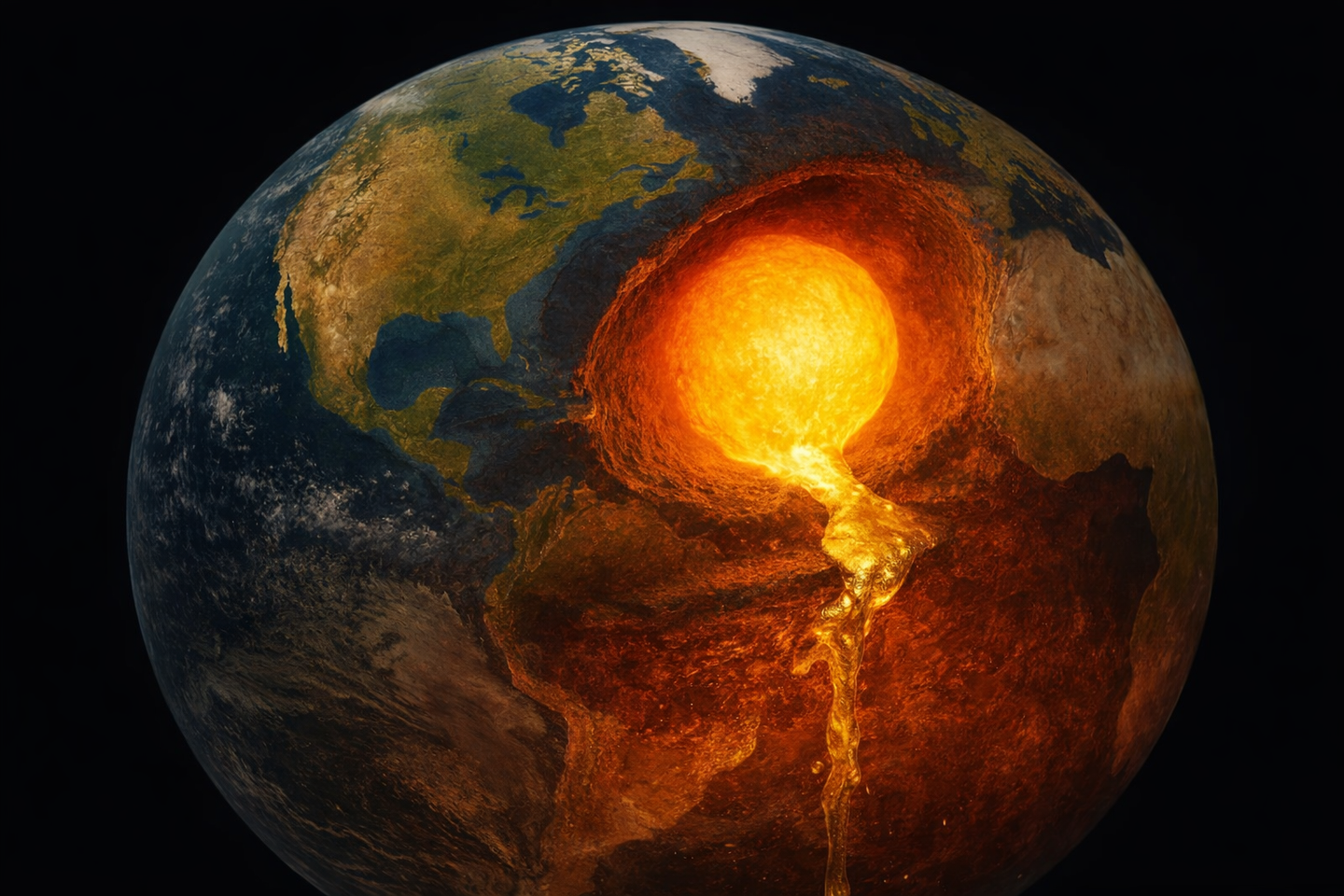
Study finds repeated hydrous mantle melting helps concentrate gold beneath island arcs north of New Zealand. (CREDIT: AI-generated image / The Brighter Side of News)
The first step in gold’s journey does not happen in a mine, a fault, or a hydrothermal vent. It begins far deeper, in mantle rock melting beneath the seafloor.
That is the picture emerging from new work led by Dr Christian Timm, a marine geologist at the GEOMAR Helmholtz Centre for Ocean Research Kiel. Studying volcanic glass from the Kermadec island arc north of New Zealand, the team found that gold-rich magmas in this setting appear to be tied not to a single burst of melting, but to repeated, water-aided melting in the mantle below subduction zones.
Island arcs are the curved chains of volcanoes that form where one oceanic plate sinks beneath another. These regions are already known for hosting some unusually gold-rich seafloor sulfide deposits. What has remained unsettled is why the magmas feeding those systems can carry so much gold in the first place.
“Our research shows that hydrous mantle melting beneath island arcs is a key driver of gold enrichment,” Timm said. “In these settings, the mantle behaves like a multi-stage melting system that progressively concentrates gold.”
Glass that kept the magma’s memory
To get at that question, the researchers analyzed 66 volcanic glass samples collected from the seafloor along the Kermadec arc and the nearby Havre Trough. These glasses formed when lava cooled rapidly underwater, freezing in a chemical snapshot of the magma from which they formed.
Some samples were especially useful because they were primitive glasses, meaning they still closely reflected the original magma before later changes from crystallization.
“When we analysed these samples, we found that their gold concentrations are often several times higher than those of comparable magmas from mid-ocean ridges,” Timm said. “This raised the key question: which processes are responsible for this enrichment?”
The team measured gold alongside several other chalcophile, or “sulphur-loving,” elements, including silver, copper, selenium and platinum. Because those elements respond in related ways during melting, they can help reconstruct what was happening in the mantle.
What the researchers found points to hot, water-rich melting beneath the Kermadec arc, under conditions above the sulfide liquidus. In simpler terms, the mantle there appears to melt under conditions where sulfide phases can break down and release metals into magma.
Not a one-time event
The primitive magmas carried original gold concentrations as high as six nanograms per gram of rock. That is not enough to mine. The study notes that economically attractive concentrations would need to be several orders of magnitude higher. Geologically, though, those values are striking.
The gold-to-copper ratios were also higher than those expected from fertile mantle and from primitive mid-ocean ridge basalts. Silver-to-copper ratios, meanwhile, mostly stayed close to mantle values. That combination mattered because it helped the team rule out some possible explanations and focus on others.
At first, the researchers suspected that fluids released directly from the subducting slab might control gold enrichment. The data pushed them elsewhere.
“We initially assumed that water released from the subduction zone directly controlled gold enrichment,” Timm said. “However, our data show that water mainly facilitates mantle melting. The key factor for high gold concentrations is the high, and in part repeated, degree of melting.”
That repeated melting is central to the paper’s argument. Gold in the mantle is commonly locked inside sulfide minerals. If melting is limited, much of that gold stays put. If melting becomes more extensive, and happens again in already depleted mantle, those sulfides can be consumed and the gold released into the melt.
“Gold in the mantle is commonly bound in sulphide minerals,” Timm said. “At high degrees of melting, these minerals break down, releasing their gold completely into the melt.”
A deeper explanation for gold-rich arc systems
The study also tested another idea, that ascending magmas may have picked up gold by interacting with sulfides in the lower crust. The researchers argue that this process is unlikely to explain the regional pattern seen in the Kermadec samples. They found no strong evidence that gold enrichment tracked the ratios expected from that kind of crustal recycling.
They also found no clear sign that extra gold from slab-derived fluids was the main driver on a regional scale. Some local slab contribution is still possible, the authors say, but it does not appear necessary to explain the most gold-rich magmas in their dataset.
Instead, the results point back to mantle history. The most gold-enriched melts seem to come from hydrous, oxidized mantle that had already been depleted by earlier melt extraction and then melted again. In that sense, the mantle beneath the arc acts less like a fresh source and more like a reworked system.
Study limits
There are limits here. The study focused on one arc-back-arc region, and the authors note that the proposed link between this deep melting process and gold-rich hydrothermal deposits at the seafloor still needs further testing. They also note that lower-crustal sulfide recycling may still happen locally, especially in thicker crust, even if it does not explain the broader regional pattern.
Still, the work sharpens the first chapter of gold’s origin story in submarine subduction zones.
“Our results demonstrate that gold enrichment is not the result of a single melting event, but of multiple stages,” Timm said. “Only repeated melting allows gold to become strongly concentrated in the magma.”
That reframes where the story starts. Not near the vent. Not in the ore body. Much deeper down.
“We are effectively looking at the first step in the life cycle of gold,” Timm said. “It begins with the transfer of gold from the mantle into a melt that eventually forms volcanoes. The alchemy starts long before the metal reaches the surface.”
Practical implications of the research
This research could help geologists better understand why submarine island arcs often host gold-rich hydrothermal sulfide systems.
It also suggests that the deep chemical history of the mantle, especially repeated hydrous melting, may be a major control on how much gold rising magmas can carry before any near-surface ore-forming processes begin.
Research findings are available online in the journal Communications Earth & Environment.
The original story "Gold’s origins lie beneath the ocean deep inside the Earth's mantle" is published in The Brighter Side of News.
Related Stories
- Earth’s core is leaking vast amounts of gold through the mantle, study finds
- Star flares blast out massive amounts of gold across the galaxy
- New gold nanospheres capture nearly the full spectrum of solar energy
Like these kind of feel good stories? Get The Brighter Side of News' newsletter.
Rebecca Shavit
Writer
Based in Los Angeles, Rebecca Shavit is a dedicated science and technology journalist who writes for The Brighter Side of News, an online publication committed to highlighting positive and transformative stories from around the world. Her reporting spans a wide range of topics, from cutting-edge medical breakthroughs to historical discoveries and innovations. With a keen ability to translate complex concepts into engaging and accessible stories, she makes science and innovation relatable to a broad audience.