Gravitational lensing helps astronomers determine the true mass of a rogue planet
A brief gravitational lensing event allowed astronomers to measure the mass and distance of a rogue planet, offering new insight into how planets form.

 Edited By: Joshua Shavit

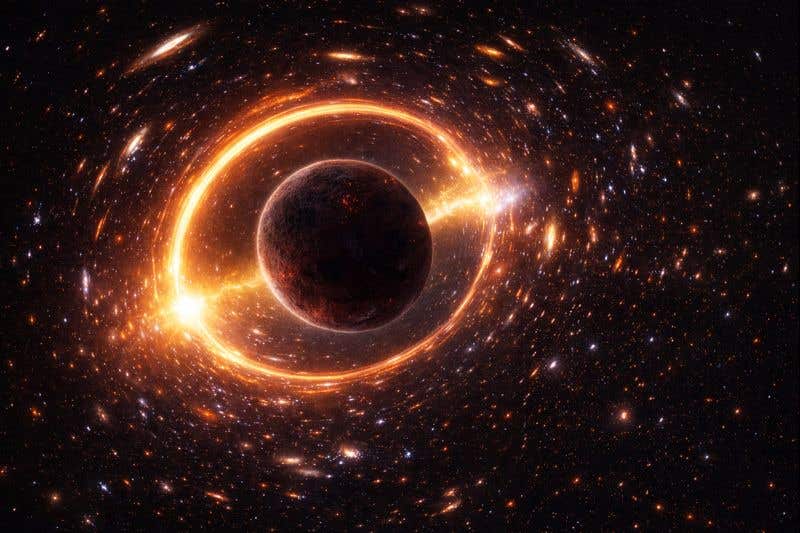
A rare cosmic alignment reveals a rogue planet drifting alone through the Milky Way. (CREDIT: AI-generated image / The Brighter Side of News)
Planets usually stay close to their host stars, tracing steady paths shaped by gravity. Yet some planets break free and drift alone through the Milky Way. Astronomers call these objects free-floating or rogue planets. A new study published in Science reports one of the clearest detections yet of such a world, including precise measurements of both its mass and distance.
The research was led by Gavin A. L. Coleman from the School of Physical and Chemical Sciences, Queen Mary University of London and an international team working alongside the Korea Microlensing Telescope Network and the Optical Gravitational Lensing Experiment. By combining ground-based and space-based observations from the European Space Agency’s Gaia mission, the scientists overcame a long-standing problem that has limited what researchers could learn about rogue planets.
Rogue planets are difficult to study because they emit almost no light. Unlike most known exoplanets, they cannot be found by watching a star dim during a transit or wobble under a planet’s pull. Without a star, those methods fail. Instead, astronomers rely on a subtler effect rooted in gravity itself.
Why rogue planets are so hard to find
The only reliable way to detect a rogue planet is through gravitational microlensing. This happens when a massive object passes in front of a distant background star. The object’s gravity bends and focuses the star’s light, briefly making the star appear brighter. The effect is short-lived and rare, but it can reveal otherwise invisible objects.
In theory, microlensing can also reveal a planet’s mass. The degree to which the light bends depends on the object’s gravity. Yet there is a catch. The same light curve can be produced by a small object nearby or a larger object farther away. Astronomers call this uncertainty mass-distance degeneracy. Without knowing one value, the other remains uncertain.
That problem has long limited studies of rogue planets. Most previously reported events offered only rough statistical estimates. Direct measurements of both mass and distance remained out of reach, until now.
A fortunate cosmic geometry
The newly discovered planet was independently detected by two surveys and received two names: KMT-2024-BLG-0792 and OGLE-2024-BLG-0516. What made this event special was timing and geometry.
Gaia, which orbits the Sun near Earth, observed the same microlensing event seen from the ground. The event happened to lie almost perpendicular to Gaia’s precession axis. This rare alignment allowed Gaia to record the signal six times over just 16 hours, beginning near the peak brightening.
“Serendipitously, the KMT-2024-BLG-0792/OGLE-2024-BLG-0516 microlensing event was located nearly perpendicular to the direction of Gaia’s precession axis,” Coleman told The Brighter Side of News. “This rare geometry caused the event to be observed by Gaia six times over a 16-hour period, beginning close to peak magnification.”
Because Gaia and Earth viewed the event from slightly different positions, the light reached them at different times. That small timing shift allowed researchers to measure microlens parallax. With that measurement, the mass-distance puzzle could finally be solved.
The team calculated that the planet has about 22 percent of Jupiter’s mass, just below Saturn’s mass. They also found it lies roughly 3,000 parsecs, or nearly 10,000 light years, from Earth. The background star involved in the event was identified as a red giant.
What this planet says about how worlds form
The planet’s mass places it in an important range. Most rogue planets identified so far appear to be smaller than Jupiter. Larger free-floating objects are usually brown dwarfs, bodies too massive to be planets but too small to ignite as stars.
Microlensing surveys have hinted at a gap between planets and brown dwarfs, often called the Einstein desert. This gap reflects how difficult it is for massive planets to be ejected from their systems. Heavier worlds are harder to fling free.
"We obeserved that earlier events lacked direct mass measurements. Still, statistical work suggested most free-floating planets are smaller than Neptune. Such objects can be produced by strong gravitational interactions within their birth planetary systems,” Coleman further shared with The Brighter Side of News. “We conclude that violent dynamical processes shape the demographics of planetary-mass objects, both those that remain bound to their host stars and those that are expelled to become free floating.”
The newly measured mass supports this picture. A planet near Saturn’s size likely formed within a planetary disk, then was expelled after gravitational encounters with other planets or stars. Its relatively high speed hints it may have come from a system with two stars, where unstable orbits are common.
Why these lonely planets matter
Each rogue planet carries a record of its violent past. Even without a star, its mass and motion preserve clues about how planetary systems evolve. By comparing rogue planets with those still bound to stars, astronomers can test models of planet formation and migration.
These discoveries also help explain differences between planet surveys. Microlensing often finds planets in places where transit surveys see few. Rogue planets may be part of the reason. They reshape estimates of how many planets exist and how often systems lose them.
Future missions are expected to expand this work. NASA’s Nancy Grace Roman Space Telescope, planned for launch later this decade, will scan wide regions of the sky in infrared light. It is expected to detect thousands of planets, including many free-floating worlds.
This discovery shows what becomes possible when observatories work together. By pairing Earth-based telescopes with a space observatory like Gaia, astronomers can weigh and locate planets that would otherwise remain hidden.
Research findings are available online in the journal Science.
Related Stories
- JWST observations reveal massive helium clouds escaping from exoplanet WASP-107 b
- JWST spots a lemon-shaped exoplanet orbiting a pulsar — rewriting the rules of planet formation
- Two collisions, one star, and a new view of planet formation
Like these kind of feel good stories? Get The Brighter Side of News' newsletter.
Joseph Shavit
Writer, Editor-At-Large and Publisher
Joseph Shavit, based in Los Angeles, is a seasoned science journalist, editor and co-founder of The Brighter Side of News, where he transforms complex discoveries into clear, engaging stories for general readers. With vast experience at major media groups like Times Mirror and Tribune, he writes with both authority and curiosity. His writing focuses on space science, planetary science, quantum mechanics, geology. Known for linking breakthroughs to real-world markets, he highlights how research transitions into products and industries that shape daily life.