Groundbreaking memory chip withstands temperatures hotter than lava
A USC team created a memory device that kept working at 700°C, opening a path to electronics for Venus, drilling, and AI.

 Edited By: Joseph Shavit

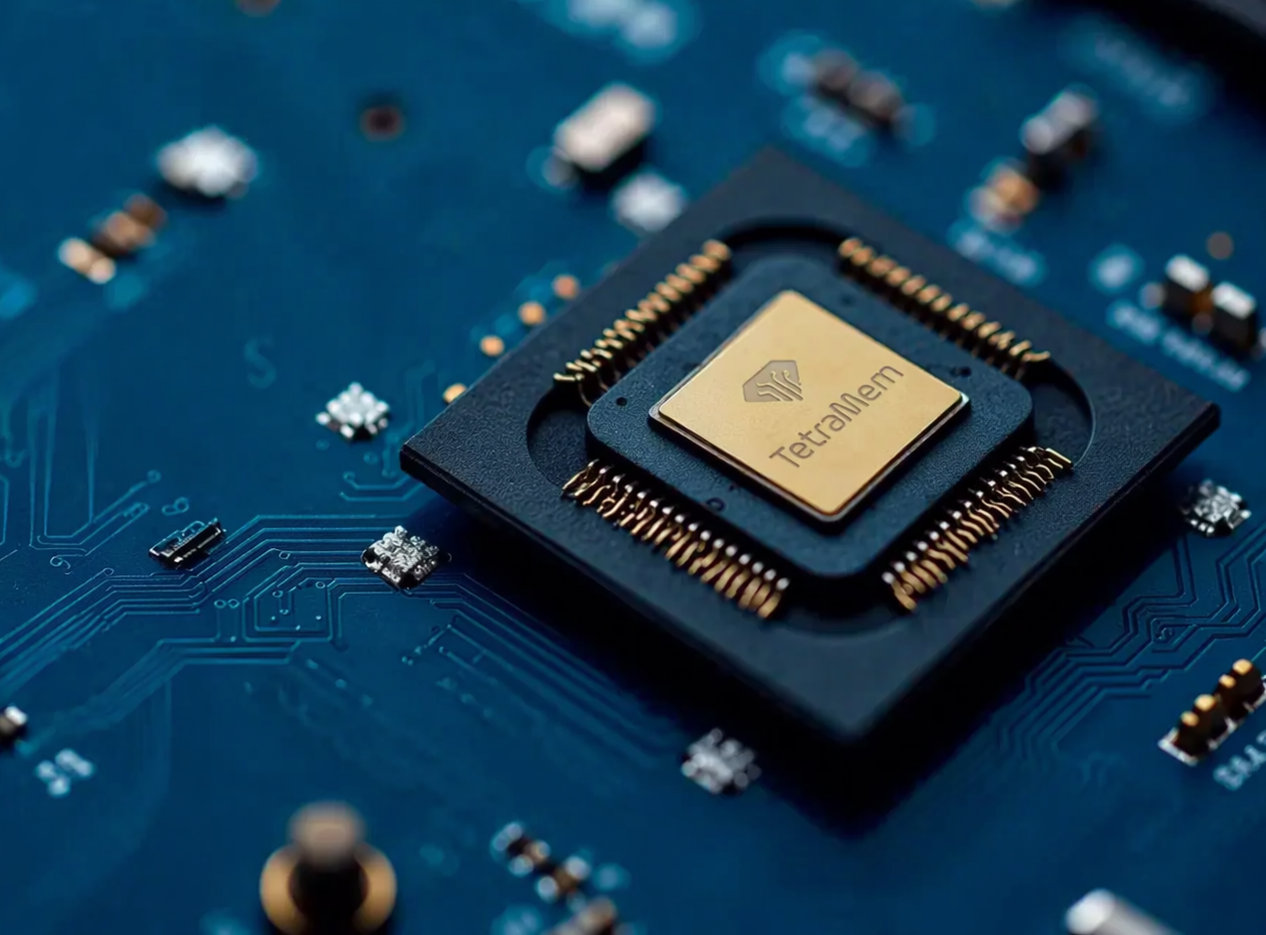
USC researchers built a memristor memory chip that worked at 700°C, far beyond standard electronics’ heat limits. (CREDIT: TetraMem)
Heat has always been the quiet enemy inside electronics. Once temperatures climb much past 200 degrees Celsius, the memory systems in ordinary chips begin to lose their footing. That has left a stubborn gap in engineering, especially for machines expected to work in places far hotter than any office, roadway, or server room.
A new device from the University of Southern California pushes straight through that limit.
In a paper published in Science, a USC-led team reported a memristor, a tiny memory component that also can carry out computing tasks, that kept working at 700 degrees Celsius. That is hotter than lava, well above the failure range of standard silicon electronics, and beyond the point their test equipment could handle. The researchers say it is the highest operating temperature yet reported for a resistive non-volatile memory device in this class.
“You may call it a revolution,” said Joshua Yang, Arthur B. Freeman Chair Professor at the Ming Hsieh Department of Electrical and Computer Engineering of the USC Viterbi School of Engineering and the USC School of Advanced Computing. “It is the best high-temperature memory ever demonstrated.”
A memory device built for extremes
The device has a simple layered structure, though the materials are anything but ordinary. It uses tungsten as the top electrode, hafnium oxide as the switching layer, and graphene as the bottom electrode. Tungsten was chosen in part because it has the highest melting point of any element. Graphene, a one-atom-thick carbon sheet, adds another unusual trait: it stays stable under extreme heat.
Jian Zhao, the paper’s first author, built the memristor in that tungsten-hafnium oxide-graphene stack. The finished devices ranged from 200 nanometers by 1 micrometer to 1 micrometer by 1 micrometer. In testing, they kept an ON/OFF current ratio above three orders of magnitude from room temperature to 700 degrees Celsius.
At 700 degrees Celsius, the devices held both memory states for more than 50 hours without refreshing. In separate tests on 30 devices, the average retention time for both states was about 145 hours, with individual devices ranging from 130 to 170 hours. The team also reported more than 1 billion switching cycles at 700 degrees Celsius, switching voltages around 1.5 volts, and pulse widths of about 30 nanoseconds.
That mix matters. High-temperature memory is not much use if it demands huge voltages, switches too slowly, or wears out quickly.
What went wrong, then right
The finding did not come from a straight path.
Yang said the group had originally been trying to build something else with graphene. “To be honest, it was by accident, as most discoveries are,” he said. “If you can predict it, it’s usually not surprising, and probably not significant enough.”
Once the device started behaving in an unexpected way, the researchers dug into the physics. In more conventional versions of this kind of memory, heat can drive tungsten atoms from the top electrode down through the hafnium oxide layer. If enough atoms make it to the lower electrode, they create a permanent short. The device gets stuck in the ON state and stops functioning as memory.
That breakdown showed up clearly in control devices built with platinum instead of graphene at the bottom. After annealing at 800 degrees Celsius, the platinum-based devices quickly shifted into a permanent ON state.
The graphene version behaved differently.
Using high-resolution transmission electron microscopy, energy-dispersive X-ray spectroscopy, electron energy loss spectroscopy, and first-principles calculations, the researchers traced the difference to the interface itself. Tungsten atoms bind strongly to platinum, but much more weakly to graphene. On platinum, they can adsorb, move, and gather into clusters. On graphene, that process is strongly suppressed.
The calculations backed up the microscope work. A tungsten adatom had much stronger adsorption on Pt(111) than on graphene, and tungsten dimers were also far less stable on graphene. The team found that tungsten surface diffusion on platinum was about three orders of magnitude greater than on graphene. Together, those effects make platinum a sink for drifting tungsten atoms, while graphene resists becoming one.
Why the device held on
The team also looked at why the device’s low-resistance state remained so stable at high temperature. Simple oxygen-vacancy diffusion alone did not explain the result. The paper points instead to a compositional phase separation mechanism, one that may create a stable boundary between oxygen-rich and oxygen-poor regions and help keep the conductive filament intact.
The device was not just stable, it was also versatile. At 700 degrees Celsius, the researchers programmed 32 distinct resistance states. The current-voltage response stayed reasonably linear, with correlation coefficients above 0.995 for 16 representative states between 0 and 0.5 volts. That kind of behavior is useful for in-memory computing, where analog-like conductance levels can represent weights in neural networks.
The group also fabricated a 32 by 32 crossbar array, a 1K array, using a two-wire configuration. Six devices became stuck in the ON state after electroforming, but the rest switched reliably, giving the first array a yield of 81.25%.
That still leaves room for improvement, but for an early device, it is a meaningful sign that the concept may scale.
Why this matters beyond the lab
The need for electronics above 500 degrees Celsius is not theoretical. Space exploration is one obvious case. Venus has surface temperatures around that range, and long-lived landers there have remained out of reach in part because electronics cannot survive the heat. Deep-well drilling, nuclear systems, fusion systems, and high-temperature industrial sensing face similar problems.
“We are now above 700 degrees, and we suspect it will go higher,” Yang said.
There is also a computing angle. Memristors can perform matrix multiplication directly through the flow of current, which makes them attractive for artificial intelligence workloads. “Over 92 percent of the computing in AI systems like ChatGPT is nothing but matrix multiplication,” Yang said. “This type of device can perform that in the most efficient way, orders of magnitude faster and at lower energy.”
Yang, along with co-authors Qiangfei Xia, Miao Hu, and Ning Ge, has already co-founded TetraMem to commercialize room-temperature memristor chips for AI computing. The high-temperature version described here could someday bring similar advantages to probes, spacecraft, and industrial systems that must process data where ordinary chips fail.
The researchers were careful not to overstate the timeline. Memory by itself does not make a full high-temperature computer. Logic circuits still have to be developed and integrated, and these devices were fabricated by hand at sub-microscale in a lab. The current study also notes a limitation: over prolonged high-temperature exposure, tungsten diffusion is strongly suppressed, but not eliminated. Some devices eventually failed by becoming stuck in the ON state, and cycling-related degradation was tied to oxygen loss.
“This is the first step,” Yang said. “It’s still a long way to go. But logically, you can see: now it makes it possible. The missing component has been made.”
Practical implications of the research
This work points to a path for electronics that can keep storing data and carrying out computation in places where today’s memory breaks down.
That could help future spacecraft process information on site, improve sensing in geothermal or nuclear systems, and make hardware for harsh industrial settings more durable.
It also gives engineers a clearer design rule: pairing thermally stable oxides with two-dimensional electrodes such as graphene may be a practical way to build memory for extreme environments.
Research findings are available online in the journal Science.
The original story "Groundbreaking memory chip withstands temperatures hotter than lava" is published in The Brighter Side of News.
Related Stories
- New Nickel-Tungsten Alloy Powers Greener, Faster Memory Chips
- New memory structure helps AI models think longer and faster without using more power
- Breakthrough MRAM chips deliver faster, ultra-efficient computer memory
Like these kind of feel good stories? Get The Brighter Side of News' newsletter.
Shy Cohen
Writer