Groundbreaking new theory rewrites quantum view of the Big Bang
Waterloo physicists say early cosmic inflation may arise from gravity itself, with predictions future experiments can test.

 Edited By: Joseph Shavit

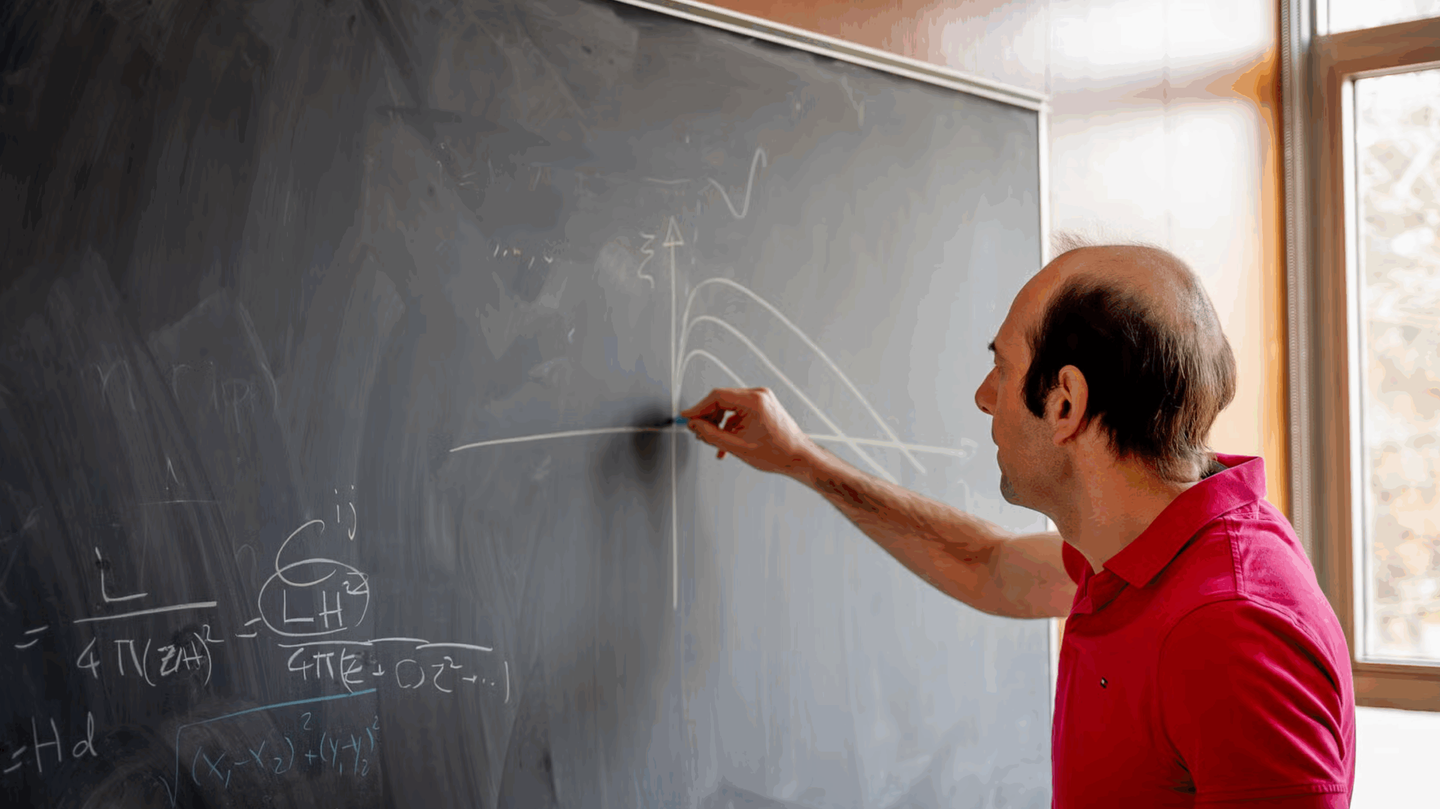
Dr. Niayesh Afshordi, professor of physics and astronomy at the University of Waterloo and Perimeter Institute (PI). (CREDIT: University of Waterloo)
A Gravity Theory That Could Rewrite the Universe’s First Moments
The first fraction of a second after the Big Bang has always posed a problem. Physics can describe a great deal about the universe once it cooled and expanded, but the very beginning, when temperatures and energies were extreme, has remained harder to pin down.
A new study from researchers at the University of Waterloo and the Perimeter Institute argues that the universe’s earliest growth spurt may not need the extra theoretical add-ons that many cosmologists have relied on for decades. Instead, the team says that rapid early expansion, known as inflation, could emerge from a more complete version of gravity itself.
That matters because Einstein’s general relativity, despite its long record of success, is not enough on its own in such extreme conditions. It works well as an effective theory, but breaks down at very high energies and runs into problems such as singularities and mathematical inconsistencies.
A different route to inflation
The Waterloo-led team explored what is known as quantum quadratic gravity, a framework that modifies the usual gravity action by adding terms quadratic in curvature. In their picture, the very early universe begins not with standard general relativity plus extra pieces inserted by hand, but with this deeper theory alone.
Dr. Niayesh Afshordi, a professor of physics and astronomy at Waterloo and the Perimeter Institute, said the appeal of the idea is its simplicity.
“This work shows that the universe’s explosive early growth can come directly from a deeper theory of gravity itself,” Afshordi said. “Instead of adding new pieces to Einstein’s theory, we found that the rapid expansion emerges naturally once gravity is treated in a way that remains consistent at extremely high energies.”
That marks a break from familiar versions of inflation, including the well-known Starobinsky model, which begins with Einstein’s gravity and adds an extra curvature term. Here, the authors start in a regime where only quantum quadratic gravity operates, then ask whether the known universe could emerge from it.
Their answer is yes, at least on paper. The model suggests that quantum effects can slightly reshape a pure curvature-driven theory and produce a near-de Sitter phase, the kind of smooth, rapid expansion cosmologists associate with inflation. Later, inflation ends, and the universe moves into a kinetic-dominated stage called kination before eventually matching onto ordinary gravity and the radiation-filled cosmos that standard cosmology describes.
One striking feature is that the theory predicts a floor for primordial gravitational waves, faint ripples in spacetime produced in the universe’s first moments. The paper argues that to remain outside the strong-coupling regime, the tensor-to-scalar ratio, a standard measure tied to those waves, should be at least about 0.01.
Where the data might enter
That prediction gives the idea something rare in quantum gravity research: a chance of being tested.
“Even though this model deals with incredibly high energies, it leads to clear predictions that today’s experiments can actually look for,” Afshordi said. “That direct link between quantum gravity and real data is rare and exciting.”
The paper compares its predictions with recent constraints from cosmic microwave background and baryon acoustic oscillation data, including results involving Planck, ACT, SPT, BICEP/Keck, and DESI. The authors argue that their model can sit in a favorable region of the current data space, especially compared with standard Starobinsky inflation under one common cosmological setup. They also note that if dark energy is allowed to evolve, both models remain within observational bounds.
Still, this is not a tidy victory lap.
The proposed framework depends on a debated version of the theory’s running equations, and the paper openly notes that the validity of those “physical” beta functions remains an active subject of discussion. The authors also make an assumption that a very large number of matter fields are present, on the order of 10^5 to 10^6, even if those fields are not excited. That is a major requirement.
There are other caveats. The onset of inflation in the model remains speculative. One suggested starting point, a no-boundary Euclidean manifold, is presented as a natural possibility rather than an established fact. The authors also acknowledge ambiguity in how they choose the physical running scale, taking it to track curvature through the Ricci scalar.
And while the Weyl term disappears in a perfectly homogeneous and isotropic background, it still affects perturbations, which means its role in stability, ghost behavior, and observable predictions still needs closer study.
A bridge between theory and observation
Ruolin Liu, a PhD student at Waterloo and the Perimeter Institute, and Dr. Jerome Quintin of l’École de technologie supérieure, a former postdoctoral scholar at Waterloo and the Perimeter Institute, also contributed to the work.
The next steps are technical but important. The team says it wants to test whether the inflationary picture survives more detailed calculations, including two-loop corrections, stronger treatment of reheating, and a better account of how general relativity emerges from the high-energy theory. It also plans to sharpen predictions for upcoming observations.
Cosmology is entering a period where that kind of effort could pay off. New galaxy surveys, cosmic microwave background experiments, and gravitational wave searches are pushing precision high enough to challenge old assumptions about the early universe.
If this framework holds up, it would do more than tweak a popular inflation model. It would suggest that the universe’s first burst of growth came from gravity’s own quantum structure, rather than from extra ingredients added later to make the math work.
Practical implications of the research
The main impact is that this theory gives observers something concrete to look for.
If future measurements detect primordial gravitational waves at the level this model requires, or tighten the limits enough to rule that out, scientists could directly test whether a quantum theory of gravity shaped the universe’s birth.
That would narrow the field of inflation models and could bring one of physics’ biggest goals, linking gravity with quantum mechanics, closer to real evidence.
Research findings are available online in the journal Physical Review Letters.
The original story "Groundbreaking new theory rewrites quantum view of the Big Bang" is published in The Brighter Side of News.
Related Stories
- Einstein–Rosen bridges are not wormholes but quantum links between opposite directions of time
- Astronomers reveal what happened less than a second after the Big Bang
- Dark matter may end our universe in a 'Big Crunch'
Like these kind of feel good stories? Get The Brighter Side of News' newsletter.
Joshua Shavit
Writer and Editor
Joshua Shavit is a NorCal-based science and technology writer with a passion for exploring the breakthroughs shaping the future. As a co-founder of The Brighter Side of News, he focuses on positive and transformative advancements in technology, physics, engineering, robotics, and astronomy. Joshua's work highlights the innovators behind the ideas, bringing readers closer to the people driving progress.