How AI is revolutionizing time of death estimations
Researchers use AI and blood chemistry to predict post-mortem intervals, improving forensic investigations even days after death.

 Edited By: Joseph Shavit

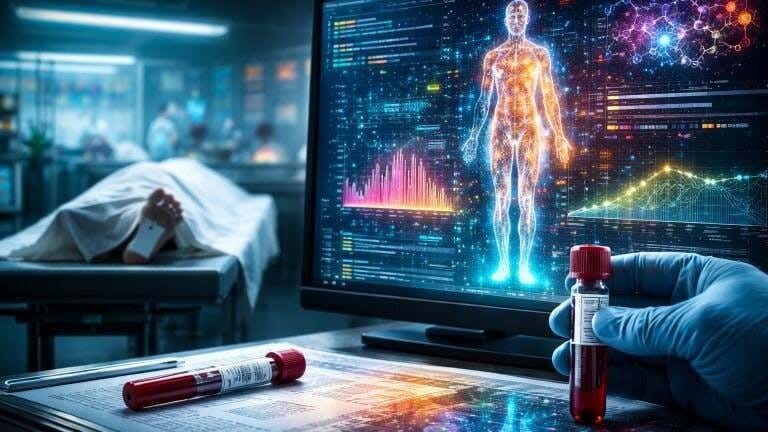
AI models trained on blood metabolites can estimate time since death with a precision of about one day, aiding forensic investigations. (CREDIT: AI-generated image / The Brighter Side of News)
The faint chemical traces in human blood can tell a story even after death. In laboratories at Linköping University and the Swedish National Board of Forensic Medicine, researchers have tapped into these traces, showing that the passage of time after death can be estimated with remarkable accuracy using artificial intelligence. Their findings suggest a major shift in how forensic investigators might pinpoint the moment life ended.
“Death is a strong biological signal,” says Rasmus Magnusson, postdoctoral fellow at the Department of Biomedical Engineering, IMT, at Linköping University. He led the study that trained AI models to track subtle chemical changes in the blood that unfold after death. These molecules, known as metabolites, break down in predictable ways, providing a biological clock for scientists to read.
Following Metabolic Footprints
The research capitalizes on the body’s natural decomposition. After death, tissues deteriorate, and organs cease their usual metabolic activity. This breakdown leaves behind specific chemical signatures in the blood. Over time, the composition of metabolites shifts, reflecting processes like protein degradation, fat breakdown, and energy failure in cells.
Henrik Green, professor of forensic sciences at Linköping University and researcher at the National Board of Forensic Medicine, emphasizes the practical stakes. “This enables us to assess the actual time of death of an individual, which is very important in forensic investigations, but also to the work of the police. For example, they need to spend their resources on the right witnesses in the right period of time in the deceased person’s life.”
Traditional methods to estimate post-mortem interval, including measuring body temperature, assessing rigor mortis, or analyzing potassium levels in the eye, have serious limitations. Their accuracy diminishes after a day or two, making it hard to establish timelines when death occurs days earlier. This is where the AI approach can fill a critical gap.
Training AI with Real Cases
The team accessed an extensive repository of over 45,000 blood samples collected by RMV over nearly a decade. While many of these samples were originally taken to detect drugs, toxins, or pharmaceuticals, they also contain the metabolites crucial for tracking decomposition. Of these, 4,876 samples with known post-mortem intervals were used to train the AI.
Magnusson notes the broader applicability of the approach. “This is a gold mine of data at the National Board of Forensic Medicine. But we were also able to show that there is no need for such large amounts of data that was perhaps previously thought. A few hundred individuals are enough to build corresponding models, which makes our method useful even in laboratories worldwide that don’t have access to as much data.”
The AI model employed neural network techniques to discern complex patterns among hundreds of metabolites. It essentially learned to correlate chemical changes in the blood with time elapsed since death. When tested on unseen cases, the system achieved a mean absolute error of only 1.45 days. The median error was 1.03 days, meaning more than half of predictions fell within a single day of the actual post-mortem interval.
Testing Across Conditions
To verify that the method was robust, the team tested it on a separate dataset of 512 individuals. These samples were collected in a different year and analyzed on a different type of mass spectrometer, the instrument used to measure blood chemicals. Even under these varied conditions, the model performed strongly, with a mean absolute error of 1.78 days and a median of 1.29 days.
This flexibility is key for global forensic use. Laboratories without large-scale datasets could still implement AI tools based on smaller collections and produce reliable post-mortem interval estimates.
Elin Nyman, docent in systems biology at IMT, recalls the uncertainties at the project’s start. “We knew that many external factors affect body decomposition and were surprised that the signal from the body’s metabolites was so strong when it comes to predicting the post-mortem interval.”
Decoding Biological Signals
The study highlighted several metabolic processes that were particularly informative. Lipid breakdown, mitochondrial dysfunction, and proteolysis, the natural degradation of fats, energy-producing cell components, and proteins, each left measurable signatures in blood. Together, these signals provide a molecular map of elapsed time since death.
Carl Söderberg, forensic pathologist and researcher at RMV, describes the process as detective work. “Forensic assessments often involve puzzle-like detective work. This new tool gives us better opportunities to assess how long someone has been deceased even when a long time has passed since their death, which is of great importance especially in more complex cases. We’re now working on developing even more accurate models.”
By identifying and measuring these signals, investigators could narrow timelines for deaths discovered days later, guiding decisions about which witnesses to interview and when events may have occurred.
Opportunities for Forensic Practice
The implications extend beyond improving post-mortem estimates. If metabolite-based AI models become standard practice, investigators could gain a consistent, objective measure of elapsed time that is less affected by environmental variables like temperature or humidity. Current approaches, relying heavily on physical changes in the body, are highly sensitive to external conditions.
The AI method also opens doors for labs with limited resources. Since smaller datasets can still train reliable models, forensic centers worldwide could adopt similar techniques without requiring decades of stored samples.
Magnusson emphasizes this point: “Even laboratories without access to tens of thousands of samples could potentially produce reliable models using only a few hundred cases.”
Challenges and Next Steps
Despite promising results, there are limitations. Present models depend on blood samples taken during autopsies, which may not always be available. Moreover, factors such as environmental exposure, the cause of death, and individual variation can affect decomposition and metabolite levels. Researchers caution that the method must be tested under diverse circumstances to confirm its general applicability.
Future work aims to improve temporal precision further. By incorporating more exact timestamps for death, models could eventually estimate not only the number of days since death but also the approximate time of day when death occurred. Expanding datasets to include tissue samples or other bodily fluids may also enhance predictions.
Bridging Biology and Computation
The study marks a step toward a new era in forensic science, where the hidden chemistry of death can be read like a clock. It combines decades of accumulated biological data with modern machine learning to tackle one of the field’s most persistent challenges: determining the post-mortem interval with confidence beyond the immediate hours after death.
Forensic scientists now have a tool that extends their investigative reach, making it possible to reconstruct events and timelines with a precision once thought impossible. By turning the body’s natural decomposition into a measurable signal, this AI-driven method connects the invisible molecular world with practical law enforcement needs.
Practical Implications of the Research
This research promises tangible benefits for criminal investigations and forensic practice. Accurate post-mortem interval estimates can help police focus on relevant evidence and witnesses, optimize investigative resources, and improve the reliability of legal proceedings.
Laboratories worldwide can implement the approach without needing enormous datasets, broadening access to a powerful tool for time-of-death analysis.
The combination of biology, chemistry, and artificial intelligence offers a pathway toward more objective, reproducible, and globally applicable forensic assessments.
Research findings are available online in the journal Nature.
Related Stories
- AI struggles with true creativity compared to humans, study finds
- The AI Scientist takes a big step toward end-to-end automation of scientific research
- AI is transforming pediatric surgery, but with strong ethical concerns
Like these kind of feel good stories? Get The Brighter Side of News' newsletter.
Shy Cohen
Writer