If the universe is full of stars then why is the night sky dark?
A simple question about darkness opens onto the age, expansion, and hidden light of the universe.

 Edited By: Joshua Shavit

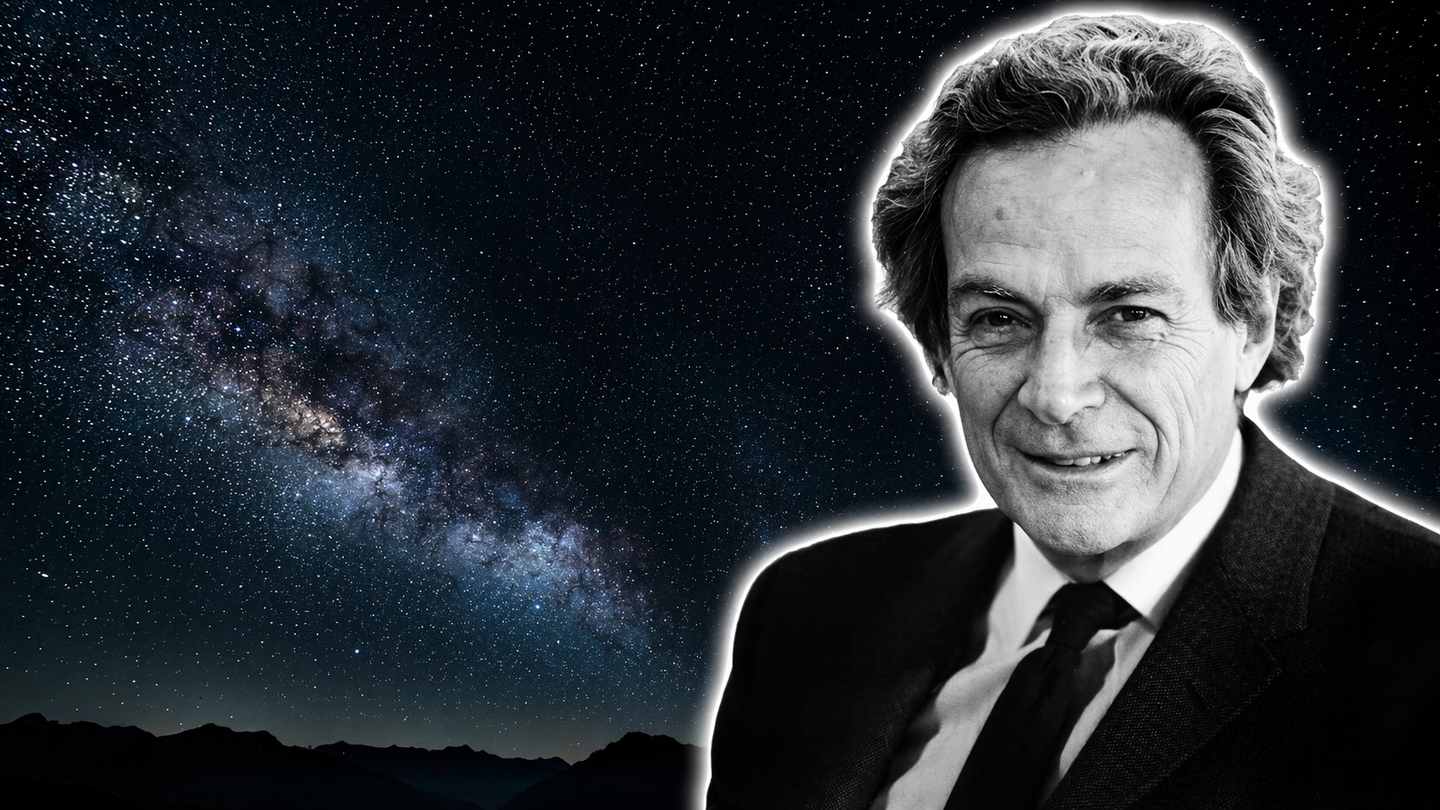
Why the night sky is dark leads to the Big Bang, cosmic expansion, and the hidden glow of the universe. (CREDIT: AI-generated image / The Brighter Side of News)
A black patch of sky looks empty until you stop taking it for granted.
That is the starting point of a theory from Professor Richard Feynman, built around what sounds like a child’s question, why the night sky is dark. The usual answer feels obvious. The sun sets, Earth rotates, and night falls. That explains why it is not daytime. It does not explain why the sky itself turns black.
For centuries, astronomers and philosophers worked from a set of assumptions that seemed reasonable enough. The universe, they thought, was infinite. It had existed forever. And stars were spread through it more or less everywhere, even if they clustered in galaxies. Put those ideas together, and the darkness overhead starts to look strange.
The way into the problem is visual. Picture yourself in a forest so vast it never ends. In a small forest, you can look between trunks and catch glimpses of open sky. In an infinite one, every line of sight eventually hits a tree. Shift your gaze slightly, and you miss the first trunk only to meet another farther back. Shift again, and another one appears. If the forest truly goes on forever, there are no final gaps.
Replace the trunks with stars, and the logic becomes unsettling.
The sky should not be black
Pick any dark patch between familiar constellations. Under the old picture of the cosmos, that darkness should not exist. If space is infinite and filled with stars, then any line from your eye, no matter where it points, ought to end on the surface of a star. The whole night sky should glow.
Not faintly, either.
The theory argues that the sky should look like a continuous wall of stellar surface, as bright as the sun. In that kind of universe, Earth would not sit under a cool, dark canopy. It would sit inside an oven. Oceans would boil. Rocks would melt. Life would never get started.
That contradiction is what later became known as Olbers’ paradox, after Heinrich Olbers, who discussed it in 1823. The idea itself is older, troubling figures such as Kepler and Halley long before it was formally named. However old the puzzle, the point is the same. A dark night sky means at least one of those earlier assumptions about the universe must be wrong.
At first glance, there seems to be an easy escape. Distant stars look dimmer, so maybe the faraway ones simply fade into insignificance.
That rescue attempt does not hold.
Why distance does not save the old universe
The reasoning can be laid out using a series of spherical shells centered on Earth. A shell at one distance contains some number of stars and sends a certain amount of light our way. Move to a shell twice as far out, and each individual star appears four times dimmer because of the inverse square law.
But that shell also has four times the surface area.
So if stars are spread evenly through space, the more distant shell contains four times as many stars. Four times as many sources, each one quarter as bright, gives the same total contribution. The logic repeats again and again. The third shell, the tenth shell, the millionth shell each add the same amount of light.
That is the crucial point. The dimming cancels out.
If the universe were infinite and static, you would keep stacking equal contributions forever. The result would not drift toward darkness. It would drive toward a sky filled with star surface.
So perhaps the problem is not the brightness of distant stars but the material between them. Maybe dust clouds absorb the light before it reaches us.
That sounds plausible for a while.
Dust cannot hide the light
For nearly a century, many astronomers leaned on dust as the answer. Space is not perfectly clean. It contains gas, debris, and dust left behind by stars. The comparison is fog on a road, the sort that swallows distant headlights.
Yet this fix runs straight into thermodynamics.
A beam of light carries energy. If a dust grain absorbs that light, the energy does not disappear. It heats the dust. Keep that process going for millions or billions of years in an old, star-filled universe, and the dust keeps taking in radiation from all sides. Eventually it warms up enough to radiate energy back out.
It reaches equilibrium.
At that point, the dust glows as strongly as the light falling on it. Instead of a wall of stars, you get a wall of hot, glowing dust. Either way, the sky stays bright. Dust can shuffle energy around. It cannot make it vanish.
That failure leaves the puzzle standing in the same place. Light does not fade away as a total contribution, and it cannot simply be hidden forever in cold clouds. Something deeper has to change.
The answer is time.
The universe has not been here forever
The real turn in the story comes when space stops being treated as a timeless backdrop. Light does not travel instantly. It moves at 186,000 miles per second, fast by everyday standards and slow by cosmic ones. Looking into space means looking into the past.
That simple fact changes everything.
The idea can be understood with a simple image. If the universe began yesterday and a postman walks from house to house, letters from your neighbor might arrive today. Letters from a distant city would still be in transit. The same logic applies to starlight. If the universe has a finite age, then light from the most distant regions has not had enough time to get here.
So the night sky has gaps because the visible part of the universe is limited by time.
Edgar Allan Poe grasped this long before modern cosmology took shape. In 1848, in a book called Eureka, he suggested that the sky is dark because the light from extremely distant stars has not yet reached us. He did not calculate it. He simply followed the idea to its conclusion.
Later, Lord Kelvin approached the same question with mathematics. He asked how old the universe would need to be for the entire sky to blaze white. The answer, as presented in this theory, was staggering. It would take hundreds of trillions of years, far longer than stars can survive.
That means the darkness overhead is evidence of a beginning.
A horizon made of time
Once you accept a finite cosmic age, the blackness between stars stops looking mysterious and starts looking historical.
The universe began roughly 13.8 billion years ago. Because light has a finite speed, there is a limit to how far we can see. Stars and galaxies within that reach can send light that arrives here. Objects beyond that reach may exist, but their light is still traveling.
We live inside what is often called the observable universe.
Return to the forest analogy, but add one condition. Suppose you woke up there only ten minutes ago, and light moves slowly. You can see nearby trees. You can even see some farther off. But you cannot see trunks whose light would need twenty minutes to arrive. In between the visible trees, dark gaps remain. Not because the forest ends, but because the visible portion of it does.
That is the main reason the sky is dark.
But it is not the only one.
Expansion robs light of energy
The universe is not merely young. It is expanding.
Observations going back to Edwin Hubble in the 1920s show that galaxies are moving away from us, and more importantly, that space itself is stretching. As light travels through that stretching space, its wavelength lengthens. The process is known as redshift.
Think of the drop in pitch from a passing train or race car. With light, a stretched wave means lower energy. Blue light shifts toward red. Push the stretching far enough, and visible light slips beyond red into infrared, then microwaves, then radio waves.
So even light that does reach us from very distant parts of the universe may no longer be visible to human eyes.
The finite age of the universe does most of the work in solving the dark-sky problem. Expansion helps by dimming and cooling the light further. One effect creates the gaps. The other fades what remains.
Then comes the final twist. The sky only looks dark to creatures who see a narrow band of the electromagnetic spectrum.
Distance quietly erases the stars
There is one more effect that works long before redshift has a chance to matter.
Distance alone.
Even in a universe that did not expand, even if wavelengths stayed exactly where they started, starlight weakens as it spreads out. The same amount of light has to cover a larger and larger area the farther it travels. By the time it reaches your eye, only a tiny fraction remains.
This is the inverse square law in its simplest form. Double the distance, and the brightness drops to one quarter. Move ten times farther away, and the light falls to one hundredth. Keep going, and the drop becomes brutal.
Now place yourself under a perfectly dark sky. The human eye has limits. There is a faintness below which it simply stops registering light. For a star like our sun, that limit arrives surprisingly close.
Roughly 50 to 60 light-years.
Beyond that distance, a Sun-like star would fade from view entirely to the naked eye, not because its light changed color, not because space stretched it, but because too little of it reaches you at all.
That is the quiet part of the story.
Redshift reshapes light over billions of years. It pulls visible light into the infrared and beyond. But distance dimming does something more immediate. It thins the light out so quickly that, for any real observer, most stars vanish long before cosmic expansion has time to act.
You can think of it this way.
Imagine holding a candle in front of your face. It is bright, almost uncomfortable. Now walk away. Across a room, it softens. Down the street, it becomes faint. A mile away, it disappears. The flame is still burning just as strongly. Nothing about it has changed. Only your share of its light has shrunk.
The same thing happens with stars.
A star can be shining steadily, pouring out energy in all directions, and yet for you it simply slips below the threshold of vision. Not because it is gone, but because its light has spread too thin.
That is why the night sky looks sparse instead of crowded. The universe may contain an enormous number of stars, but your eyes only catch the nearest and brightest. Everything else fades into the background, not because of time or expansion, but because distance has quietly diluted their light beyond perception.
It is a different kind of darkness.
Not the darkness of missing light, and not the darkness of stretched light, but the darkness of light that is still there, just too faint for you to see.
The hidden glow behind the darkness
Look in any direction long enough, and your line of sight does hit something.
It hits the afterglow of the Big Bang.
The early universe was a hot plasma, a bright fog of particles and photons. For the first 380,000 years, the cosmos glowed white-hot. When it cooled enough for that fog to clear, the trapped light was released and began traveling freely through space. That light is still around.
What changed is its wavelength.
That light left the early universe at about 3,000 degrees Kelvin and has since been stretched by cosmic expansion by a factor of roughly 1,100. Waves that began as visible light now measure about 2 millimeters long. That places them in the microwave range. Human eyes cannot register them.
So the sky is not truly black. It is full of radiation.
That radiation is the cosmic microwave background, discovered in 1964 by Arno Penzias and Robert Wilson. They detected a persistent hiss with a radio antenna, first suspecting mundane contamination. The signal remained. What they were hearing was the leftover glow from the birth of the universe.
The night sky, then, is only dark in visible light. In microwaves, it is luminous everywhere.
The original story "If the universe is full of stars then why is the night sky dark?" is published in The Brighter Side of News.
Related Stories
- Interstellar travel is impossible and aliens haven't visited Earth, physicists say
- Breakthrough theory links Einstein’s relativity and quantum mechanics
- Distance in space is an illusion
Like these kind of feel good stories? Get The Brighter Side of News' newsletter.
Joseph Shavit
Writer, Editor-At-Large and Publisher
Joseph Shavit, based in Los Angeles, is a seasoned science journalist, editor and co-founder of The Brighter Side of News, where he transforms complex discoveries into clear, engaging stories for general readers. With vast experience at major media groups like Times Mirror and Tribune, he writes with both authority and curiosity. His writing focuses on space science, planetary science, quantum mechanics, geology. Known for linking breakthroughs to real-world markets, he highlights how research transitions into products and industries that shape daily life.