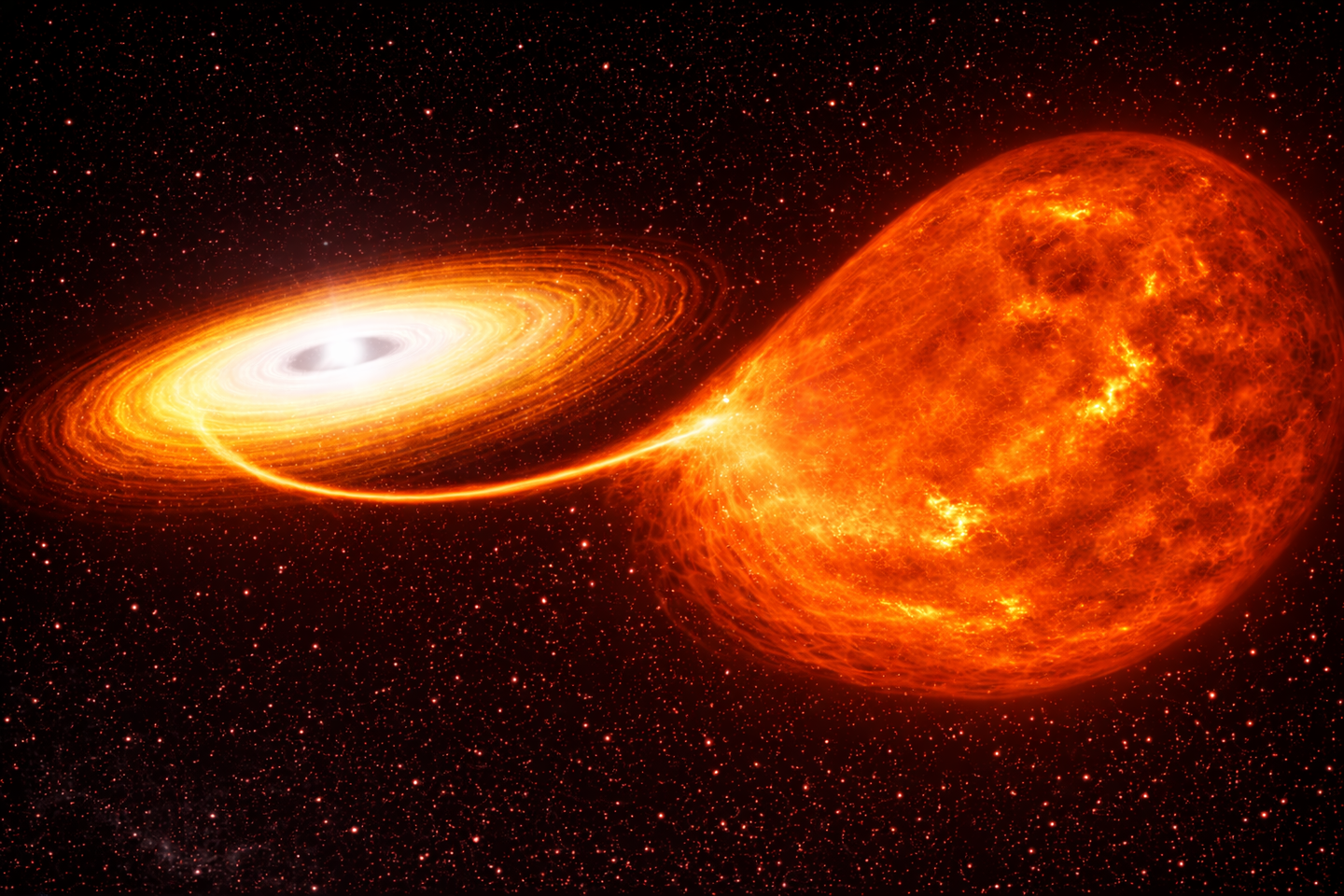
In a dusty young solar system, two giant planets are taking shape
WISPIT 2 now hosts two directly imaged forming planets, offering a rare look at how young planetary systems take shape.

 Edited By: Joshua Shavit

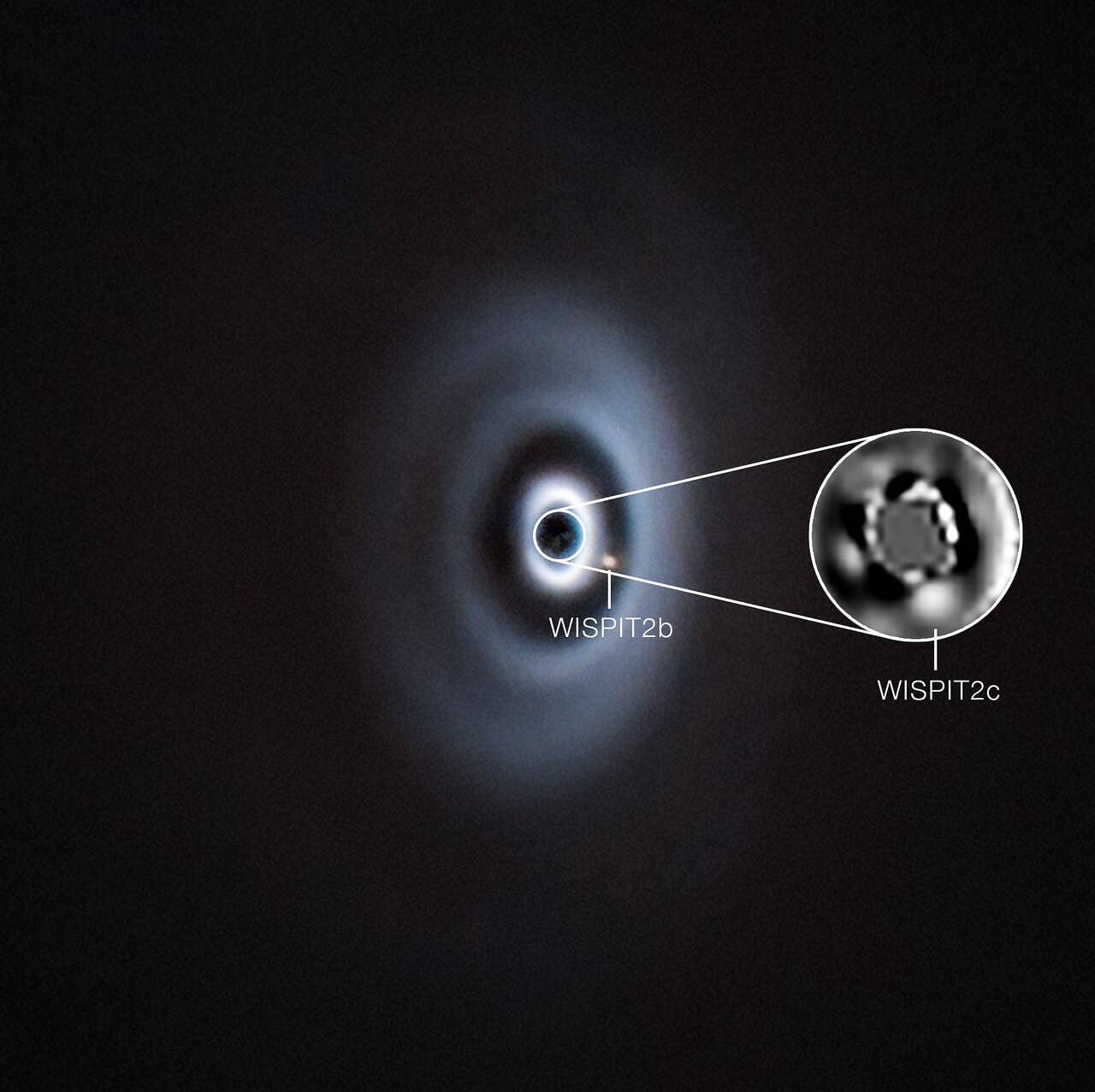
VLT images of two planets forming around the young star WISPIT 2. (CREDIT: ESO/C. Lawlor, R. F. van Capelleveen et al.)
The scene around WISPIT 2 is messy in a way that matters. Rings of dust circle the young star, gaps cut through the disc, and inside two of those openings sit giant planets still in the act of forming. For astronomers, that makes this system unusually valuable. It offers a rare look at how a planetary system comes together before the dust settles.
“WISPIT 2 is the best look into our own past that we have to date,” Chloe Lawlor, a PhD student at the University of Galway and lead author of the new study, said in a statement.
The system is about 5.1 million years old and is now only the second known case, after PDS 70, where two planets have been directly observed forming around the same star. The new work, published in The Astrophysical Journal Letters confirms the existence of the second planet, called WISPIT 2c.
That matters because WISPIT 2 is not just a star with planets. It has a broad, multi-ringed disc that looks like an active construction zone. Astronomers think the layout may resemble a young version of the Solar System, with gas giants embedded in a dusty disk.
A second planet, closer in
The first known planet in the system, WISPIT 2b, was reported last year. It has a mass of about 4.9 times Jupiter’s and orbits far from the star, at roughly 57 astronomical units. The newly confirmed WISPIT 2c sits much closer, at about 14 astronomical units, and appears to be about twice as massive as WISPIT 2b.
The team used two European Southern Observatory tools to pin that down. First, the SPHERE instrument on the Very Large Telescope captured the object in H-band observations. Then the GRAVITY+ instrument on the Very Large Telescope Interferometer helped confirm that the object was a planet rather than a dust clump or background star.
That second step was crucial. The host star outshines the planet by thousands of times, which makes the detection difficult from the ground. “Critically our study made use of the recent upgrade to GRAVITY+ without which we would not have been able to get such a clear detection of the planet so close to its star,” said co-author Guillaume Bourdarot of the Max Planck Institute for Extraterrestrial Physics.
The GRAVITY data also gave the team a spectrum, essentially a chemical fingerprint. In that spectrum they found carbon monoxide, a signal commonly associated with young giant planets. Lawlor said that was the moment the team knew the object was significant.
“When we saw it clearly in the data, that was when we knew we had something significant,” she said. “There was definitely an element of disbelief.”
What the disc is hinting at
Both planets sit inside clear gaps in the surrounding disc of gas and dust. Those gaps are not random. As planets form, they gather material and alter the disc around them, leaving behind rings and lanes that can mark where a growing planet is shaping its environment.
WISPIT 2 has more than those two gaps. The team says there is at least one smaller gap farther out in the disc, and they suspect a third planet may be carving it. Lawlor said that possible world could be about Saturn’s mass because the gap is narrower and shallower than the others.
One sentence stands out here.
WISPIT 2 may be giving astronomers a view of whole-system assembly, not just a single planet coming together. “WISPIT 2 gives us a critical laboratory not just to observe the formation of a single planet but an entire planetary system,” said Christian Ginski, a co-author and researcher at the University of Galway.
The researchers also compared WISPIT 2 with PDS 70, the only other directly imaged young multi-planet system of this kind. The two systems share some broad similarities in planet mass and spacing, though WISPIT 2 has a more extended disc. The authors suggest this may hint at a possible “Goldilocks zone” for early giant planet formation, but they are careful to describe that idea as speculative.
A rare system, with some unanswered questions
The new planet’s atmosphere appears hot and dusty. Based on model comparisons, the team estimates a likely mass range of 8 to 12 times Jupiter’s mass. It also found carbon monoxide absorption and a rising slope in part of the K-band spectrum, both signs consistent with a young gas giant.
Still, some uncertainty remains. The authors note that more high-precision measurements will be needed to pin down WISPIT 2c’s orbit. Current data suggest it is bound to the system and moving like a planet, but the exact direction of its orbit still needs confirmation. Some data hint at a retrograde path, though the researchers say a prograde orbit is more likely.
There are other limits too. The team did not detect significant H-alpha emission from WISPIT 2c, even though such emission can trace active accretion. That could mean the accretion is variable, or that dust is blocking the signal. The data also do not settle whether the planet is surrounded by a circumplanetary disk or dusty envelope.
Those loose ends are part of the appeal. WISPIT 2 is still changing, and that makes it worth watching. Ginski said future observations with ESO’s Extremely Large Telescope may even be able to directly image the suspected third planet.
Practical implications of the research
This study gives astronomers a rare chance to watch a young planetary system while its structure is still being shaped.
By tracking planets inside a dusty birth disk, researchers can test how giant planets grow, how they carve rings and gaps, and how systems like our own may have looked early on.
Research findings are available online in the The Astrophysical Journal Letters.
The original story "In a dusty young solar system, two giant planets are taking shape" is published in The Brighter Side of News.
Related Stories
- Two blazing stars once raced past the Sun and reshaped our solar system
- Historical first: Scientists observe the birth of a solar system 1,300 light-years away
- From gas giants to rocky worlds: Why planets in our solar system differ
Like these kind of feel good stories? Get The Brighter Side of News' newsletter.
Joseph Shavit
Writer, Editor-At-Large and Publisher
Joseph Shavit, based in Los Angeles, is a seasoned science journalist, editor and co-founder of The Brighter Side of News, where he transforms complex discoveries into clear, engaging stories for general readers. With vast experience at major media groups like Times Mirror and Tribune, he writes with both authority and curiosity. His writing focuses on space science, planetary science, quantum mechanics, geology. Known for linking breakthroughs to real-world markets, he highlights how research transitions into products and industries that shape daily life.