Large-scale waves are forming deep inside our Sun
Scientists detect large-scale waves inside the Sun, opening a new window into its hidden magnetic activity.
 Edited By: Joseph Shavit

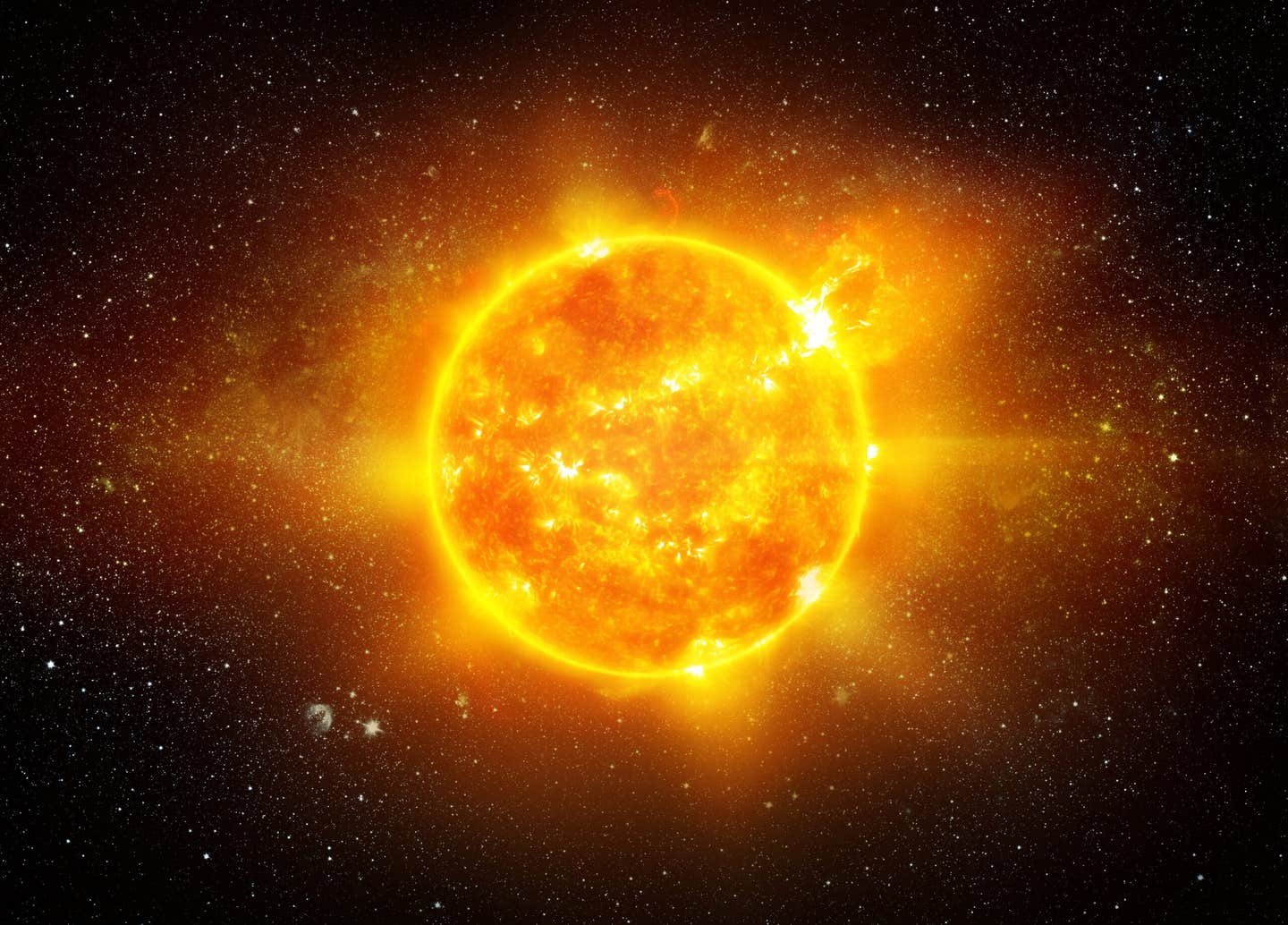
New research reveals magnetic waves deep inside the Sun, offering a way to study hidden solar processes. (CREDIT: Shutterstock)
They move through the Sun like slow, immense swells, far below anything telescopes can see.
For years, those depths have remained out of reach. Light cannot escape them, and direct measurements are impossible. Yet a new analysis suggests that the Sun’s interior is not silent. It carries large-scale waves shaped by magnetic forces, and those waves can be tracked from afar.
The work comes from researchers at NYU Abu Dhabi’s Center for Astrophysics and Space Science, who examined more than a decade of the Sun’s natural vibrations. Their findings point to a way of probing the Sun’s hidden magnetic system using motion rather than light.
Listening Instead of Looking
The Sun does not sit still. Its surface and interior constantly tremble with subtle oscillations. Scientists have long used these vibrations to study its structure, a method often compared to seismology on Earth.
This time, the focus shifted deeper. By carefully analyzing long-term data, the team identified a pattern that had gone unnoticed. The signals suggested the presence of global-scale waves moving through the Sun’s interior, influenced not just by rotation or heat, but by magnetism.
“These waves give us a unique look at the Sun’s hidden magnetic system,” said Shravan Hanasoge, co-principal investigator at the center and lead author of the study. The statement hints at a shift in approach. Instead of trying to observe magnetic fields directly, the researchers read their effects on motion.
A Magnetic Ocean Below the Surface
Beneath the Sun’s visible surface lies a vast region of hot, electrically charged gas. It churns, rotates, and responds to magnetic forces that twist and stretch through it. Those forces drive the solar cycle, shape sunspots, and power eruptions that can reach Earth.
Until now, much of that behavior has been inferred rather than observed. The newly identified waves appear to carry information from deep within this environment. As they travel, their motion reflects the magnetic conditions they encounter. By measuring how the waves shift, scientists can begin to reconstruct what lies below.
It is an indirect method, but one that opens a new window. The Sun’s magnetic field does not stay fixed. It evolves over time, building, weakening, and reversing during the solar cycle. Understanding that process requires access to regions far beneath the surface, where the field is generated and organized. That is where the waves come in.
Signals Buried in Years of Data
The discovery did not come from a single observation. It required patience. The team worked with more than ten years of vibration data, looking for patterns that persisted over time. Short-term signals can be noisy or misleading. Long-term trends carry more weight.
Somewhere in that extended record, the waves emerged. They are not small ripples. The study describes them as global in scale, meaning they extend across large portions of the Sun’s interior. Their behavior suggests a strong link to magnetic fields rather than purely thermal or mechanical processes.
That distinction matters. Magnetic forces are central to many solar phenomena, yet they remain difficult to map below the surface. A method that ties wave motion to magnetism offers a new kind of probe.
“Understanding these internal processes is crucial for predicting solar activity, which can impact satellites, communications, and power systems on Earth,” Hanasoge said.
A Different Way to Read the Sun
Traditional solar observations rely on light, whether visible, ultraviolet, or X-ray. Each reveals something about the Sun’s outer layers. None can directly expose its core dynamics. The approach here sidesteps that limitation.
Instead of imaging the interior, researchers interpret how it influences motion. Waves act as messengers. Their paths and speeds change depending on the medium they cross, including its magnetic properties. That idea is not entirely new, but applying it to these newly identified waves expands its reach.
It also changes the kind of questions scientists can ask. Rather than focusing only on surface activity, they can begin to track how magnetic structures form and evolve deep inside the Sun. That interior behavior shapes what eventually appears at the surface.
Implications Beyond One Star
The Sun serves as a test case. It is close enough to study in detail, yet complex enough to challenge existing models. Insights gained here often extend to other stars. Magnetic activity is not unique to the Sun. Many stars exhibit cycles, flares, and variability linked to their internal magnetic fields. If similar wave-based methods can be applied elsewhere, they could help explain those behaviors.
For now, the work remains focused on our own star. The findings suggest that the Sun’s interior holds more structure than previously recognized. Waves influenced by magnetism add another layer to an already dynamic system. They also provide a tool, one that does not rely on direct observation.
What Remains Uncertain
The study opens a path, but it does not answer every question. The data reveal the presence of waves and their connection to magnetic fields. They do not fully map those fields or explain every detail of their evolution. More analysis will be needed to refine the picture.
Long-term observations will remain important. Patterns that develop over years or decades can clarify how the system changes over time. There is also the challenge of interpretation. Translating wave behavior into precise magnetic structures is complex. It requires models that can connect motion to field strength and geometry. Those models are still developing.
A Quiet Signal with Wide Reach
The Sun’s influence extends far beyond its surface. Solar activity can disrupt satellites, interfere with communications, and affect power systems on Earth. Predicting that activity depends on understanding its origins.
That brings attention back to the interior. If magnetic processes deep within the Sun can be tracked through waves, forecasting may improve. Subtle shifts in those signals could offer early clues about changes in solar behavior. The idea remains in its early stages, but it carries promise. The Sun, in this view, becomes less opaque. Not fully transparent, but more readable than before.
Practical Implications of the Research
This approach offers a new way to monitor the Sun’s internal magnetic activity without direct observation.
By tracking wave behavior over time, scientists may improve predictions of solar events that affect technology on Earth.
It also provides a framework for studying magnetic processes in other stars, using motion as a proxy for otherwise hidden dynamics.
Research findings are available online in the journal Nature.
The original story "Large-scale waves are forming deep inside our Sun" is published in The Brighter Side of News.
Related Stories
- The Sun could be one of thousands of solar twins moving through the Milky Way
- Earth’s distance from the Sun found to dramatically alter seasons
- Astronomers find clearest evidence yet of a dark matter subhalo near the Sun
Like these kind of feel good stories? Get The Brighter Side of News' newsletter.
Joseph Shavit
Writer, Editor-At-Large and Publisher
Joseph Shavit, based in Los Angeles, is a seasoned science journalist, editor and co-founder of The Brighter Side of News, where he transforms complex discoveries into clear, engaging stories for general readers. With vast experience at major media groups like Times Mirror and Tribune, he writes with both authority and curiosity. His writing focuses on space science, planetary science, quantum mechanics, geology. Known for linking breakthroughs to real-world markets, he highlights how research transitions into products and industries that shape daily life.