Laser power stations could keep lunar missions running in permanent darkness
Harbin Institute of Technology researchers developed an optimization framework for laser power networks at the lunar south pole.

 Edited By: Joshua Shavit

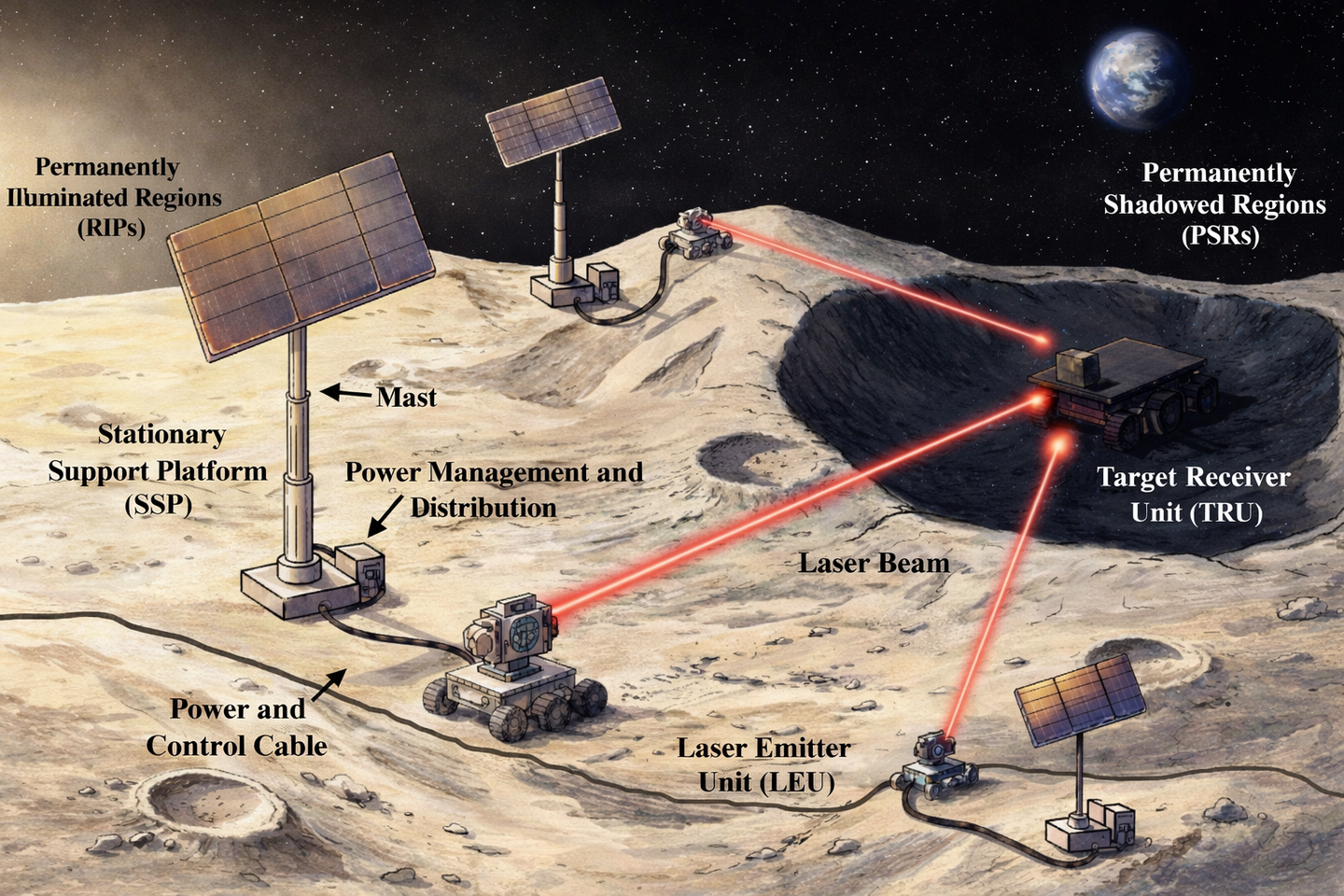
New modeling shows laser power networks could better connect and energize the Moon’s shadowed south pole craters. (CREDIT: HIGHER EDUCATION PRESS)
Cold, dark crater floors near the Moon’s south pole may hold one of space exploration’s most useful prizes: water ice. Yet those same places sit in permanent darkness, with temperatures dropping below minus 230 degrees Celsius, which makes ordinary solar power a poor fit for missions that want to work there for long stretches.
That mismatch has turned lunar power into a problem of geography. The ridges and high points around the south pole receive near-continuous sunlight, while the crater floors that interest scientists most do not. A study in Planet by Professor Lifang Li and Pengzhen Guo’s team at the Harbin Institute of Technology takes aim at that split by asking a practical question: where should laser power stations go if future rovers and equipment are going to work inside those shadowed regions?
Rather than treating power delivery as a single beam sent from one spot to another, the team modeled it as a coordinated network spread across the terrain near Shackleton Crater.
A power map, not a single beam
The study focuses on laser wireless power transmission, or LWPT, a system in which solar energy collected in sunlit areas is converted into laser beams and sent across the lunar surface to receivers on rovers or fixed equipment. The appeal is straightforward. It avoids long cables, reduces dependence on batteries, and can direct energy into places sunlight never reaches.
What makes the problem hard is the terrain itself. Shackleton’s surroundings are full of ridges, slopes, and obstructions that can block line-of-sight transmission. Dust can also weaken the beam through absorption and scattering. A site that looks ideal because it gets plenty of light may still do a poor job of sending power where it is needed.
So the Harbin team built a terrain-aware optimization model using high-resolution topographic data from NASA’s Lunar Orbiter Laser Altimeter, or LOLA. Their framework accounted for local illumination, beam divergence, pointing errors, terrain blockage, and lunar dust attenuation. It also used a split architecture: fixed support platforms would gather solar energy, while laser emitter units could be repositioned locally to find better transmission angles.
That last detail mattered. The model did not just ask which sites should be selected. It also asked exactly where, within a local area around those sites, the laser units should sit.
Coverage is not enough
The researchers set up the problem around three goals that push against one another. One was coverage, meaning how much useful area in the permanently shadowed regions could receive enough power. Another was connectivity, meaning whether those powered areas formed one large, continuous region or a patchwork of isolated pockets. The third was cost, represented here by the number of deployed stations.
To solve that trade-off, the team used a Multi-Objective Genetic Algorithm, with the NSGA-II method as the core solver. In plain terms, the system searched through many possible layouts and kept the ones that best balanced broad coverage, strong connectivity, and a limited number of stations.
The study area included nine candidate support platform sites in three high-illumination zones near Shackleton Crater. Each site was assumed to have a 10-meter mast and illumination rates above 85 percent. The team set a 60-watt power threshold for receiving units, linking that number to the power needs of scientific instruments on NASA’s VIPER rover and on Curiosity.
The baseline case was simple: pick the three sites with the best local illumination and do no fine-tuning. That approach performed badly. Across 441.34 square kilometers of valid terrain, it covered 47.48 square kilometers, an effective coverage rate of 10.76 percent. Regional connectivity was just 39.93 percent, leaving what the researchers described as fragmented, island-like patches of powered ground.
The better answer was less obvious
After 100 iterations, the optimization produced a set of trade-off solutions. One of them, chosen with the TOPSIS decision method, delivered a much stronger balance. Instead of choosing sites 1, 4, and 7, the model selected sites 3, 5, and 6, then shifted the laser emitter units by tens of meters from their original positions.
That changed the shape of the powered terrain. Effective coverage rose from 10.76 percent to 27.55 percent. Connectivity jumped from 39.93 percent to 98.92 percent. Areas that had been isolated became part of a broad, nearly continuous network. The overlap between stations also expanded, which the paper says would improve fault tolerance because a receiver could still get power from another station if one unit failed.
The paper also found something less intuitive. Adding more stations does not automatically improve the network. In some cases, coverage increases while connectivity drops because new stations create fresh power “islands” away from the main network. That means lunar planners cannot judge a system by area alone.
The study stops short of claiming the problem is solved. Its model uses annual average illumination rather than changing light conditions over time. It also includes dust attenuation in the beam path, but not the long-term effects of dust settling onto optical or photovoltaic surfaces. The authors say future work should include time-varying illumination, multi-rover power supply scenarios, and high-fidelity physical simulation testbeds.
Practical implications of the research
This work gives mission planners a clearer way to think about powering the Moon’s darkest terrain.
It suggests that successful lunar energy systems will depend not just on strong hardware, but on careful placement across real terrain.
For future rovers, ice prospecting systems, and fixed installations in permanently shadowed regions, that could make the difference between scattered short missions and sustained operations.
Research findings are available online in the journal Planet.
The original story "Laser power stations could keep lunar missions running in permanent darkness" is published in The Brighter Side of News.
Related Stories
- Solar cells made from moon dust could power future space missions
- Superionic form of water may power planetary magnetic fields
- Solar power from space could help Europe reach net-zero emissions by 2050
Like these kind of feel good stories? Get The Brighter Side of News' newsletter.
Joseph Shavit
Writer, Editor-At-Large and Publisher
Joseph Shavit, based in Los Angeles, is a seasoned science journalist, editor and co-founder of The Brighter Side of News, where he transforms complex discoveries into clear, engaging stories for general readers. With vast experience at major media groups like Times Mirror and Tribune, he writes with both authority and curiosity. His writing focuses on space science, planetary science, quantum mechanics, geology. Known for linking breakthroughs to real-world markets, he highlights how research transitions into products and industries that shape daily life.