Lightning bolts on Jupiter are up to 100 times stronger than Earth’s
A rare lull in Jupiter’s storms gave scientists their clearest look yet at the planet’s lightning, and the results are electrifying.

 Edited By: Joshua Shavit

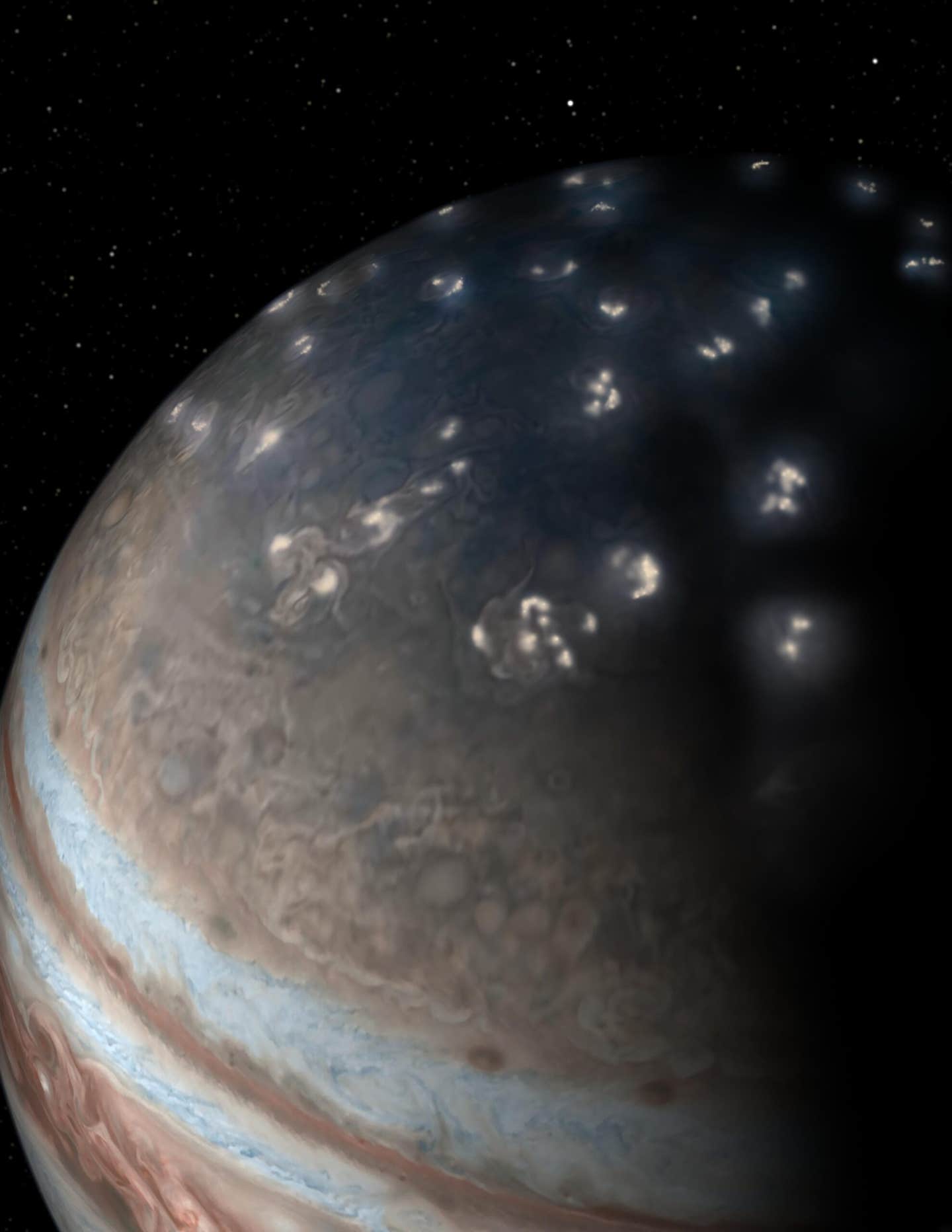
Scientists used NASA’s Juno to measure Jupiter lightning power during rare isolated storms. Artist’s concept of lightning distribution in Jupiter’s northern hemisphere. (CREDIT: NASA/JPL-Caltech/SwRI/JunoCam)
On Jupiter, a storm doesn't just brew, it can simmer for centuries. The planet's atmosphere is a perpetual engine of turbulence, and somewhere inside those churning cloud bands, lightning is cracking with a force that dwarfs anything the Earth has ever managed. Just how much force has been, until recently, surprisingly hard to measure.
A study published March 20 in the journal AGU Advances by planetary scientist Michael Wong and colleagues at UC Berkeley's Space Sciences Laboratory finally puts some numbers to it, and the range is staggering. Depending on how you account for the physics of radio emissions across different frequency ranges, bolts on Jupiter could be anywhere from comparable to terrestrial lightning to a million times more powerful.
A lull that became an opening
The measurement problem was one of noise, not signal. Jupiter's storms erupt across wide atmospheric bands simultaneously, and when lightning fires from multiple locations at once, pinpointing the source of any given bolt is nearly impossible. Measuring power without knowing where the flash came from is like trying to estimate the size of a firecracker by its bang alone, without knowing if it went off across the room or down the block.
Then, between 2021 and 2022, something unusual happened. The North Equatorial Belt, one of the planet's most storm-prone regions, went quiet. Nearly all convective activity stopped. When storms began returning, they appeared sporadically, concentrated at a single drifting location.
Wong called these "stealth superstorms," a term acknowledging their paradoxical nature: they behaved like the planet's most intense eruptions in many respects, reshaping clouds across wide swaths of the atmosphere for months, but their cloud towers never reached the soaring heights typical of true superstorms.
That relative modesty turned out to be scientifically useful.
With storms isolated enough to track individually, Wong's team used the Hubble Space Telescope, Juno's onboard camera, and images contributed by amateur astronomers to pin down storm locations with precision. This gave them what they'd been missing: a fixed reference point.
Listening from orbit
NASA's Juno spacecraft, which has circled Jupiter since 2016, carries a microwave radiometer designed to probe the planet's deep atmosphere. It wasn't built to study lightning. But lightning produces microwave emissions, and Juno's instrument picks them up, sidestepping the problem of cloud cover that obscures optical measurements. The clouds that block a camera mean nothing to a radiometer.
Over 12 passes above the isolated stealth superstorms, Juno was close enough on four of them to detect microwave static from lightning. The flashes averaged three per second. On one flyover, the spacecraft registered 206 separate pulses of microwave radiation. Across all four passes, a total of 613 pulses were logged.
What made the stealth superstorm data uniquely valuable was that the source location was no longer a mystery. Knowing exactly where the storm sat let the team calculate precisely how far the signal had traveled and how much the instrument's antenna had attenuated it. From there, they could work backward to the actual power at the source.
The range they found was enormous. Most pulses clustered in a distribution that looked lognormal, a statistical shape common in natural phenomena where many small factors multiply together. The typical bolt fell somewhere between comparable to an Earth flash and about 100 times stronger. A handful of outliers reached far higher. One pulse registered an equivalent isotropic radiated power of 5.3 megawatts, a candidate for what the team terms a "Jovian radio superbolt."
Why Jupiter's storms hit harder
The physics behind Jovian lightning's intensity comes down to atmosphere. Earth's air is mostly nitrogen, which is heavier than water vapor, so moist air here is buoyant. It rises relatively easily, and storms build with that assistance.
On Jupiter, the atmosphere is dominated by hydrogen, which is lighter than water. Moist air on Jupiter is actually heavier than the surrounding atmosphere, which means it takes an enormous amount of energy to push a storm upward. But when it finally gets there, everything releases at once.
The result is storms that can rise more than 100 kilometers, compared to about 10 kilometers for Earth's tallest thunderheads. The electrical charge separation driving lightning likely happens through a process broadly similar to what occurs here: water vapor rises, condenses into droplets and ice crystals, and the particles collide and charge. On Jupiter, ammonia is also involved, combining with water to form what some researchers call "mushballs," icy slush that falls like hail while carrying electrical charge.
The precise mechanism connecting all this to lightning more powerful than Earth's remains unsettled. Whether the key factor is the hydrogen atmosphere, the sheer height of the storms, or the greater heat energy that accumulates before a storm can even begin is still an open question, Wong says.
Co-author Ivana Kolmašová, a space physicist at Charles University in Prague and a member of the Czech Academy of Sciences, noted that converting microwave power to total energy released is not a direct calculation. Lightning radiates across the full electromagnetic spectrum, and the microwave piece is only one slice.
On Earth, a single bolt releases roughly a billion joules of total energy, enough to power 200 average homes for an hour. Wong estimates the energy in a Jovian bolt ranges from 500 to perhaps 10,000 times that amount.
There's uncertainty built into these comparisons. The study compared Earth and Jupiter emissions at different radio wavelengths, and the scaling between those frequencies is not perfectly understood.
What this research opens up
The practical value of mapping lightning on Jupiter extends beyond curiosity about an alien planet. Lightning is a tracer of convection, the atmospheric churning that transports heat from a planet's interior outward. On Jupiter, where internal heat plays a significant role in driving the weather, understanding convection helps clarify how the planet's energy budget works over time.
On Earth, convection and the storms it drives remain imperfectly understood despite centuries of study. Wong noted that scientists have only recently identified several new categories of short-lived electrical phenomena above terrestrial thunderstorms, and there may be more to find.
Studying Jupiter's more extreme version of the same basic process offers a high-contrast comparison that could illuminate what's still missing from our models of how atmospheres, on any planet, move heat and generate electricity.
Research findings are available online in the journal AGU Advances.
The original story "Lightning bolts on Jupiter are up to 100 times stronger than Earth's" is published in The Brighter Side of News.
Related Stories
- Researchers find Jupiter holds 1.5x more oxygen than the Sun
- How a young Jupiter saved Earth from falling into the Sun
- How old is Jupiter? Tiny molten spheres embedded in meteorites have the answer
Like these kind of feel good stories? Get The Brighter Side of News' newsletter.
Joseph Shavit
Writer, Editor-At-Large and Publisher
Joseph Shavit, based in Los Angeles, is a seasoned science journalist, editor and co-founder of The Brighter Side of News, where he transforms complex discoveries into clear, engaging stories for general readers. With vast experience at major media groups like Times Mirror and Tribune, he writes with both authority and curiosity. His writing focuses on space science, planetary science, quantum mechanics, geology. Known for linking breakthroughs to real-world markets, he highlights how research transitions into products and industries that shape daily life.