Lion-sized armadillo, ancient tortoises: Ice Age creatures discovered in Central Texas
Snorkeling through a flooded Texas cave, a paleontologist found Ice Age animals that had never been documented in Central Texas before.

 Edited By: Joseph Shavit

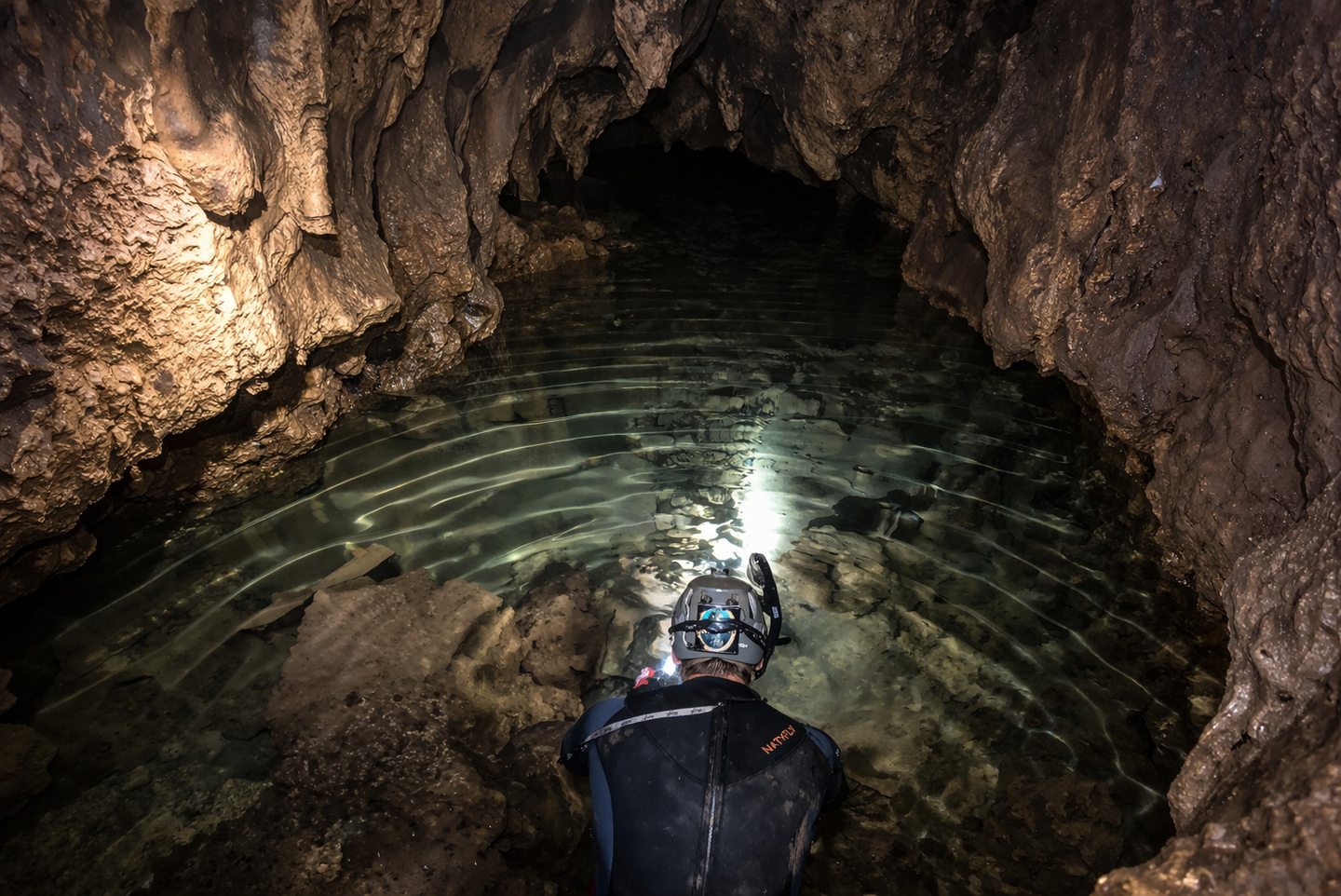
A paleontologist snorkeling an underground stream in Texas found Ice Age fossils never before seen in Central Texas. (CREDIT: Quaternary Research / AI-enhanced for aspect ratio)
The floor of Bender's Cave looked like a graveyard. Fossils spread across the submerged stream bed in every direction, packed tightly enough that paleontologist John Moretti could barely move without disturbing them. He was wearing a snorkel mask.
"There were fossils everywhere, just everywhere, in a way that I haven't seen in any other cave," said Moretti, who recently completed his doctoral degree at the UT Jackson School of Geosciences. "It was just bones all over the floor."
What Moretti pulled from that underground stream in Comal County turned out to be far more unusual than a typical Ice Age bone haul. Among the finds were shell fragments from a giant tortoise and armor plates from a pampathere, an armadillo relative roughly the size of a lion. Neither species had ever been documented in Central Texas before. The research was published in the journal Quaternary Research.
The cave itself sits beneath private land and carries an active underground stream connected to the Trinity Aquifer system. Moretti and co-author John Young, a local caver, made six trips into the cave between March 2023 and November 2024, dividing the stream passage into 21 sampling zones and collecting fossils by hand from the underwater gravel. No excavation needed. The bones were simply lying there.
A Different Kind of Fossil Site
Water caves are common throughout the karst limestone of the Edwards Plateau, which stretches across much of Central Texas. But despite nearly a century of paleontology work in the region, no one had formally studied the fossils sitting in these underground rivers. Water caves are, in some ways, difficult places to do science. The stream level fluctuates with rainfall. Access requires rappelling into sinkholes. And without stable sediment layers, pinning down the age of the bones is genuinely hard.
Moretti estimates the Bender's Cave fossils are late Pleistocene, likely older than 20,000 years. The more intriguing possibility, which he describes carefully, is that they could date to the last interglacial period, a warm interval that peaked around 125,000 years ago and is known in geological terms as Marine Isotope Stage 5. If so, they would fill a conspicuous gap.
"This site is showing us something different, and that's really important because of all the work that's been done in this region," Moretti said. "If it is interglacial in age, it's a new window into the past and into a landscape, environment, and animal community that we haven't observed in this part of Texas before."
Other notable finds from the cave include claws from a Jefferson's ground sloth, teeth from saber-tooth cats, bones from camels, horses, bison, and mammoths, and fragments from mastodons. The bones are polished, reddish-brown, and heavily mineralized, suggesting they entered the cave roughly together, swept in through sinkholes during flooding events. Two bone samples submitted for radiocarbon dating lacked usable collagen, and the one date that came back was almost certainly contaminated by carbonate-rich groundwater.
What the Animals Suggest
The real argument for an interglacial age comes from the animals themselves. The pampathere and giant tortoise needed warm temperatures to survive. The ground sloth and mastodon were forest browsers, dependent on woody vegetation. Central Texas during the last glacial maximum, roughly 20,000 years ago, was an open grassland in a cool, relatively dry climate. There would have been little room for them.
During warmer interglacial periods, the region may have supported forests, a warmer climate, and the animals that came with both. That's exactly the combination seen at coastal and north Texas sites, like Ingleside and Moore Pit, which are interpreted as interglacial in age and contain the same four species found at Bender's Cave.
To put numbers behind this intuition, Moretti ran a hierarchical cluster analysis comparing the fossil composition at 43 Texas sites from the Late Pleistocene. The algorithm grouped Bender's Cave with sites from the last interglacial, not with the younger Central Texas caves that share its geography.
David Ledesma, an assistant professor at St. Edward's University who was not part of the study, said the results were genuinely surprising. "Some of the fossils that John has come across are species that we didn't think would occur in this part of Texas," he said. "That we're still learning new things and finding new things is quite exciting."
Practical Implications
The limitations of the study are real. The fossils in a cave stream are not sealed in sediment like those in a dry cave deposit. They can mix across time, and without reliable radiometric dates, the ages remain uncertain. Moretti acknowledges that the assemblage could represent multiple time intervals rather than a single snapshot. New dating approaches, including uranium-thorium dating of speleothems and coupled uranium-series and electron spin resonance dating of fossil teeth, are underway.
But even before those results come in, the cave matters. If the four novel species really did live in Central Texas during a warm interglacial period, the regional fossil record has a significant gap in it, one that existing sites were unable to detect. That has direct consequences for how scientists understand the habitat diversity of Pleistocene Texas, and possibly for how they model the relationship between climate and large mammal distributions more broadly.
It also has a more immediate message for land stewardship. Most caves in Texas sit on private land. Moretti was only able to conduct this research because local landowners gave access and donated the fossils to the Jackson School Museum.
"These connections and partnerships make possible a lot of the natural science that gets done in Texas," he said. "It takes contributions from everyone, not just scientists at universities, to learn about the natural world we live in and depend on."
Research findings are available online in the journal Quaternary Research.
The original story "Lion-sized armadillo, ancient tortoises: Ice age creatures discovered in Central Texas" is published in The Brighter Side of News.
Related Stories
- Did an exploding comet end the age of the wooly mammoths? New evidence says yes
- Hippos in the Ice Age: Ancient DNA rewrite Europe’s wildlife story
- New study reveals how mammals evolved to survive the ice age
Like these kind of feel good stories? Get The Brighter Side of News' newsletter.
Hannah Shavit-Weiner
Medical & Health Writer
Hannah Shavit-Weiner is a Los Angeles–based medical and health journalist for The Brighter Side of News, an online publication focused on uplifting, transformative stories from around the globe. Passionate about spotlighting groundbreaking discoveries and innovations, Hannah covers a broad spectrum of topics—from medical breakthroughs and health information to animal science. With a talent for making complex science clear and compelling, she connects readers to the advancements shaping a brighter, more hopeful future.