MeerKAT discovers largest-ever cosmic laser 8 billion light-years away
A pair of galaxies that are merging far away in space has been magnified by gravity, making it easier to see from Earth.

 Edited By: Joseph Shavit

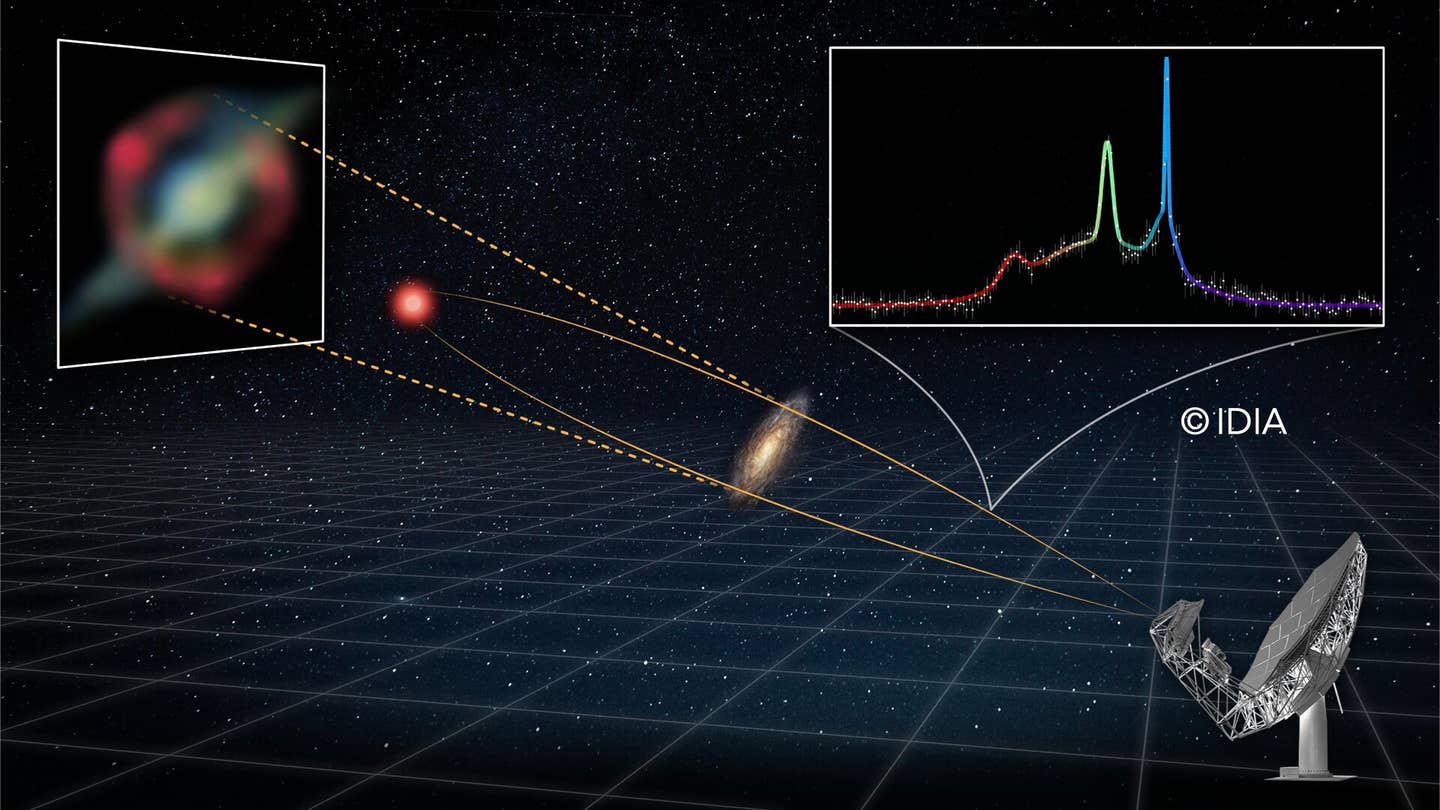
Illustration of the distant galaxy 8 billion light-years away (red), magnified by an unrelated foreground disk galaxy, resulting in a red ring. Splitting up the radio light into different colors, as a prism does, reveals the hydroxyl gigamaser (top-right rainbow-colored line). (CREDIT: Inter-University Institute for Data-Intensive Astronomy (IDIA))
A razor-thin spike of radio light, tuned to a wavelength of about 18 centimeters, just traveled more than 8 billion light-years and still arrived loud enough to stand out in MeerKAT’s data.
That signal comes from HATLAS J142935.3–002836, also called H1429-0028, a violently merging, gas-rich system at redshift z = 1.027. In new MeerKAT observations, astronomers detected hydroxyl (OH) maser emission from the galaxy, making it the highest-redshift hydroxyl megamaser yet found.
The team’s paper has been accepted for publication in Monthly Notices of the Royal Astronomical Society Letters, with a preprint posted on arXiv.
A “space laser” that works in radio
Hydroxyl megamasers are sometimes described as “space lasers,” but they operate at radio frequencies rather than visible light. The basic idea is still familiar: you need the right conditions to invert a molecular population so that passing photons get amplified into a bright, coherent signal.
For OH megamasers, earlier work has shown those conditions tend to appear in the dense, dusty central regions of luminous and ultra-luminous infrared galaxies, many of them major merger systems. They also rely on a strong far-infrared radiation field that pumps the hydroxyl molecules and helps sustain the inversion needed for stimulated emission.
The MeerKAT detection is striking because H1429-0028 sits far enough away that you are seeing it when the universe was less than half its current age. The system also lands at the extreme bright end of the class. The study reports an integrated apparent OH luminosity of log(μ L_OH / L⊙) = 5.51 ± 0.67. Even if you assume a near-infrared magnification factor of roughly μ ~ 10, the source remains among the most luminous known, with log(L_OH / L⊙) = 4.5.
The spectrum itself is not a simple single bump. Bayesian model selection favored a five-Gaussian fit to the line profile. One narrow component has a full-width half-maximum of ΔV = 7.05 ± 1.27 km s⁻1, sitting alongside broader emission, including a component with ΔV = 315 ± 10 km s⁻1.
A foreground galaxy turns into a lens
The signal did not make the trip alone. It also passed through a cosmic magnifying glass.
"This system is truly extraordinary," said Dr. Thato Manamela, postdoctoral researcher at the University of Pretoria and lead author of the new study.
"We are seeing the radio equivalent of a laser halfway across the universe. Not only that, during its journey to Earth, the radio waves are further amplified by a perfectly aligned, yet unrelated foreground galaxy. This galaxy acts as a lens, the way a water droplet on a windowpane would, because its mass curves the local space-time.
"So we have a radio laser passing through a cosmic telescope before being detected by the powerful MeerKAT radio telescope—all together enabling a wonderfully serendipitous discovery."
That foreground lens is a disk galaxy viewed edge-on at redshift z = 0.218. Previous modeling of the system found an Einstein ring close to complete, with an angular scale of about 0.7 arcseconds. Using a lens model from Calanog et al. (2014), the new study adopts a Single Isothermal Ellipsoid profile with Einstein radius θE = 0.738 arcsec, an axis ratio q = 0.792, and a position angle θ = −51.0 deg (east of north), with small offsets between the lens center and the brightest foreground light.
The lensing is not just a convenient boost. It also complicates interpretation. The study notes that MeerKAT’s angular resolution at these frequencies is about 10 arcseconds, and the OH emission is unresolved. That limits what can be said about where, exactly, the maser originates within the merging system, and how much each component is magnified. Still, the lens model allows the team to explore plausible magnification ranges, including cases where compact regions near a caustic could be boosted far more than the galaxy’s diffuse emission.
Turning terabytes into a spectrum
MeerKAT observed H1429-0028 from April 13 to 16, 2021, using 62 of its 64 antennas in the 544 to 1088 MHz band. The team used one six-hour track with about 4.7 hours on source, splitting the signal into 32,768 channels for fine spectral resolution.
Extracting the line required careful data work. The study describes using the Oxkat pipeline for calibration and interference excision, then “peeling” two bright continuum sources from the field with CubiCal before spectral-line imaging with wsclean. After imaging, the team reports a circularized point-spread function with full-width half-maximum of 32.08 arcseconds and a median per-channel rms noise of σ = 362 μJy beam⁻1 at 16.6 kHz resolution.
"This result is a powerful demonstration of what MeerKAT can do when paired with advanced computational infrastructure, fit-for-purpose data processing pipelines, and highly trained software support personnel," said Prof Roger Deane, co-author of the study and Director of the Inter-University Institute for Data Intensive Astronomy (IDIA), as well as Professor at the Universities of Cape Town and Pretoria.
"This synergistic combination empowers young South African scientists, like Dr. Manamela, to lead cutting-edge science and compete with the best in the world."
A hint of outflow, and a reminder of limits
The MeerKAT data also show H i absorption. Bayesian model selection favored a two-component model with centroid velocities of Vc = −36.3 ± 2.0 and 18.1 ± 3.7 km s⁻1. The components have similar widths, FWHM 38.2 ± 3.6 and 44.1 ± 5.9 km s⁻1, and peak depths of −0.58 ± 0.03 and −0.44 ± 0.05 mJy.
Assuming a spin temperature Ts = 100 K and covering factor fc = 1, the study estimates H i column densities of 1.21 × 10²¹ and 1.09 × 10²¹ cm⁻2. When the authors compare the absorption to OH emission, and to prior CO and [C i] measurements from Messias et al. (2014), they note that the two brightest OH peaks are blueshifted relative to the colder gas tracers. They suggest the OH may be tracing a warm molecular outflow, but they also lay out alternative explanations, including multiple maser components tied to two merging nuclei, plus the extra confusion introduced by differential lensing magnification.
A second uncertainty sits in the galaxy’s power source. The study reports a far-infrared to radio ratio qFIR = 2.2 ± 0.2, within 2σ of the median for star-forming galaxies in Ivison et al. (2010), and notes that it cannot exclude contamination from the foreground lens or differential magnification between an active nucleus and star formation. The measured dust temperature is reported as Tdust ~ 40.7 K (Ma et al., 2018), and the authors note that this may not reflect temperatures in the nuclear region where OH emission is expected.
Dr. Manamela puts the larger ambition plainly: "This is just the beginning. We don't want to find just one system—we want to find hundreds to thousands. Here at the University of Pretoria, we are carrying out systematic surveys of the universe, building the required computational pipelines and algorithms to open this observational frontier ahead of, and ultimately with, the Square Kilometer Array."
Practical implications of the research
Bright, lensed OH masers like the one in H1429-0028 can serve as long-range signposts for extreme galaxy mergers, in an era when many key processes, like rapid star formation and black hole growth, were more common.
The same searches that find these “radio lasers” can also flag strongly lensed systems worth deeper follow-up. The study also highlights a bottleneck that is not a telescope dish at all.
Building reliable calibration, imaging, and modeling pipelines can turn vast MeerKAT surveys into clean spectral detections, and do it repeatedly as the Square Kilometre Array era approaches.
Research findings are available online in the journal Monthly Notices of the Royal Astronomical Society Letters.
The original story "MeerKAT discovers largest-ever cosmic laser 8 billion light-years away" is published in The Brighter Side of News.
Related Stories
- JWST confirmed the most distant galaxy ever observed at 13.5 billion light years away
- Gigantic ‘Bubble of Galaxies’ found stretching across billions of light years
- Previously unseen phenomenon spotted in galaxy 12.9 billion light-years away
Like these kind of feel good stories? Get The Brighter Side of News' newsletter.
Joshua Shavit
Writer and Editor
Joshua Shavit is a NorCal-based science and technology writer with a passion for exploring the breakthroughs shaping the future. As a co-founder of The Brighter Side of News, he focuses on positive and transformative advancements in technology, physics, engineering, robotics, and astronomy. Joshua's work highlights the innovators behind the ideas, bringing readers closer to the people driving progress.