Metal tubes stay afloat even after severe damage — opening the door to unsinkable ships
Engineers at the University of Rochester have created superhydrophobic aluminum tubes that stay afloat even when punctured.

 Edited By: Joseph Shavit

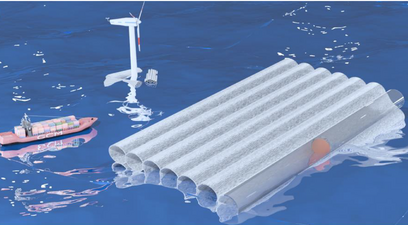
Schematic of a floating device made of SH Al tubes. (CREDIT: Advanced Functional Materials)
More than a century after the RMS Titanic slipped beneath the Atlantic, engineers still chase the dream of ships that refuse to sink. At the University of Rochester’s Institute of Optics, that goal now looks less like fantasy and more like physics.
Chunlei Guo, a professor of optics and physics and a senior scientist at the Laboratory for Laser Energetics, leads a team that has found a way to make ordinary aluminum tubes float no matter what. Their study, published in Advanced Functional Materials, describes a method that turns simple metal into a powerful water-repelling structure.
The idea sounds simple. The science behind it is not. By using lasers to etch the inner surface of aluminum tubes, the researchers create tiny pits at the micro and nano scale. Those pits change how water interacts with the metal.
Instead of soaking in, water beads up and rolls away. The treated surface becomes superhydrophobic, meaning it strongly repels water and stays dry.
How Trapped Air Keeps Metal Afloat
When one of these treated tubes enters water, something unusual happens. The textured surface traps a stable bubble of air inside the tube. That trapped air acts like a built-in life jacket.
Even if the tube is forced underwater, it pops back up. The air pocket prevents water from filling the tube and dragging it down. The effect mirrors tricks seen in nature. Diving bell spiders carry air bubbles underwater to breathe. Fire ants cling together in floating rafts because their bodies repel water.
“Importantly, we added a divider to the middle of the tube so that even if you push it vertically into the water, the bubble of air remains trapped inside and the tube retains its floating ability,” Guo says.
That divider solves a major weakness seen in earlier designs. Without it, air could escape if the object tilted at sharp angles. The new structure keeps air sealed inside even under stress.
Built To Withstand Rough Seas
This is not the team’s first attempt at water-repelling floaters. In 2019, the lab created buoyant devices made from two superhydrophobic disks sealed together. Those early models worked, but they struggled under extreme tilting.
The tube design changes that. It adds strength and stability while keeping the water-repelling surface.
“We tested them in some really rough environments for weeks at a time and found no degradation to their buoyancy,” Guo says. “You can poke big holes in them, and we showed that even if you severely damage the tubes with as many holes as you can punch, they still float.”
In lab tests, the team forced the tubes underwater, slammed them with waves, and tilted them at sharp angles. The tubes resurfaced every time. Even heavy structural damage did not sink them.
The researchers built tubes up to nearly half a meter long. They say scaling up to larger sizes should not pose major barriers. That opens the door to serious marine applications.
From Floating Rafts To Power Generation
One tube floats. Link several together, and you have a raft. Connect many more, and you begin to see the outline of floating platforms, buoys, or even large vessels.
The team demonstrated that assemblies of these tubes can support weight while staying buoyant. Because the tubes resist mechanical wear and environmental stress, they hold up in harsh water conditions.
The researchers also built a small floating generator powered by water movement. As waves move the raft, mechanical motion converts that energy into electricity. This proof-of-concept shows how the design could help harvest ocean wave or tidal energy.
The concept combines strength and simplicity. Instead of relying on sealed chambers that fail when cracked, these tubes use surface physics to stay afloat. Even when damaged, the trapped air keeps doing its job.
The approach may also lower maintenance costs. Traditional floating systems often need repairs after storms or impacts. These tubes remain buoyant even after heavy abuse.
Practical Implications of the Research
This research could change how floating systems are built. Strong, unsinkable components may improve safety for ships, offshore platforms, and rescue equipment. Structures built from these tubes would be harder to sink, even if damaged.
The technology may also support renewable energy efforts. Floating wave and tidal generators built from durable, self-floating tubes could provide steady power from the ocean. Because the design resists wear and water damage, it could lower repair costs and extend equipment life.
Beyond marine uses, the work expands how scientists think about materials. By carefully shaping surfaces at tiny scales, researchers can control how materials behave in water. That insight could influence designs in engineering, energy, and environmental systems.
The dream of an unsinkable ship still faces many hurdles. But this work shows that physics can give metal an unexpected advantage. In the right design, even damaged aluminum refuses to go down.
Research findings are available online in the journal Advanced Functional Materials.
The original story "Metal tubes stay afloat even after severe damage — opening the door to unsinkable ships" is published in The Brighter Side of News.
Related Stories
- Newly discovered quantum state revolutionizes material science
- 'Einstein Shape' tiles will revolutionize material science
- New carbon discovery will revolutionize material science, study finds
Like these kind of feel good stories? Get The Brighter Side of News' newsletter.
Shy Cohen
Writer