Nanoparticle discovery could unlock universal immunotherapy for cancer
A new dual-function nanoparticle re-energizes exhausted T cells and clears solid tumors, with effects that spread to untreated tumors elsewhere in the body.

 Edited By: Joseph Shavit

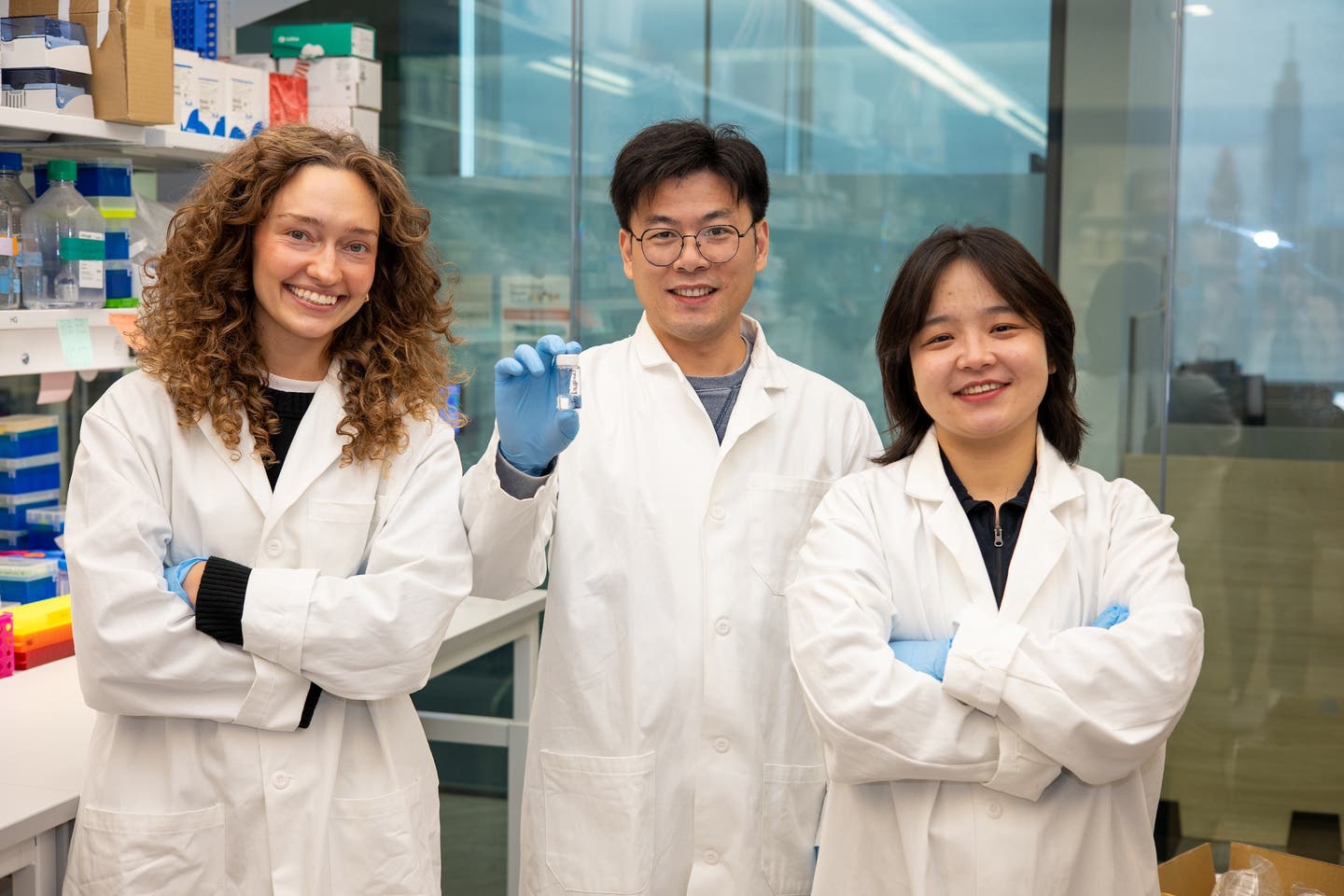
Penn engineers built a nanoparticle that blocks tumor immune suppression and activates T cells simultaneously. (CREDIT: Bella Ciervo)
T cells are supposed to be relentless. These white blood cells patrol the body, identify threats, and destroy them. But inside solid tumors, something goes wrong. The tumor environment is hostile by design, flooding immune cells with suppressive signals and starving them of resources. Over time, T cells exposed to cancer lose their capacity to fight, entering a state researchers call exhaustion. They're still there, still present, but functionally spent.
Reversing that exhaustion has been one of the central challenges in cancer immunotherapy, particularly for tumors growing within organs. In these organs, existing therapies have largely failed. Now, engineers at the University of Pennsylvania have built a nanoparticle that attacks the problem from two directions at once. As a result, the research team describes the results in animal models as striking.
The new particles, described in Nature Nanotechnology, eliminate established colon tumors in mice, protect against recurrence, and even cause distant, untreated tumors to shrink. While the work remains preclinical, the underlying approach may offer a path toward immunotherapy that works broadly across solid tumor types. This could happen without requiring the costly, patient-specific engineering that has limited existing treatments.
"Traditionally, immunotherapies have been highly specific," said Michael J. Mitchell, associate professor of bioengineering at Penn and the study's senior author. "This more general approach works by simply re-energizing T cells, whose exhaustion has been a bottleneck for developing solid-tumor immunotherapies."
Two Problems, One Particle
The core challenge the Penn team faced was combining two fundamentally different therapeutic strategies into something that works as a unified system. They wanted a unified system rather than a mixture.
Many solid tumors produce an enzyme called IDO that actively suppresses immune activity. Blocking IDO can partially restore T cell function. Separately, a protein called interleukin-12, or IL-12, is a powerful immune stimulant that can activate T cells and recruit additional immune fighters to a tumor. Clinical experience with both approaches exists, but each has limitations on its own. Furthermore, combining them as separate agents has proven insufficient.
The Penn team's solution was structural. They chemically bonded an IDO-blocking drug directly into the ionizable lipid, the core component that helps nanoparticles enter cells and release their cargo. This is the first time such a drug has been linked to the ionizable lipid itself rather than to other nanoparticle components like cholesterol. The result is what the researchers call a prodrug lipid nanoparticle. In this case, the drug doesn't just ride inside the particle. Instead, it becomes part of the particle's architecture, releasing only when a molecule abundant in cancer cells triggers the chemical linkage to break.
The particle also carries mRNA, genetic instructions that direct tumor cells to produce IL-12 directly at the site. In this way, it avoids the systemic toxicity that has made intravenous IL-12 dangerous in past clinical attempts.
"Inside a solid tumor, T cells are like cars trying to drive with one foot on the brake and almost no fuel in the tank," said Qiangqiang Shi, a postdoctoral fellow and co-first author. "These particles release the brake and refuel the T cells at the same time."
What the Experiments Showed
The researchers tested seven different control conditions before concluding that the combined particle was genuinely producing something greater than the sum of its parts. Neither the IDO blocker alone nor the IL-12 mRNA alone produced complete tumor clearance. Only the dual-function particle, delivering both from a single integrated structure, caused every treated mouse to clear its tumor within about 30 days.
"We tested seven different control groups," said Hannah Geisler, a doctoral student and co-author to The Brighter Side of News. "Putting both components into one particle produced a much stronger immune response than delivering them separately."
The immune changes inside treated tumors were extensive. Levels of killer T cells rose sharply. Immune-suppressive regulatory T cells declined. Markers of T cell exhaustion fell. Tumors that had been immunologically "cold," meaning largely invisible to immune attack, became "hot," flooded with active immune cells and pro-inflammatory signals. As further evidence, gene expression analysis of treated tumors confirmed a broad shift across dozens of immune pathways simultaneously.
Perhaps the most unexpected finding involved tumors the researchers never directly treated. In mice bearing tumors on both flanks, injecting particles into one tumor caused the other to regress. The immune system had been retrained well enough to seek out cancer cells beyond the injection site.
"We were targeting one tumor, but we saw immune activity throughout the body," Shi said. "That told us the treatment was not just acting locally, it was retraining the immune system."
Mice that cleared their tumors also resisted new tumors introduced weeks later. This suggests the therapy generated durable immunological memory without ever targeting a tumor-specific marker.
A Key Limitation to Solve
The therapy's strongest performance came through direct injection into tumors, a route that kept side effects minimal. When delivered intravenously, the particles produced moderate tumor suppression but also elevated inflammatory markers and signs of liver stress. These effects are consistent with known risks of systemic IL-12 administration. Intravenous delivery is the standard clinical route for cancer therapies, so the toxicity observed at that route represents a real constraint on the platform's path to clinical use.
The researchers are actively working on several approaches to address this. One involves embedding sequences in the mRNA that prevent the liver from translating the IL-12 instructions. Another involves attaching tumor-targeting antibodies to the particles so they preferentially accumulate at tumor sites rather than in the liver. A third strategy explores whether co-administering drugs that suppress the specific inflammatory proteins responsible for toxicity could allow intravenous dosing to become safe enough for trials.
The work is also expanding in other directions. The team is investigating additional immune-stimulating proteins that could replace or supplement IL-12. In addition, they are exploring chemical linkers that respond to different features of the tumor environment, allowing drug release timing to be tuned more precisely. Breast, liver, and colon cancers were cited as target tumor types for the broader platform.
Practical Implications
The significance of this work sits in what it doesn't require. Current CAR-T cell therapy, the most celebrated advance in cancer immunotherapy, involves extracting a patient's immune cells, genetically engineering them in a specialized facility, and reinfusing them weeks later at a cost that can exceed $400,000. That process works well for certain blood cancers, but has shown limited effectiveness against solid tumors. Moreover, the logistical and financial barriers place it out of reach for most patients globally.
The prodrug nanoparticle approach needs none of that infrastructure. There is no patient-specific manufacturing, no extracted cells, no weeks-long waiting period. If intravenous delivery can be made safe, administration would resemble a standard infusion.
The broader implication is that this strategy doesn't depend on identifying which specific proteins are displayed on a patient's cancer cells, a requirement that has made precision immunotherapy difficult to generalize. By targeting the tumor environment's suppression machinery rather than the cancer cells directly, and by supplying the fuel T cells need to act on what they find, the approach potentially applies across a wide range of solid tumors regardless of their individual molecular profiles.
"Our platform is designed to be adaptable," Mitchell said. "We've shown it can restore immune function inside solid tumors. The next step is to refine and expand it so that it can be safely and effectively translated to the clinic."
Research findings are available online in the journal Nature Nanotechnology.
The original story "Nanoparticle discovery could unlock universal immunotherapy for cancer" is published in The Brighter Side of News.
Related Stories
- Researchers develop new tools for early cancer detection and treatment
- New molecule targets and destroys harmful RNA linked to cancer and aging
- Scientists create nanoparticle vaccine that prevents cancer
Like these kind of feel good stories? Get The Brighter Side of News' newsletter.
Mac Oliveau
Writer
Mac Oliveau is a Los Angeles–based science and technology journalist for The Brighter Side of News, an online publication focused on uplifting, transformative stories from around the globe. Passionate about spotlighting groundbreaking discoveries and innovations, Mac covers a broad spectrum of topics including medical breakthroughs, health and green tech. With a talent for making complex science clear and compelling, they connect readers to the advancements shaping a brighter, more hopeful future.