Nanoparticles help low-powered lasers remove melanoma tumors
New nanoparticles eliminate melanoma in mice while staying below skin safety limits.

 Edited By: Joseph Shavit

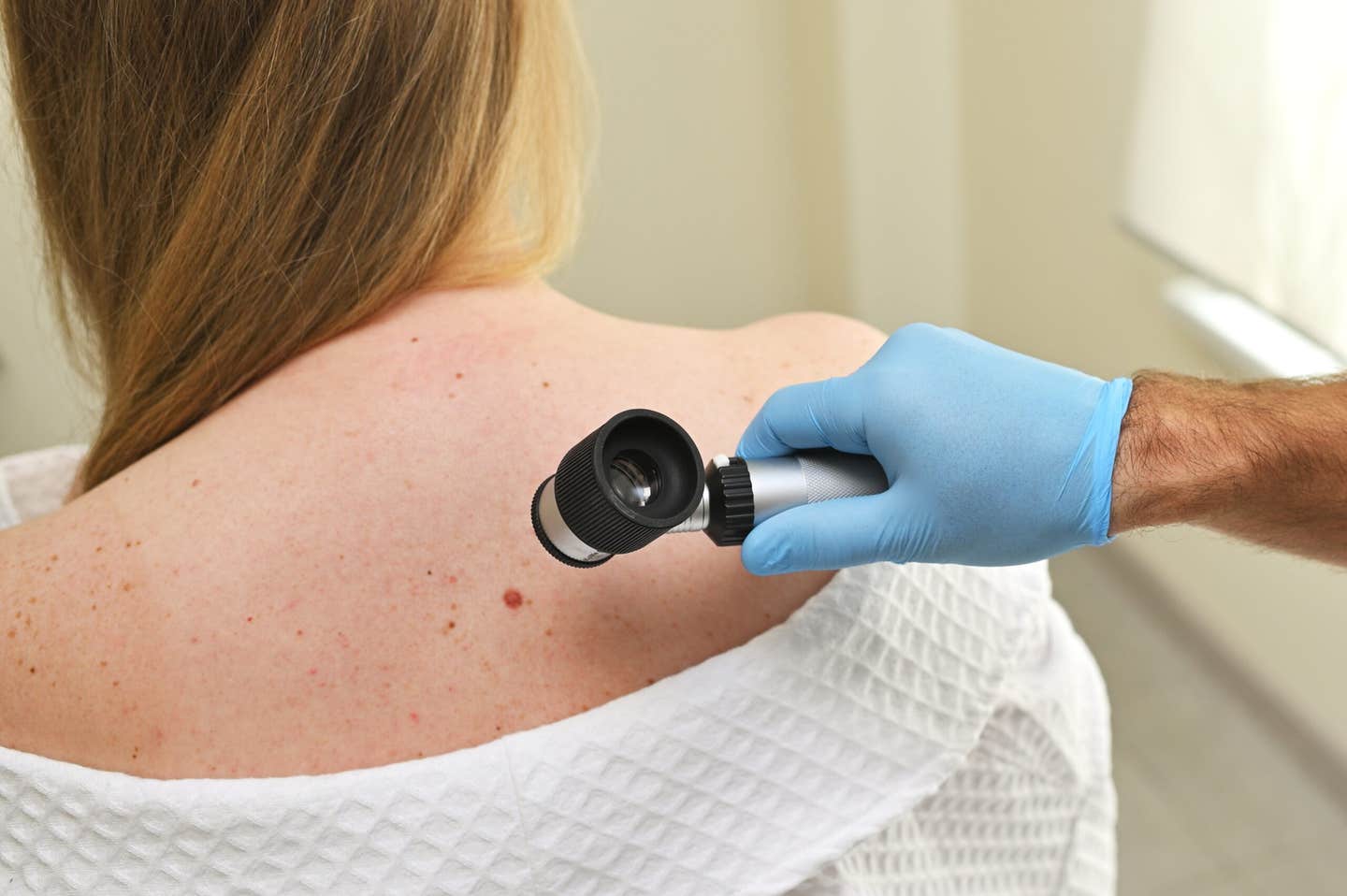
Engineered nanoparticles destroy melanoma tumors in mice using safe, low-power near-infrared light. (CREDIT: Shutterstock)
A near-infrared light beam appears harmless, as it is a low-frequency type of light that does not have a dramatic effect but rather passes through tissue unnoticed. However, under some circumstances, this same beam can create enough energy to generate heat capable of destroying a tumor.
The balance between the efficiency of power and safety has been a limiting factor for the use of photothermal therapy in melanoma. The traditional nanoparticles employed must use laser intensities that are far above what can be tolerated by human skin. Researchers at Oregon State University now have a solution for that issue.
Researchers from the College of Pharmacy at OSU, led by Dr. Olena Taratula and Dr. Prem Singh, have created a nanoparticle system capable of killing melanoma tumors in mice while using laser power below the skin's safety threshold. The basis for this system is a nanoscale energy relay that ensures that each photon is used to its fullest potential.
Safety Limits In Photothermal Therapy
Limiting factors of safety in photothermal therapy have been around for years.
Photothermal therapy, or PTT, utilizes near-infrared light to excite tiny particles and then heat the tumor to destroy it within a designated area. PTT has the potential to be a less invasive alternative to surgical options for tumor removal.
Unfortunately, PTT has many limitations. Conventional photothermal agents require immense concentrations of laser energy to reach the temperatures necessary to destroy the tumor. These dense concentrations can easily exceed the 0.33 watts per square centimeter skin safety limit. This leads to concerns about resultant burning and other collateral damage.
To address this issue, Taratula and Singh set out to design a particle capable of producing enough heat from less laser energy. “The safety limit is 0.33 watts per centimeter squared,” Taratula explained. “Using our nanoparticles, treatment at a power density of 0.25 W/cm2 destroyed completely (ablated) the tumor in a single treatment of an aggressive melanoma mouse model developed by one of our colleagues, Adam Alani at Ohio State University.” This is an important measure because it is well below the current accepted safety threshold.
Constructing a Smarter Particle
The theranostic platform developed by the team utilizes gold nanorods as its base component. These nanorods are well known for their strong affinity to light. The team then coated the gold nanorods with an iron and cobalt shell approximately 3.5 nanometers in thickness.
Next, they loaded the entire structure with a near-infrared dye known as silicon naphthalocyanine, or SiNc, all contained within a polymer-based carrier.
The overall particle system is referred to as PC-Fe/Co-AuNRs@SiNc. It serves many roles, not just as a stacked particle collection. The iron and cobalt shell acts as a nanoscale spacer and plasmonic modulator. The plasmonic modulator redirects and amplifies the resonance wavelength of the gold nanorods and increases the spectral overlap with the dye.
The additional spectral overlap allows for the transfer of energy via resonance energy transfer, or RET. The process of RET does not involve any emitted light and has essentially direct transfer of energy from one molecule to another. Thus, RET generates a significant improvement in the ability of the theranostic platform to convert near-infrared light into thermal energy compared to more conventional systems.
When subjected to low power exposure at 0.25 W/cm2 and 780 nm, the nanoparticle had a 6.6x increase in photothermal conversion efficiency over SiNc alone. It had a 3.3x increase over iron cobalt-coated nanorods with no dye and a 2.3x increase over an agent without the iron cobalt shell. The higher efficiencies mean that less laser energy is required.
Probing For Aggressive Melanoma
The research group examined their platform with a transgenic melanoma model created in a lab by Adam Alani of OSU.
Once systemically administered, nanoparticles targeted cancerous tissue. Following a single treatment with near-infrared light at 0.25 W/cm2, they led to the complete destruction of tumors with no collateral damage to healthy tissue.
According to the American Cancer Society, the most frequently diagnosed type of cancer in the U.S. is skin cancer. Melanoma accounts for only about 1 percent of skin cancers, but the majority of skin cancer deaths occur from melanoma. The National Institute of Health reported that there were 100,000 new cases of melanoma in 2025 and over 8,000 melanoma deaths in the U.S.
“Several patients experiencing these cases probably underwent surgery that involved cutting through a large amount of tissue and left a significant amount of tumor behind,” Singh stated. “Our work highlights that photothermal therapy is a minimally invasive procedure and that it is truly innovative to develop a next generation photothermal therapy agent based on resonance energy transfer.”
Seeing and Treating
The platform also supports fluorescence-guided ablation, as the nanoparticle acts as a fluorescent imaging agent. This allows medical professionals to observe where the nanoparticle accumulates and direct the laser precisely toward the tumor.
This dual capacity of diagnosis and treatment integrated into one system is part of what qualifies this system as a theranostic platform.
The ability of near-infrared light to penetrate deeper into tissue than visible light, combined with the improved energy transfer properties of the nanoparticle, makes it possible to achieve the necessary therapeutic temperatures while ensuring the safety limits of the laser are not exceeded.
Research findings are available online in the journal Advanced Functional Materials.
The original story "Nanoparticles help low-powered lasers remove melanoma tumors" is published in The Brighter Side of News.
Related Stories
- Tanning beds turn young skin genetically old, study finds
- New AI model reveals key genetic, social, and lifestyle factors impacting skin cancer risk
- Gray hair may be a natural defense against cancer, study finds
Like these kind of feel good stories? Get The Brighter Side of News' newsletter.
Hannah Shavit-Weiner
Medical & Health Writer
Hannah Shavit-Weiner is a Los Angeles–based medical and health journalist for The Brighter Side of News, an online publication focused on uplifting, transformative stories from around the globe. Passionate about spotlighting groundbreaking discoveries and innovations, Hannah covers a broad spectrum of topics—from medical breakthroughs and health information to animal science. With a talent for making complex science clear and compelling, she connects readers to the advancements shaping a brighter, more hopeful future.