NASA spots colossal eruptions shaking Io — Jupiter’s most volcanic moon
A massive eruption on Jupiter’s moon Io released more energy than any volcano ever recorded beyond Earth, stunning scientists.

 Edited By: Joseph Shavit

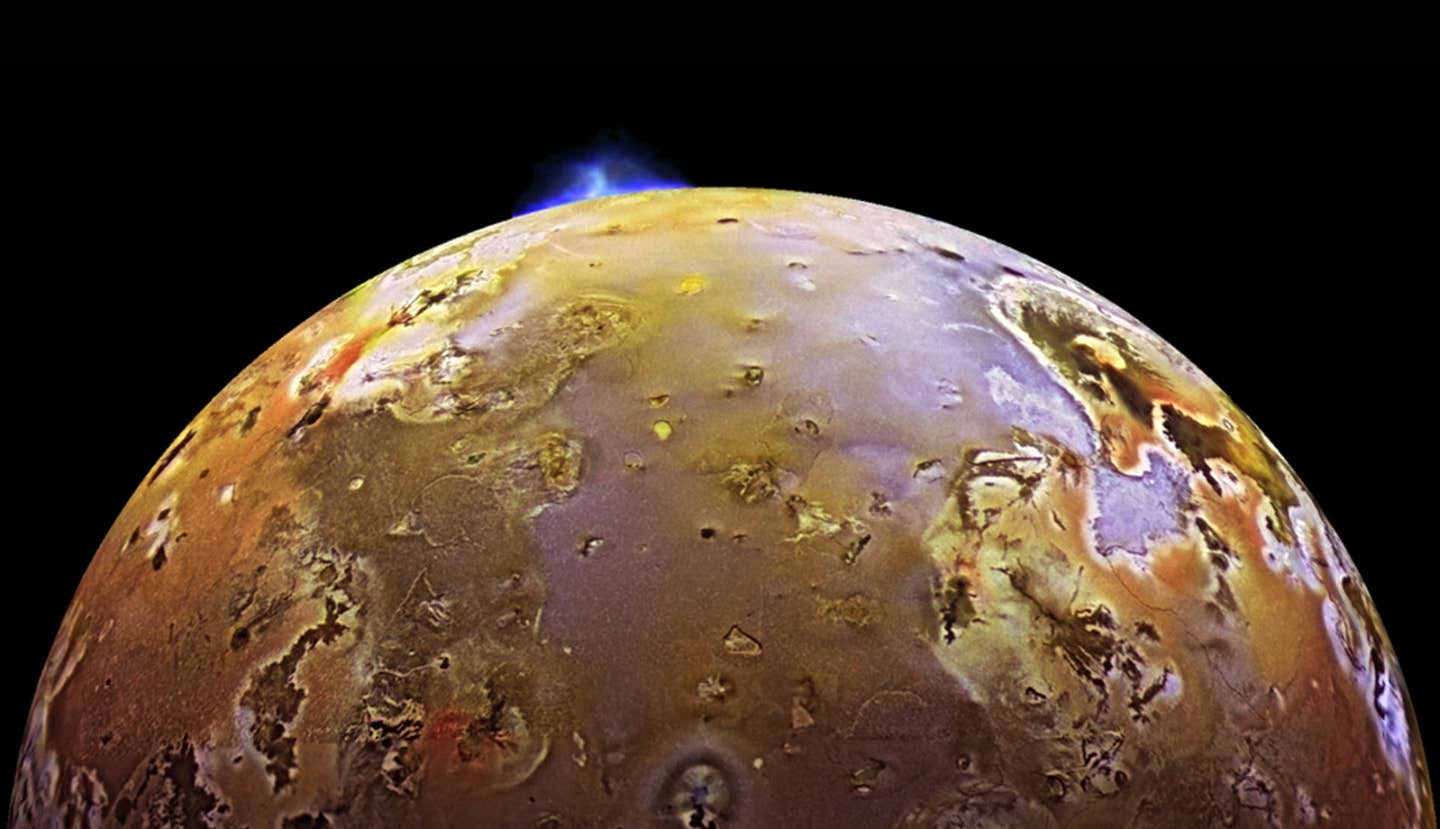
NASA’s Juno spacecraft captured the most powerful volcanic eruption ever seen on Jupiter’s moon Io. (CREDIT: NASA / JPL / University of Arizona)
NASA has recorded the most powerful volcanic eruption outside of Earth on Io, one of Jupiter's moons. On December 27, 2022, Juno, NASA’s spacecraft, witnessed numerous active volcanoes erupting simultaneously and releasing far more energy than any other eruption recorded in the solar system to date.
A team of researchers from Italy's National Institute for Astrophysics (INAF) published a paper summarizing the results of their analysis of Juno's infrared instrument data. It is believed that Io's volcanism may be connected beneath the surface by a large network of magma reservoirs.
Io currently holds the record for being the most volcanically active body in the solar system, with an estimated 400 active volcanoes. However, this most recent eruption was unprecedented. The eruption covered approximately 40,400 square miles, which is larger than many U.S. states, and released between 140 and 260 terawatts. By comparison, the infamous 1980 Mount St. Helens eruption released around 52 terawatts.
Unprecedented Observations From Juno
“It is also notable that this eruption occurred simultaneously from multiple active sources; as such, the eruption increased its brightness by over 1,000 times from what would be expected in typical conditions,” said Dr. Alessandro Mura of INAF. The eruption’s evidence suggests that it was a massive eruption event occurring at one time and traveling beneath the surface of Io for a distance of hundreds of kilometers.
Evidence of the eruption was collected during one of Juno's closest flybys of Io, when the spacecraft was approximately 46,200 miles above the moon's surface. The eruption was detected with the Jovian Infrared Auroral Mapper (JIRAM), which was specifically designed to study Jupiter’s atmosphere but was also capable of detecting the volcanic thermal energy of Io.
The temperature measurements collected by JIRAM were so intense that parts of the detector became saturated. Despite the saturation, researchers were able to determine the eruption's temperature and pressure by using additional spectral measurement data and stray light patterns on the JIRAM detector.
Signs Of A Shared Magma System
The main hot spot was approximately 400 kilometers long and remained heated throughout the entire observation period. Previous measurements of the same spot were negligible. Many of the other nearby hot spots erupted at the same time, with some increasing their thermal energy by more than 1,000 times.
There is a significant difference between volcanoes in the same area that erupted and those that did not erupt. This suggests that some volcanoes may share a magma system underground, while others have separate magma sources.
The Moon was shaped through the combination of pressure and fire
Why Io Is So Volcanically Active
Io's intense volcanic activity is due to the effects of Jupiter's gravitational pull on the moon. Jupiter’s immense gravity creates pressure on Io, causing it to flex like a stress ball. This constant flexing heats the moon’s interior. When heated, the rocks convert into magma, which continues to rise to the surface and cool down.
The magma system used by scientists to describe Io is referred to as a “heat pipe system.” Magma rises to the surface, erupts, cools, and then sinks again to continue the cycle. This process provides material that keeps Io’s interior extremely hot. The same mechanism could also be responsible for the formation of Io's massive mountains, similar to those found on Earth due to tectonic forces rather than volcanic material buildup.
Prior to this eruption, scientists had not established how magma moves through Io’s crust or whether distant volcanoes share a connection. This eruption has provided an important clue for researchers. Several newly discovered hot spots were detected at distances of 400 kilometres or more from one another, making coincidental eruptions extremely unlikely.
The research team has proposed that a magma network exists beneath Io’s surface, potentially shaped like a sponge filled with molten pockets. A sudden surge of magma or a shift in subterranean compression may have triggered the simultaneous eruption of multiple hot spots.
What’s Next For Io
The duration of the eruption may have lasted several days. Based on its intensity, researchers believe the lava released could have filled an area of 100 cubic kilometres, enough to reshape significant portions of Io’s surface.
During future close approaches of Juno to Io, scientists are expected to discover additional lava flows, ash deposits, and changes in volcanic structure. Some volcanoes may appear reshaped as a result of this event.
The eruption serves as a reminder that even in a well-studied solar system, major surprises can still emerge without warning.
Practical implications of the research
Understanding how magma moves through Io is important for learning how heat is transferred away from rocky planets. It also provides insight into how volcanic threats continue to evolve on Earth.
This discovery may help improve models of volcanic hazards and increase understanding of how rocky planets and moons remain geologically active for billions of years.
In addition, this knowledge could help guide future missions aimed at locating volcanic activity on other rocky worlds.
Research findings are available online in the Journal of Geophysical Research: Planets.
Related Stories
- Jupiter's volcanic moon Io is burning much hotter than expected
- How a young Jupiter saved Earth from falling into the Sun
- How old is Jupiter? Tiny molten spheres embedded in meteorites have the answer
Like these kind of feel good stories? Get The Brighter Side of News' newsletter.
Joshua Shavit
Writer and Editor
Joshua Shavit is a NorCal-based science and technology writer with a passion for exploring the breakthroughs shaping the future. As a co-founder of The Brighter Side of News, he focuses on positive and transformative advancements in technology, physics, engineering, robotics, and astronomy. Joshua's work highlights the innovators behind the ideas, bringing readers closer to the people driving progress.