New AI blood test can help detect several brain diseases at once
An AI blood test may help detect several brain diseases at once, offering a new way to sort overlapping symptoms.

 Edited By: Joseph Shavit

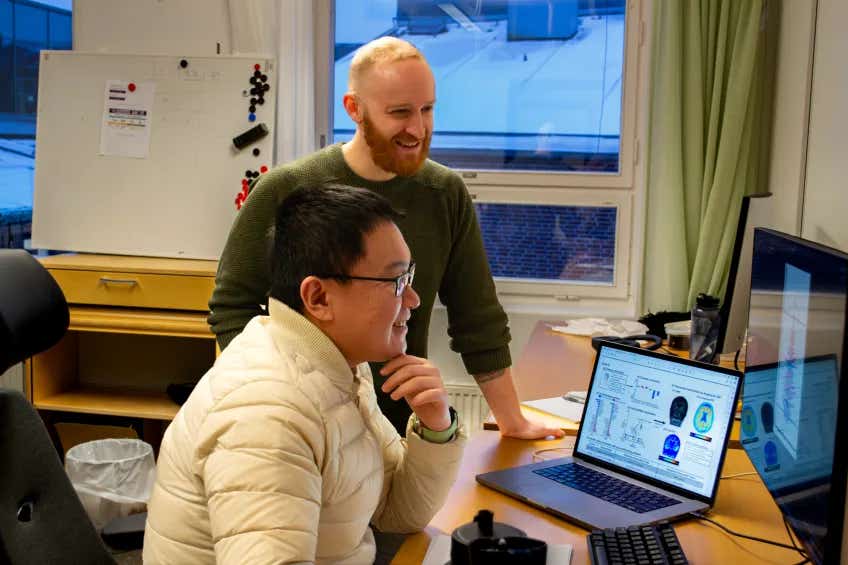
Two of the researchers behind the AI model, Jacob Vogel and Lijun An, show the results of their study. (CREDIT: Emma Nyberg)
Memory loss can point in more than one direction.
A patient may seem to fit Alzheimer’s disease, only to have signs that also resemble Parkinson’s disease or a past stroke. In many older adults, those conditions can overlap inside the brain, which helps explain why diagnosis is often messy, slow, and sometimes wrong. A new study from Lund University in Sweden suggests that a single blood sample, paired with artificial intelligence, may one day help sort out that confusion.
Writing in Nature Medicine, researchers described an AI system called ProtAIDe-Dx that used blood-based protein patterns to detect several neurodegenerative conditions at the same time. The model was built from plasma proteomics data from 17,187 participants gathered across 19 sites through the Global Neurodegenerative Proteomics Consortium, or GNPC.
“Our hope is to be able to accurately diagnose several diseases at once with a single blood test in the future,” said Jacob Vogel of Lund University, who led the study.
The idea matters because diagnosis remains a major obstacle in brain disease care. The paper notes that misdiagnosis rates run around 25 to 30 percent even in specialized dementia clinics, and can top 50 percent in primary care. The problem gets harder with age, since 70 percent of patients 80 or older may carry multiple neurodegenerative pathologies at the same time.
A pattern hidden in thousands of proteins
Instead of looking for one disease marker at a time, the team trained its model on 7,595 proteins measured in blood. Using a “joint learning” approach, the system learned shared patterns across several disorders while still producing separate probabilities for each one. That let it flag more than one possible condition in the same person.
The model was designed to classify Alzheimer’s disease, Parkinson’s disease, amyotrophic lateral sclerosis, frontotemporal dementia, previous stroke or transient ischemic attack, and cognitively unimpaired controls. Importantly, the researchers used only proteomic information. They did not feed the model demographic, cognitive, diagnostic, or site information.
ProtAIDe-Dx performed best overall against several comparison models, including Random Forest, XGBoost, and TabPFN. Its median balanced classification accuracy reached 95 percent for ALS and 92 percent for Parkinson’s disease. It posted 81 percent for Alzheimer’s disease, 72 percent for frontotemporal dementia, and 70 percent for stroke or TIA. The model also produced area under the curve values above 0.8 for every task except stroke or TIA prediction.
That still does not make it clinic-ready on its own. But the results hint that blood may carry a broader signal of brain disease than researchers once thought.
Diagnosis did not always match biology
One of the more striking findings came when the team looked beyond yes-or-no labels.
Lijun An, the study’s first author, said the protein profile “predicted cognitive decline better than the clinical diagnosis did,” and added that people with the same diagnosis may carry different biological subtypes.
Some patients labeled with Alzheimer’s disease showed protein patterns that looked more like other brain disorders. According to Vogel, that could mean several things: more than one disease process may be present, Alzheimer’s may develop through different biological routes, or the original clinical diagnosis may be wrong.
The model also picked up signals in harder-to-classify groups, including people with mild cognitive impairment or subjective cognitive decline. Those cases spread across the disease map rather than falling into a single cluster, suggesting the system may help identify underlying pathology earlier than standard diagnosis alone.
In an external memory clinic dataset called BioFINDER-2, which included 1,786 participants and biomarker-supported diagnoses, the model’s probabilities tracked with expected disease biology. Alzheimer’s probabilities rose in some non-Alzheimer’s cases that carried amyloid-beta and tau pathology. Stroke probabilities rose with heavier white matter hyperintensity burden. Among cognitively unimpaired people, the model was less likely to classify them as healthy if they already showed Alzheimer’s, Lewy body, or neurovascular pathology.
Useful, but not enough yet
The researchers are careful not to oversell the system.
Vogel said current blood protein measurements are not sufficient by themselves to diagnose multiple diseases. The paper makes the same point repeatedly. Performance dropped when the team tested how well the model generalized from one site to another, a sign that site effects and data differences remain a serious challenge. Some diseases were also harder to classify because of uneven sample distribution or because their clinical labels were not backed by biomarkers.
The authors also note that many brain-related proteins may never reach the blood in ways that are easy to measure, partly because of the blood-brain barrier. Medication effects can also distort protein levels. And because many of the training diagnoses came from routine clinical work rather than autopsy or biomarker confirmation, some “false” predictions may not have been false at all.
Even so, ProtAIDe-Dx added value when combined with common clinical markers such as age, sex, MMSE, cortical thickness, plasma p-tau217, and plasma NEFL. In the BioFINDER-2 sample, that combined model improved diagnosis, especially for non-Alzheimer’s dementias. The system also separated patients by future cognitive decline more effectively than baseline diagnosis did.
The next step, Vogel said, is to expand the proteomic markers, including through mass spectrometry, to search for disease-specific patterns that current tools may miss.
Practical implications of the research
This study does not deliver a simple blood test that can replace scans, spinal fluid tests, or expert clinical work.
What it does offer is a glimpse of a more practical future, one where a single blood draw could help doctors sort through overlapping brain diseases, identify patients who need follow-up testing, and catch hidden pathology earlier.
That could matter for treatment decisions, drug trials, and care planning as more disease-modifying therapies move closer to routine use.
Research findings are available online in the journal Nature Medicine.
The original story "New AI blood test can help detect several brain diseases at once" is published in The Brighter Side of News.
Related Stories
- Hidden body fat may put you at greater brain disease risk
- Electrodes grown in the brain - a possible new solution for brain disease
- Breakthrough study reveals why certain brain diseases affect men and women differently
Like these kind of feel good stories? Get The Brighter Side of News' newsletter.
Shy Cohen
Writer