New biodegradable material gets stronger in water and could one day replace plastics
A chitosan-based material doped with nickel strengthened in water, reaching levels the authors compare to engineering plastics.

 Edited By: Joseph Shavit

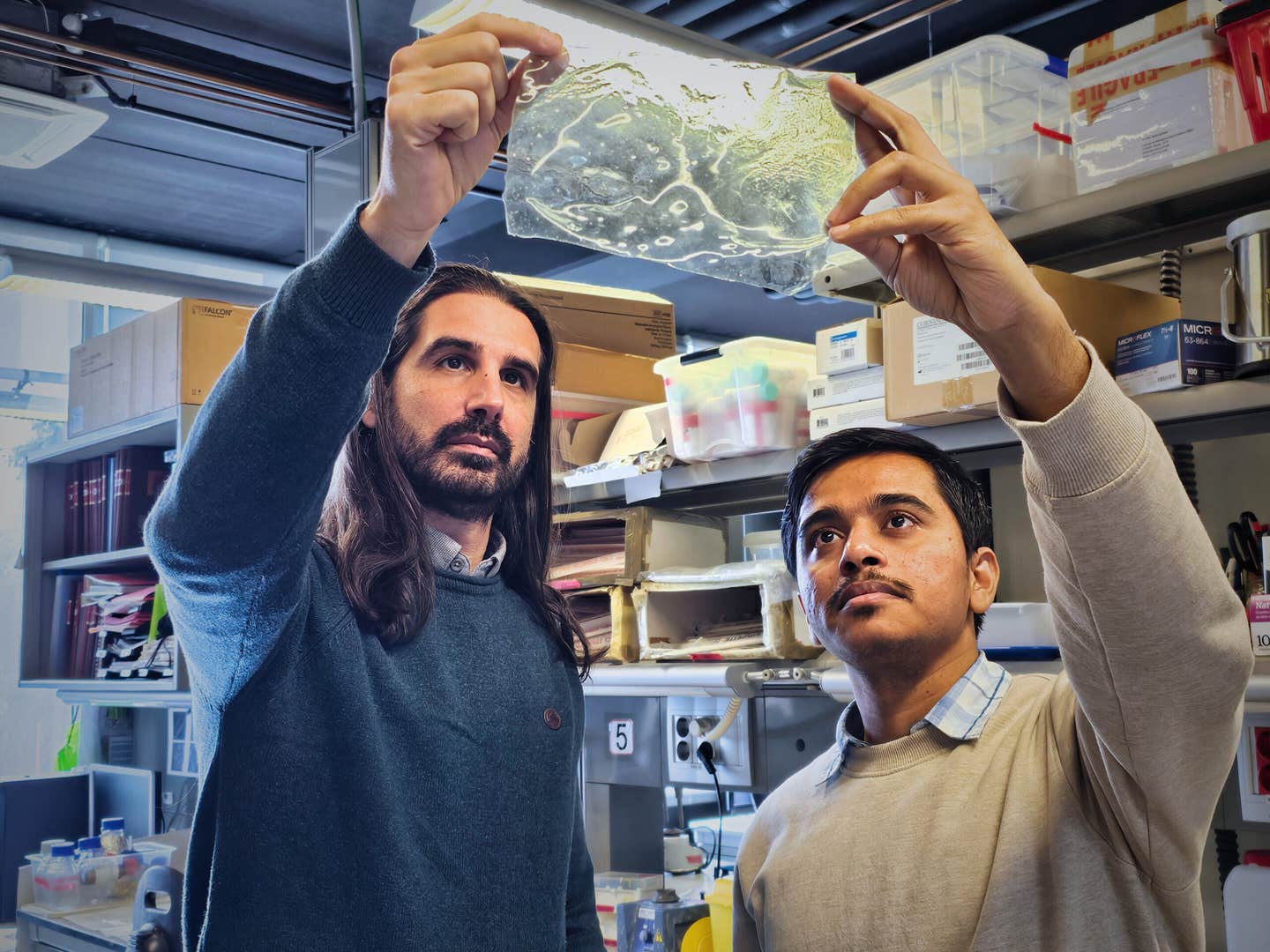
Javier G. Fernández (left) and Akshayakumar Kompa (right) holding a sample of the material at the IBEC laboratories. (CREDIT: Institute for Bioengineering of Catalonia (IBEC))
That trait, which makes a coffee lid or a fishing float so useful, also turns plastic into a long-term guest in places it was never invited. Unrecovered fragments collect across ecosystems, and they have become common in food chains. The worry is not just litter, it is persistence.
A team of researchers now argues that water does not have to be the enemy of biodegradable materials. In their study, a chitin-derived biopolymer called chitosan gained strength when it got wet, reaching levels the authors place above many everyday plastics in the same conditions. The work was led by the Institute for Bioengineering of Catalonia (IBEC) with the Singapore University of Technology and Design (SUTD) and published in Nature Communications.
A wet weakness, turned into a design feature
Engineers have chased biobased alternatives to plastic for decades. The familiar snag is water. Many natural materials soften or weaken with moisture, which pushes manufacturers toward chemical tweaks or protective coatings. Those fixes often undercut the point of using biomaterials in the first place.
In the new study, chitosan stayed “biologically pure,” according to Javier G. Fernández, an ICREA Research Professor at IBEC and leader of the study. “The material is still biologically pure in the eyes of nature; it remains essentially the same molecule found in insect shells or mushrooms,” he said.
The researchers framed that purity as more than a talking point. If the molecule stays essentially unaltered, it can more easily re-enter ecological cycles after use, instead of becoming a stubborn, half-synthetic compromise.
Fernández also challenged a common assumption in materials design. “For over a century, we have assumed that, in order to succeed in nature, materials must become inert,” he said. “This research shows the opposite: materials can thrive by interacting with their environment rather than isolating themselves from it.”
A clue from a worm’s fangs
The study’s origin story begins with a natural oddity. The researchers cite a prior observation involving the sandworm Nereis virens: when zinc is removed from its fangs, the fangs become susceptible to hydration and soften in water. That detail helped steer the team toward a broader question, whether metals could do more than just “reinforce” biological structures. Maybe they could influence how water moves through them, and how that water affects strength.
Instead of trying to recreate an arthropod cuticle, the authors built a simpler system: chitosan films doped with a transition metal. They chose nickel, described in the paper as a ubiquitous micronutrient necessary for life and water-soluble, with versatility in how it can interact with chitin and chitosan in theoretical models. The authors note that linking their findings back to natural cuticle processes remains an open question for future work.
For the material itself, the team started with chitosan extracted from discarded shrimp shells (Penaeus monodon). They dispersed it at a 3% concentration in a weak acetic acid solution, described as 1% acetic acid in water, and added nickel chloride dissolved in water at concentrations from 0.6 to 1.4 M. As the water evaporated, the polymer vitrified into solid films. One visible sign of nickel’s presence was color: films turned green, intensifying with higher nickel concentration.
Stronger in water, not despite it
Here is the result the authors keep circling back to: these films did not fall apart in water. In some cases, they became tougher and stronger.
Across samples, the films had dry tensile strengths in the range of 30 to 40 MPa, which the paper compares to commodity plastics. Beyond about 1 M nickel concentration, the material preserved strength while its Young’s modulus dropped, which the authors interpret as a jump in stretchiness and toughness.
Then came the surprise. When immersed, most nickel-doped films held steady or increased in strength. The most notable case used a starting nickel concentration of 0.8 M. That formulation increased in strength by almost 50% upon immersion, with a reported wet tensile strength of 53.01 ± 1.68 MPa compared with 36.12 ± 2.21 MPa when dry. The authors place that wet strength in the range of “engineering plastics.”
The proposed mechanism is not a rigid, locked network. It is the opposite. Water becomes an active structural ingredient, with nickel ions and water molecules enabling a shifting web of weak, reversible interactions. Bonds break and reform as molecules move. That microscopic reshuffling, the authors argue, helps the material distribute stress instead of cracking under it. Fernández summarized the idea as “a material where being ‘soft’ at the molecular scale actually makes it stronger”.
Not every metal worked. Under identical conditions, swapping nickel for zinc or copper did not produce a comparable water-strengthening effect. The authors interpret that as a sign that coordination chemistry matters, not just the fact that the ions carry a double positive charge.
The first soak is part of the manufacturing
One practical twist is that freshly made films do not stay chemically identical after their first immersion. During that first soak, a large share of nickel leaches out. The authors report that 87.18 ± 2.72% of the nickel is released during the first immersion, leaving roughly one nickel ion per 7.91 pyranose rings as the amount that actually contributes to bonding and the water-strengthening behavior.
After 24 hours, they report no further measurable nickel release, even with boiling-water tests. They also tested performance in 0.9% NaCl instead of pure water and found indistinguishable strength, which they take as evidence the effect is not driven by long-range electrostatics.
To show nickel’s central role, the authors describe chelating coordinated nickel with 0.5 M EDTA for two hours. That treatment collapsed the films into a jelly-like material indistinguishable from chitosan, suggesting the coordinated nickel is necessary for the wet-strengthening effect.
Cups, containers, and a closed-loop metal budget
The study does not stop at tensile curves. The researchers built objects.
Using a looped process, they recycled the nickel-containing water from the “first soak” step into the next production cycle, aiming for 100% utilization of nickel even though the material initially needs to be saturated with more nickel than it ultimately retains. With molding approaches, including a two-axis clinostat to keep the polymer solution in contact with a negative mold during vitrification, they made containers and cups. They report the cups retained water like common plastics, demonstrating impermeability in their tests.
They also explored scale. The authors produced a 1 m² film and later a three-times-larger film, reporting no notable processing challenges at that size and similar macroscopic behavior to smaller samples.
The team makes a big scalability claim rooted in biology itself. Akshayakumar Kompa, a postdoctoral researcher in Fernández’s group and the study’s first author, said, “Each year, the world produces an estimated one hundred billion tonnes of chitin, equivalent to three centuries’ worth of plastic production.” The paper also links this abundance to regional manufacturing possibilities, including sourcing chitosan from shrimp shells or via bioconversion of organic waste.
The authors include one more forward-looking note, and it comes with a boundary: nickel may not be the only option. With the basic effect established, they argue other combinations of ions and biopolymers could produce similar water-strengthening behavior.
Research findings are available online in the journal Nature Communications.
The original story "New biodegradable material gets stronger in water and could one day replace plastics" is published in The Brighter Side of News.
Related Stories
- Methane-eating microbes turn greenhouse gas into fuel, food, and bioplastics
- Scientists develop a shelf-stable 'smart' plastic that hardens only when you trigger it
- Chemists convert plastic waste into a powerful new tool to capture carbon dioxide
Like these kind of feel good stories? Get The Brighter Side of News' newsletter.
Melanie Livingstone
Writer
Melanie is a San Diego–based journalist for The Brighter Side of News, an online publication focused on uplifting, transformative stories from around the globe. Passionate about spotlighting groundbreaking discoveries and innovations, Melanie covers a broad spectrum of topics including biology, geology and historical achievements. With a talent for making complex science clear and compelling, she connects readers to the advancements shaping a brighter, more hopeful future.