New DNA study reveals Beachy Head Woman was local to Roman Britain
A new genetic study reveals the Beachy Head Woman was a local resident of Roman-era southern England, not a migrant from afar.
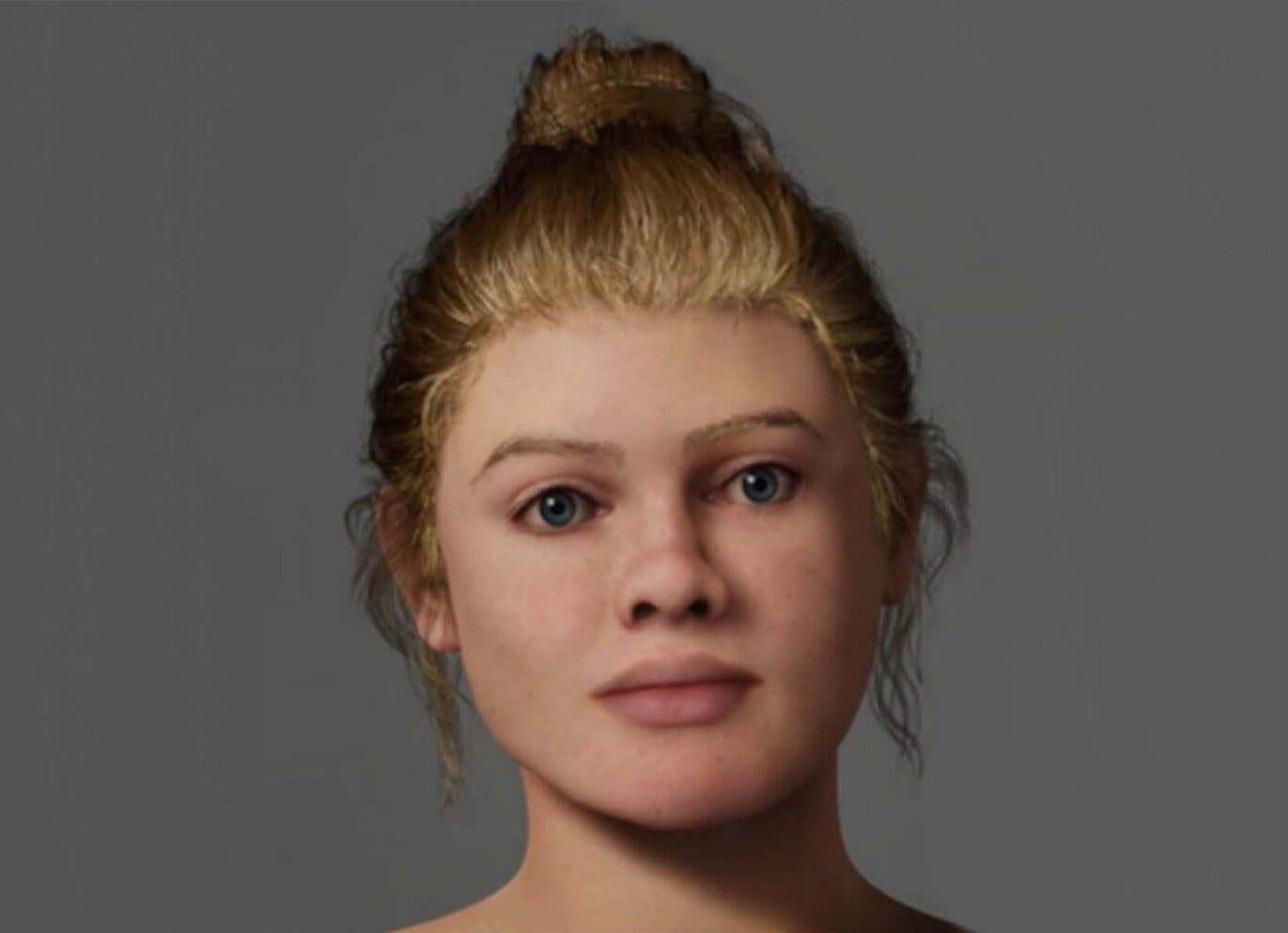
This digital image was generated from a 3D scan of Beachy Head Woman’s skull. The skin, hair and eye pigmentation were informed by ancient DNA results. (CREDIT: Face Lab at Liverpool John Moores University)
A young woman who lived nearly two millennia ago along the southern coast of England has been the center of scientific controversy for more than the last decade. We know her name as the Beachy Head Woman, and when her skeletal remains were discovered, they were considered to be from either sub-Saharan Africa or from the Mediterranean region. However, recent comprehensive genetic analyses have concluded that she has ancestry much closer to home.
In an article published in the Journal of Archaeological Science, researchers from University College London and the Natural History Museum have demonstrated conclusively that the Beachy Head Woman is descended from the local population living in southern Britain at the time of the Roman occupation. This conclusion is based on the largest and most detailed analyses of the DNA from her skeletal remains that have been performed to date. It contradicts earlier conclusions reached using only skeletal morphology and very limited amounts of genetic data.
According to Dr. William Marsh of the Natural History Museum, who oversaw this latest study, the application of new DNA methodology allowed researchers to make new determinations regarding the Beachy Head Woman’s place of origin. “Using cutting-edge DNA techniques, we were able to determine the origins of this person and confirm her genetic ancestry as being the most similar to that of other individuals from the local population of Roman-era Britain.”
Unknowns Of The Skeleton
The skeletal remains of the Beachy Head Woman were located in the basement of Eastbourne Town Hall at the time of their discovery in 2012. They had been placed in a cardboard box with an inscription on it of only “Beachy Head (1959),” with no museum records or excavation records. This label led researchers to associate these bones with the geographic location of the Beachy Head chalk headland located east of Eastbourne, along the southern coast of England.
Through additional radiocarbon dating of the skeletal remains, it was determined that she died sometime between 129 CE and 311 CE, during the Roman occupation of Britain. Skeletal evidence showed that she was between the ages of 18 and 25 when she died and was approximately 4 feet 9 inches tall. The skeletal evidence also showed that she had survived a serious injury to her right leg that had healed. Bone chemical analyses showed that her diet was primarily seafood based, indicating that she probably lived near a coast.
"Although much is known about the woman’s skeletal characteristics, there is still a great deal of uncertainty concerning many other aspects of her life. There are no grave goods or burial context available to assist scientists in piecing together her life story, and scientists must rely heavily on the condition of her bones to gather as much information as possible," Marsh told The Brighter Side of News.
"Early interpretations of the findings sparked considerable debate within the scientific community," he added.
Early Interpretations And Public Debate
In 2013, the University of Dundee conducted craniofacial analyses of her skull. They concluded that several physical characteristics indicated that the individual was probably of sub-Saharan African descent. They also cautioned against using these characteristics to determine ancestry based on skull shape. However, the identification of recent African ancestry gained significant attention within the media and influenced how exhibits of the individual were displayed in museums and how she was identified in public.
A facial reconstruction of the individual produced at that time showed her with dark hair and dark eyes, as well as a mid-tone skin. This portrayal supported the suggestion of African ancestry and became widely circulated.
Later studies began to add complexity to the story being told about the woman. Isotopic analyses suggested that the individual probably lived in southern Britain as a child, not overseas. In 2017, previously unpublished DNA studies suggested that the individual had some genetic ties to the Mediterranean region, potentially Cyprus. However, the amount of genetic data was minimal and not sufficient to draw firm conclusions.
The Beachy Head Woman, as a scientific mystery and a representation for society, has faced many interpretations throughout time that have called into question what it means to be identified as being descended from or having ancestry in common with one another.
Improved Tools Provide Clearer Answers
A new study analysing the body of the Beachy Head Woman, conducted by UCL Genetics, Evolution and Environment and led by doctoral candidate Andy Walton, has provided better understanding through the use of improved DNA sequencing technologies. These advances resulted in the recovery of roughly ten times more DNA from this person’s remains than was previously achieved through the methodology of 2017.
“The advancement in new DNA sequencing technology allowed us to recover approximately ten times more of the DNA from Beachy Head Woman’s remains than had been achieved through the work performed in 2017,” states Walton. “By combining this information with advances in computational and statistical methods and datasets of ancient and modern genomes, we are now able to obtain a far greater understanding of Beachy Head Woman than was once thought possible.”
Using variable regions of her nuclear genome, researchers performed comparisons with thousands of ancient and modern genomes. The results confirmed the same basic findings across multiple analyses and were consistent with previous evidence. The Beachy Head Woman’s genetic signature is closely related to Roman and Iron Age populations from Britain and Northern Europe, with the greatest similarity to people who lived in England.
Additionally, further analyses of her genetics found no evidence of recent migration from sub-Saharan Africa into her population. Her mitochondrial DNA haplogroup is typically found among populations from northern Europe and the British Isles.
Reconstructing Identity And Appearance
Genetic indicators of appearance suggest that the Beachy Head Woman would have possessed blue eyes, light hair, and some amount of pigmentation intermediate between the black and the white races. The study demonstrated that the updated digital face reconstruction of the Beachy Head Woman in 2025, developed using the same fundamental facial structure as used by 21st-century predecessors, produced a significantly different display of her appearance than the one currently familiar to the public.
According to the study’s senior author, Dr. Selina Brace, a senior researcher with the Natural History Museum and an honorary researcher at University College London, “The fact that we now know so much more about how science is progressing” indicates that it is the role of scientists “to continue to set out as much of it as we can” for future generations. Advancements in technology over the last decade have greatly facilitated this opportunity to bring together more complete data on this and other individuals. This allows researchers to offer more insight into her life.
As opposed to identifying only one woman’s origins, the research provides important data about how the field of bioarcheology is changing. Traditional methods of bioarcheology relied on cranial measurement practices developed in the late 19th century. These methods were based on an age-old paradigm of separate, distinct biological categories of race and ethnicity.
Shifting Frameworks In Bioarcheology
Modern genetic research has revealed that the continuum of genetic variation among humans is greater than suggested by earlier research methodologies. The authors argue that improved genetic research methods enable scientists to test and validate previous scientific and sociological findings with greater accuracy. These tools also allow researchers to revise older perceptions of how biology and culture intersected in the formation of identity throughout human history.
The Beachy Head Woman’s story is also an example of why caution is required when interpreting early results that significantly affect public understanding of identity and cultural history.
In conclusion, the Beachy Head Woman’s story provides an effective context for understanding the many changes that have occurred within the field of bioarcheology over time. It supports the need to revisit older archaeological sites using new technologies and approaches. It also highlights the importance of museums and educators revising exhibits based on evolving evidence related to cultural identities and history.
Additional studies continue to deepen understanding of the human experience and help researchers move away from fixed race-based categories toward an appreciation of overlapping human experiences.
Research findings are available online in the Journal of Archaeological Science.
Related Stories
- Humans and Neanderthals interbred 100,000 years earlier than previously thought
- Ancient lead exposure may have helped early humans evolve language and intelligence
- Million-year-old skull discovery rewrites the story of human evolution
Like these kind of feel good stories? Get The Brighter Side of News' newsletter.

Rebecca Shavit
Writer
Based in Los Angeles, Rebecca Shavit is a dedicated science and technology journalist who writes for The Brighter Side of News, an online publication committed to highlighting positive and transformative stories from around the world. Her reporting spans a wide range of topics, from cutting-edge medical breakthroughs to historical discoveries and innovations. With a keen ability to translate complex concepts into engaging and accessible stories, she makes science and innovation relatable to a broad audience.