New machine captures carbon dioxide from air and converts it into usable gasoline for cars
A startup unveiled a machine that pulls CO2 from air and turns it into gasoline compatible with today’s cars.

 Edited By: Joseph Shavit

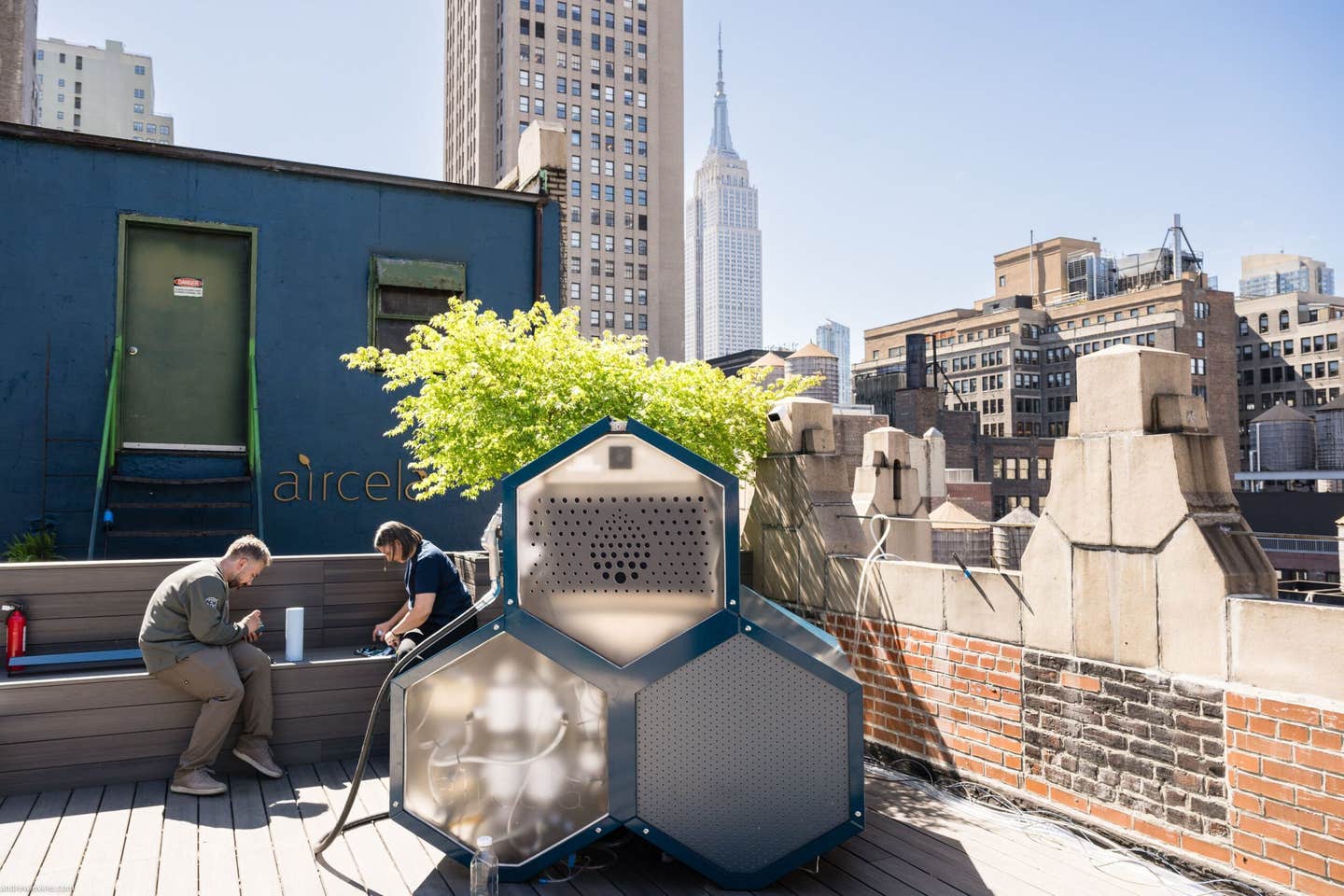
Aircela’s compact machines turn air, water, and renewable electricity into real, drop-in gasoline, fully compatible with today’s engines and infrastructure. (CREDIT: Aircela)
On a rooftop in Manhattan’s Garment District, a blue hexagonal machine hummed quietly while producing something unexpected: gasoline.
The device, about the size of a commercial refrigerator, pulls carbon dioxide from the air and converts it into usable fuel. According to New York–based startup Aircela, the result can be poured straight into the tank of a standard car with no engine modifications required.
Transportation accounts for about 28 percent of U.S. greenhouse gas emissions, with most of that tied to gasoline vehicles. Electric cars are often promoted as the solution, yet adoption remains limited. Only about 8 percent of vehicles on U.S. roads are electric today, and roughly 90 percent worldwide still rely on fossil fuels.
Aircela’s pitch is simple: instead of replacing the car, replace the fuel.
“We didn’t build a prototype. We built a working machine,” co-founder and CEO Eric Dahlgren said in a statement. “We want people to walk away knowing this isn’t too good to be true, it actually works.”
Capturing carbon, then recycling it
The machine combines two processes into a single unit. First, it uses direct air capture, a method that removes carbon dioxide directly from the atmosphere. Then it converts that captured gas into gasoline using water and renewable electricity.
Direct air capture itself is not new. Facilities in Europe and the United States already use large industrial systems to pull carbon dioxide from the air, often storing it underground to prevent it from contributing to climate change. Some companies rely on giant fans that pass air through chemical filters, while others use liquid solutions that bind with carbon dioxide molecules.
Aircela’s idea is different. Instead of storing the carbon, the company recycles it into fuel.
Photos show three connected hexagonal modules, two on the bottom and one stacked above, each handling part of the capture and synthesis process. A standard gasoline nozzle sits on the back of the unit. In theory, the machine could be installed outside a home or business, producing fuel on-site.
The company says the gasoline it generates contains no sulfur, ethanol, or heavy metals.
Output is modest, at least for now
According to a company spokesperson, the device captures about 10 kilograms of carbon dioxide per day and converts that into roughly one gallon of gasoline. The onboard tank can store up to 17 gallons.
That output would not fill a typical vehicle overnight. For comparison, a Toyota Tacoma fuel tank holds about 21 gallons.
Cost details have not been disclosed. The company says affordability is central to its strategy and expects mass production to reduce prices over time. Manufacturing could begin as early as this fall, targeting residential, commercial, and industrial customers.
Guests at the rooftop demonstration included New York City Councilmember Erik Bottcher, New York State Energy Chairman Richard Kauffman, investors, and industry figures.
“When I first spoke with Eric, I told him, ‘I wish you all the success in the world, but I can’t believe this is going to work.’ Fortunately, I was wrong,” said Karl Dums, former senior project lead of eFuels at Porsche AG. “I’m convinced this marks the beginning of a long and important journey, one whose impact is still vastly underestimated today.”
A distributed fuel vision
Aircela argues that smaller, modular machines could spread faster than large industrial plants. Individual units could serve homeowners, businesses, fuel stations, or even shipping operations.
The approach has attracted attention from investors focused on energy transition. Maersk Growth, the venture arm of shipping giant A.P. Moller–Maersk, backed the company partly for that reason.
“We invested in Aircela because of their innovative approach to production of low-emission fuels based on direct air capture,” said Morten Bo Christiansen, senior vice president and head of energy transition at A.P. Moller Maersk. “We now look forward to seeing Aircela scale and reduce cost, paving the way for what will hopefully become the transition of Maersk from investor to customer.”
The appeal lies in compatibility. Unlike electric vehicles, synthetic gasoline could work within existing infrastructure, pipelines, and engines.
Still, the concept faces clear limitations.
The energy question
Carbon-neutral fuel only remains climate friendly if the electricity powering the system comes from renewable sources. If the machine runs on energy generated by fossil fuels, much of the environmental benefit disappears.
Scaling also presents challenges. A single unit produces limited fuel, so widespread impact would require large numbers of machines deployed across regions.
Yet the company believes speed matters more than size.
“We truly believe that our approach is the fastest way to bring carbon-neutral fuels to as many people as possible, to as many places as possible, as soon as possible,” Dahlgren said.
Initial deployments are expected later this year.
Competitive technologies to Aircela
1. Climeworks (Direct Air Capture + Storage or Fuel Use)
What it is:
Climeworks builds modular machines that pull carbon dioxide directly from ambient air using solid filters. The captured CO₂ can then be stored underground permanently or used to make fuels and chemicals.
Why it’s similar to Aircela:
- Same core idea: capturing CO₂ from the atmosphere rather than smokestacks.
- Uses renewable energy to power the process.
- Can feed into synthetic fuel production pathways.
Key difference:
Climeworks typically focuses on carbon removal and storage, not producing gasoline on-site like Aircela.
The company operates some of the world’s largest direct air capture plants, including facilities in Iceland designed to scale toward megaton-level removal.
2. Carbon Engineering (DAC + Synthetic Fuels)
What it is:
Carbon Engineering, a Canadian company, is developing large-scale plants that capture CO₂ using liquid solvents and then convert it into low-carbon synthetic fuels such as jet fuel or gasoline.
Why it’s similar to Aircela:
- Very close technical pathway: CO₂ capture + hydrogen + fuel synthesis.
- Goal is “drop-in” fuels compatible with existing infrastructure.
Key difference:
Carbon Engineering focuses on industrial-scale plants, whereas Aircela emphasizes compact, distributed machines.
Its process captures CO₂ from air and either stores it underground or converts it into fuels for transportation.
3. LanzaTech (Carbon Recycling into Fuels)
What it is:
LanzaTech uses engineered microbes to convert carbon-rich gases into ethanol and other fuels.
Why it’s similar:
- Converts carbon emissions into usable fuels.
- Fits into the broader “carbon-to-fuel” or circular carbon economy.
Key difference:
- Usually captures carbon from industrial exhaust (steel mills, refineries), not directly from the air.
The company ferments CO₂ and carbon monoxide into ethanol that can be blended into fuels or turned into chemicals.
The original story "New machine captures carbon dioxide from air and converts it into usable gasoline for cars" is published in The Brighter Side of News.
Related Stories
- Two promising technologies to remove carbon dioxide from the atmosphere
- New CO2 Capture Technology is 99,000x Faster Than Earth’s Oceans
- Is it actually practical to convert captured carbon to fuel?
Like these kind of feel good stories? Get The Brighter Side of News' newsletter.
Rebecca Shavit
Writer
Based in Los Angeles, Rebecca Shavit is a dedicated science and technology journalist who writes for The Brighter Side of News, an online publication committed to highlighting positive and transformative stories from around the world. Her reporting spans a wide range of topics, from cutting-edge medical breakthroughs to historical discoveries and innovations. With a keen ability to translate complex concepts into engaging and accessible stories, she makes science and innovation relatable to a broad audience.