New optical trick pulls hidden quantum signals out of background noise
A new INRS method pulls fragile quantum photon states out of heavy background noise using a simple optical trick.

 Edited By: Joseph Shavit

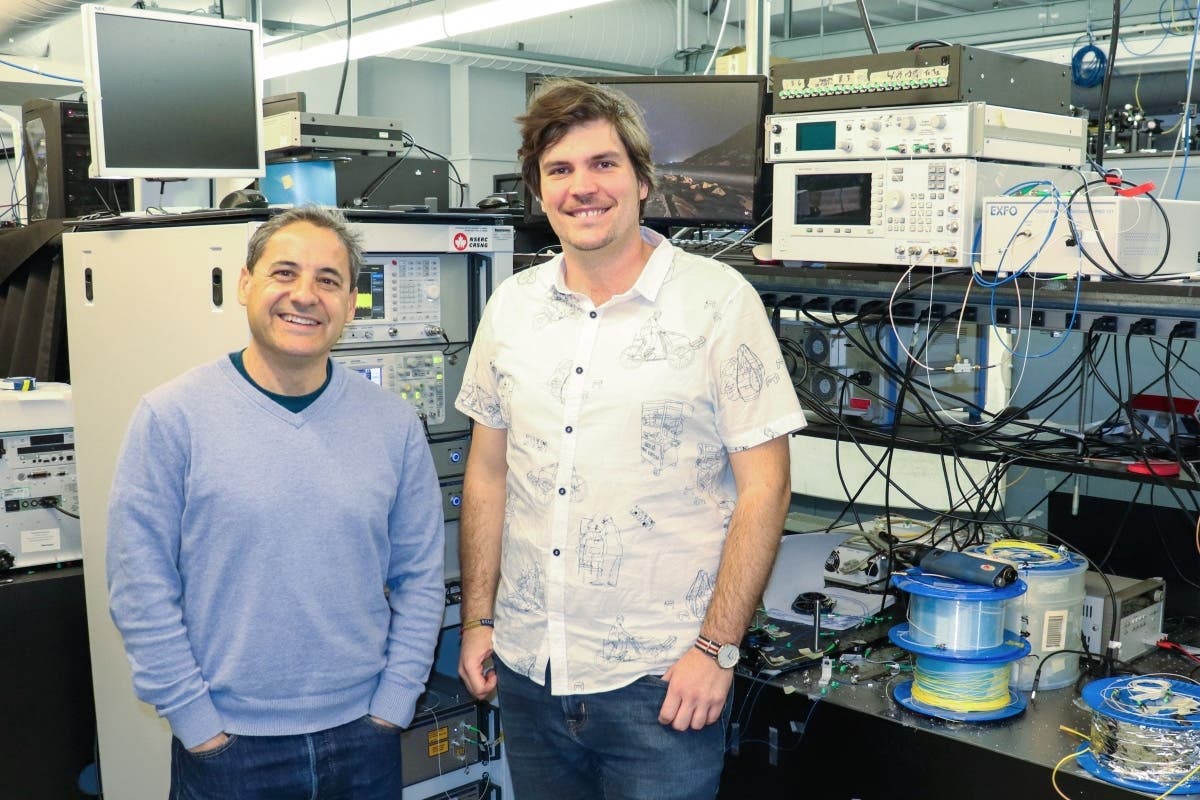
Professor José Azaña and Benjamin Crockett. (CREDIT: INRS)
Bright background light can do more than clutter a quantum experiment. It can wash out the very features that make quantum systems useful in the first place.
That is the problem a team at the Institut national de la recherche scientifique, or INRS, set out to tackle. Working with light particles called photons, the researchers built a way to sift out meaningful quantum signals even when those signals are buried under heavy optical noise. Their results, published in Science Advances, point to a simpler and more energy-efficient route for keeping quantum information intact in messy, real-world conditions.
The work came from the group of Professor José Azaña, in collaboration with Professor Roberto Morandotti’s team. It was carried out by Benjamin Crockett during his PhD at the INRS Énergie Matériaux Télécommunications Research Centre. Crockett has since moved to the University of British Columbia as a Banting postdoctoral fellow.
Quantum technologies depend on detecting the properties carried by single photons. That sounds manageable in a carefully controlled lab. It becomes much harder when the photon you care about is mixed with unwanted light from other sources.
That noise has held back a wide range of systems, including secure quantum communication, quantum sensing, and links between quantum computers.
A trick borrowed from classical optics
Instead of trying to amplify the fragile quantum signal, the team took a different approach. They repurposed a classical optical device called a Talbot Array Illuminator, or TAI, and adapted it for quantum use.
The basic idea is surprisingly visual.
In the study, the researchers compare the process to cleaning up a noisy image. If a blurry picture is passed through the right sequence of lenses, its useful features can be reorganized into sharp, bright points. The background noise does not behave the same way, so the important parts stand out more clearly.
The INRS team applied that same principle in time rather than space. Their system reorganizes photon correlations into distinct temporal peaks, making the quantum information easier to pick out from the noise.
“Seeing quantum properties emerge in a bright environment, without complex processing steps, was one of the most striking results,” Azaña said.
The method works not only for individual photons but also for time-entangled photon pairs, which are a key resource in quantum communication.
What the researchers actually recovered
The team says the system does more than reduce background clutter. It can recover quantum properties that would otherwise be lost.
“With this new methodology, we were able to recover quantum states corrupted by large amounts of noise, states that would otherwise have been lost,” Crockett said. “This could allow quantum systems to operate under real-world noise conditions, helping overcome one of the major barriers to the practical deployment of quantum technologies.”
To test the method, the researchers worked with infrared biphotons near 1550 nanometers using standard telecommunications components. They measured several important indicators of quantum performance, including the coincidence-to-accidental ratio, known as CAR, the Schmidt number, quantum interference visibility, and fidelity.
One result stood out. In a moderately noisy case, the CAR rose from 2.2 before the denoising system to 21.3 afterward, a 9.6-fold improvement.
The team also found that the device could restore signs of entanglement that noise had buried. In interference measurements, visibility improved by as much as 49.3%. In quantum state tomography, fidelity in a noisy case was 0.62 at the input and 0.86 after processing.
Those gains matter because entanglement is central to many quantum technologies. Once noise pushes an entangled state into a separable one, the special quantum advantage can disappear.
Where the method helps, and where it does not
The researchers argue that the approach could be useful in settings where quantum signals must coexist with noisy surroundings, such as optical fibers carrying other traffic or free-space links affected by sunlight.
It also has practical advantages. The system processes multiple wavelength channels at the same time and does not require knowledge of a signal’s exact arrival time or duration. It can be used during transmission, processing, or detection.
Still, the study lays out clear limits.
The method does not remove every kind of noise. If unwanted light shares the same time-frequency distribution as the signal itself, it goes through the same focusing process and cannot be filtered out this way. The current setup also loses about 5.3 decibels through the denoising module, though the team says a lower-loss version should be possible. Another constraint comes from detector timing jitter, which broadens the output peaks and weakens the full denoising effect.
Those are not minor details. They shape how well the system can work outside a proof-of-concept experiment.
The next steps at INRS are to integrate the method onto a chip, test it in optical fibers and free-space channels, and combine it with other techniques to improve future quantum links.
Practical implications of the research
This work suggests quantum systems may not need perfectly dark, tightly controlled environments to function well.
If the method scales as hoped, it could make quantum communication links more practical, improve low-noise measurements, and help preserve fragile quantum states in conditions that now overwhelm them.
Research findings are available online in the journal Science Advances.
The original story "New optical trick pulls hidden quantum signals out of background noise" is published in The Brighter Side of News.
Related Stories
- Microsoft’s quantum breakthrough signals the dawn of ultra-fast computing
- The quantum effect that could power next-gen, battery-free devices
- Scientists build the world’s first large-scale quantum sensor network to search for dark matter
Like these kind of feel good stories? Get The Brighter Side of News' newsletter.
Shy Cohen
Writer