Our world is entering an ‘era of global water bankruptcy’, UN scientists declare
A UN-backed report says humanity has crossed into global water bankruptcy, where water use exceeds nature’s ability to recover.

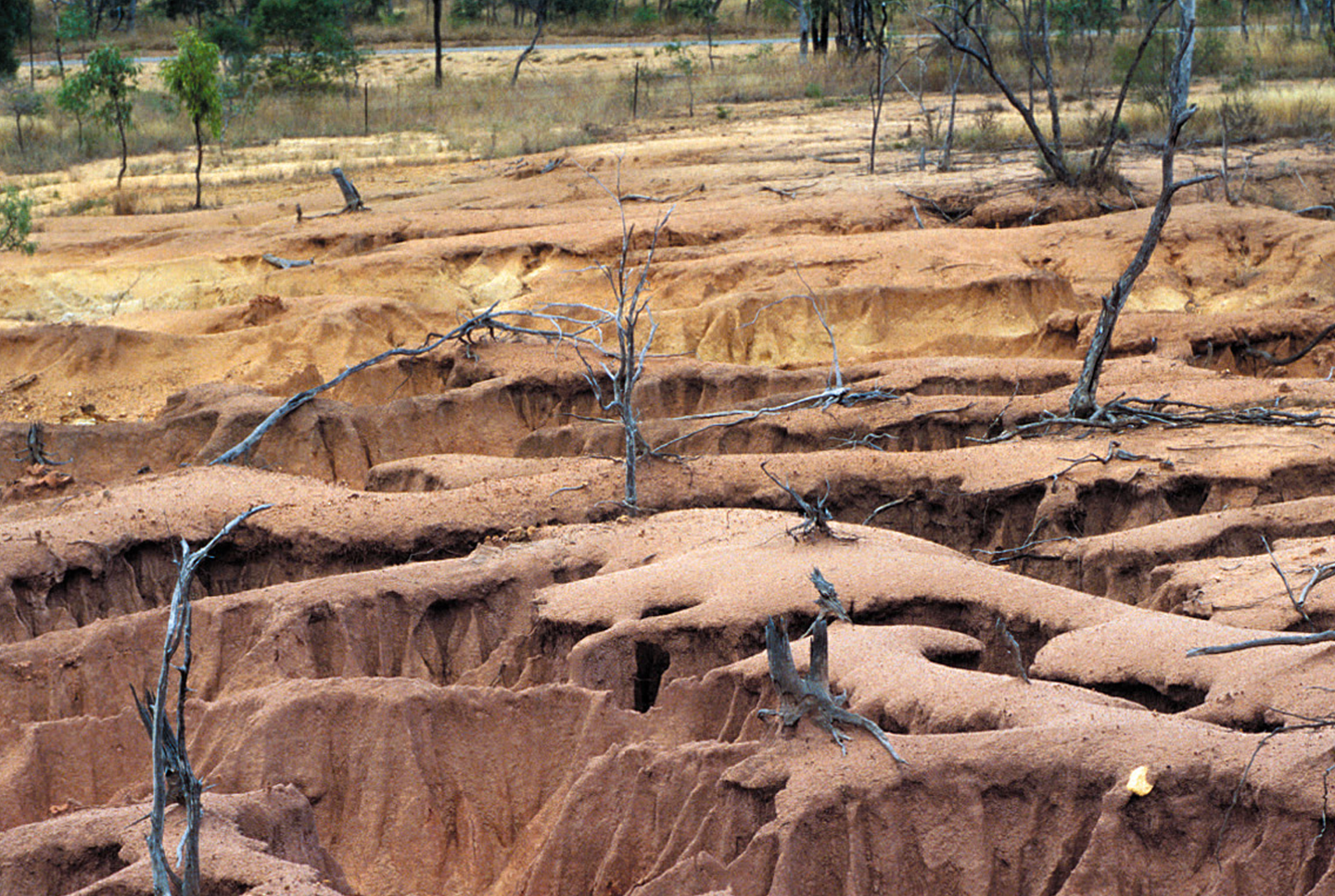
Environmental degradation due to dryland salinity, causing trees to die and inducing serious hillslope gully and sheet erosion at the base of a mesa landscape west of Charters Towers, Northern Queensland, Australia. (CREDIT: CSIRO, Wikimedia Commons)
For decades, we have heard many warnings about a global water crisis. However, a new UN-supported report states that these previous warnings do not capture the extent of the problem. Instead, the authors of this report state that the world has now moved from the crisis phase to a more severe phase called global water bankruptcy.
Kaveh Madani is the lead author of the report entitled Global Water Bankruptcy: Living Beyond Our Hydrological Means in the Post-Crisis Era, which was produced by The City College of New York and the UN University’s Institute for Water, Environment and Health, which is often referred to as the UN’s “think tank” for water issues. This report drew its conclusions from peer-reviewed literature in the journal Water Resources Management, as well as from an extensive worldwide dataset.
Most of the world’s population, around 75%, now lives in regions that are either insecure with respect to water supplies or are critically insecure. The report contends that the concept of water bankruptcy differs from temporary shortages in that it describes a long-term, permanent imbalance in water supply and demand, where humanity is consuming more water than can be produced naturally.
When Nature’s Savings are Gone
In much the same way that a bank account or credit card provides a source of money for individuals to use, so too do rivers, snowpack, aquifers, wetlands, glaciers, and soil moisture. In addition to receiving annual “income” from rainfall and runoff, for many years societies have relied upon long-term sources of water savings.
Madani stated, “We can no longer consider water shortages to be temporary emergencies. When you consistently spend more than you earn in a financial sense, you become bankrupt.” “Our water checking and savings accounts have also been depleted.”
As shown in the report, these accounts now contain only about 30% of their original amounts. The glaciers that support billions of people have lost over 30% of their mass since 1970 and are becoming weaker.
Around 70% of the major aquifers throughout the world are now showing long-term declines due to excessive withdrawals. As these aquifers empty out, the land is sinking, in some cases by up to 25 centimeters (10 inches) annually.
In addition to these water towers, or buffers, many ecosystems have also been greatly reduced. Between 1970 and 2018, approximately 410 million hectares (1 billion acres) of wetlands were lost, an area equivalent to the European Union. Wetlands helped filter and clean wastewater, reduce flooding, and provide wildlife habitat. The economic value of the ecosystem services provided by wetlands is estimated to be worth over $5.1 trillion.
Agriculture, Cities, & Higher Prices
These numbers illustrate that water bankruptcy reaches far beyond rivers and lakes. Approximately 70% of all freshwater used in the world for food production occurs in agriculture.
About half of the food produced in the world comes from areas that consist of collective groundwater sources that are either diminishing or on the verge of being depleted.
“Millions of farmers are doing everything they can to produce more food, but they are working with an increasingly limited, contaminated, and poor-quality supply,” said Madani. He predicts that if no significant changes are made, there will be far-reaching effects on food availability in the future.
Already, the damage being inflicted on the economy due to man-made droughts is estimated to be around $307 billion annually. In total, around 100 million hectares of cropland are suffering from salt poisoning, and one out of four people worldwide does not have access to clean and properly treated drinking water.
There are also many more people who do not have access to proper sanitation facilities. Today’s cities also face growing risks. Approximately 2 billion people live in areas experiencing land subsidence. The combination of land subsidence in coastal areas and river deltas with rising sea levels will increase flooding risk.
Rethinking Terminology
According to the report, the terms “water stress” and “water crisis” do not accurately represent today’s circumstances. Water stress can be overcome; however, water crises are fleeting shocks from which recovery is possible. Water bankruptcy is a long-term problem with permanent damage that has eliminated natural capital from the water system.
A region may experience flooding one year and still be water bankrupt if it continues to withdraw more water than it can replenish on a long-term basis. “It does not matter how wet or dry a location may be,” said Madani. “It is about balance, accounting, and sustainability.”
While not every basin has reached this point, enough basins have crossed this line to create a new global risk. Water systems around the world are connected because they share trade, migration, climate feedbacks, and geopolitical risks. When one region is unable to maintain its water system, its problems will be felt by other areas through increased food costs, impacts on global supply chains, and increased pressure on local governments.
High-Risk Areas
The study identifies specific geographical areas where multiple pressures are converging. In the Middle East and Northern Africa, high water demand coincides with growing vulnerability to climate change and increasing reliance on energy-intensive desalination. South Asia is experiencing declining groundwater levels as a result of excessive agricultural withdrawals, increased urbanization, and rapid population growth. In the Southwestern United States, the Colorado River has become a symbol of the unmet promise of abundant water.
There is also a broader global trend related to regional water issues. Approximately 50% of the world’s largest lakes have decreased in volume since the early 1990s, and dozens of the world’s large rivers stop flowing to the ocean for parts of the year. Many river basins have been overdrawing their natural water supplies for more than 50 years.
The effects of water bankruptcy are globally dispersed because food systems are interconnected across national and regional borders. As a result, localized water failures become a shared risk.
Rethinking Global Water Policy
As world leaders prepare for the UN Water Conferences in 2026 and 2028, the authors of the report recommend a shift in the global water agenda. Instead of reacting to emergencies, they call for what they describe as bankruptcy management.
Bankruptcy management entails protecting remaining aquatic ecosystems, rebalancing water rights based on reduced withdrawal capacity, and assisting communities in transitioning to alternative sources of income. In addition, the new global water agenda would transform water-dependent industries through crop changes, modified irrigation methods, and the development of more efficient cities.
The report argues that water should be viewed as a central component of climate, biodiversity, and land-use negotiations, rather than as a secondary issue. Investing in water can facilitate cooperation in conflict-ridden regions because every country depends on it.
Globally, water bankruptcy signifies inequity, instability, and uncertainty about the future.
Justice, Stability, and the Future
The burden associated with water bankruptcy often falls on smallholder farmers, Indigenous peoples, the urban poor, women, and youth, while the benefits of water overexploitation accrue to those with political and economic power.
According to UN Under-Secretary-General and UN University Rector Tshilidzi Marwala, “Water bankruptcy is now driving instability, displacement, and conflict.” He adds that equitable management of water bankruptcy is essential to ensuring peace and social stability.
While the report is a grim reminder of reality, Madani emphasizes that it is not a message of hopelessness. “To declare bankruptcy means turning the corner on your former way of thinking. It does not mean giving up,” said Madani. “It means re-establishing yourself.”
Implications of Findings for Future Practice
Governments and researchers must acknowledge the finite limits of the world’s freshwater in terms of how much natural water can be used annually. Raising awareness of water bankruptcy will change how water is managed, consumed, and improved. This shift will move the focus from temporary, supply-driven fixes to sustainable freshwater management over extended periods.
Future research is likely to include initiatives related to water bankruptcy, particularly the development of early warning systems, improved monitoring through satellite and modeling techniques, and policies that link water planning with agricultural, energy, and climate objectives.
The potential benefits of addressing water bankruptcy for communities include fairer access to water, reduced risk of sudden shortages, and stronger protection of ecosystems that support livelihoods. If action is taken now, society may avoid escalating losses and reduce conflicts associated with declining freshwater supplies.
Research findings are available online at the United Nations University Institute for Water, Environment and Health.
Related Stories
- Solving the global water crisis: Hydropanel produces 10 liters of safe drinking water every day
- Study finds groundwater loss is spiraling out of control - affecting billions worldwide
- NASA study exposes increasing human effects on the global water cycle
Like these kind of feel good stories? Get The Brighter Side of News' newsletter.

Rebecca Shavit
Writer
Based in Los Angeles, Rebecca Shavit is a dedicated science and technology journalist who writes for The Brighter Side of News, an online publication committed to highlighting positive and transformative stories from around the world. Her reporting spans a wide range of topics, from cutting-edge medical breakthroughs to historical discoveries and innovations. With a keen ability to translate complex concepts into engaging and accessible stories, she makes science and innovation relatable to a broad audience.