Pigs and grizzly bears may be the key to youthful human skin
Scientists discovered a hidden skin structure forms after birth, not before, changing how aging and healing may be treated.

 Edited By: Joseph Shavit

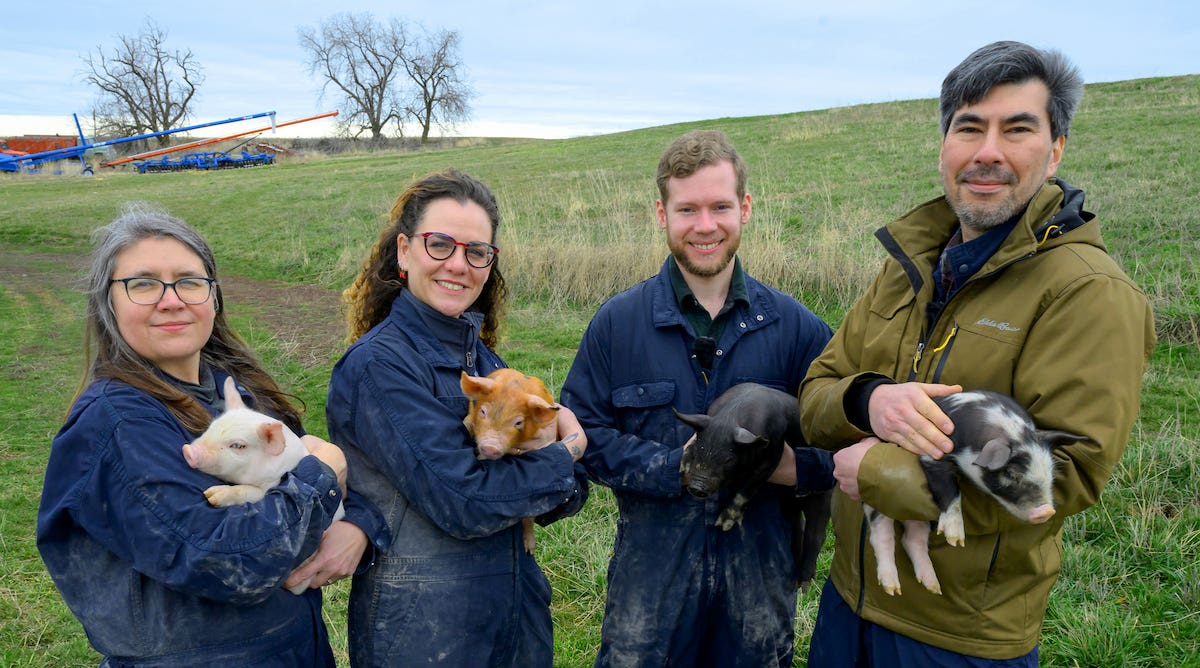
From left, Iwona Driskell, scholarly assistant professor, Michela Ciccarelli, assistant professor, Sean Thompson, PhD graduate student, and Ryan Driskell, associate professor, pose for a photo while holding piglets at a farm near Garfield, Wash. (CREDIT: Ted S. Warren, College of Veterinary Medicine)
A tiny structure hidden beneath the skin may hold clues to smoother skin and better healing. New research shows this feature forms after birth, not before, and scientists now know what controls it.
Researchers at Washington State University’s College of Veterinary Medicine led the work, with early help from the University of California, Irvine. The team focused on rete ridges, small ridge-and-valley shapes that help bind skin layers together. These structures give skin strength and stretch, much like Velcro.
For years, most scientists believed rete ridges formed during fetal growth. That assumption slowed progress. By closely tracking skin development in pigs, the researchers found the ridges appear only after birth. The discovery reshapes how skin growth is understood.
“These structures degrade as we age; now we know how they form and have a blueprint to guide future work on restoring them,” said Ryan Driskell, an associate professor in the School of Molecular Biosciences. “Most scientists assumed these skin ridges formed during early embryonic development, which explains why no one really understood their origin.”
Looking beneath the fur
Rete ridges anchor the outer skin layer to deeper tissue. As these ridges flatten over time, skin becomes thinner and weaker. Wrinkles deepen, and wounds heal more slowly.
Finding the right animal model proved critical. Mice and non-human primates are common in skin research, but their furry skin lacks rete ridges.
“When most people look at the skin of different animals, they see differences in fur,” said Sean Thompson, a doctoral student and first author. “Rete ridges lie under the surface of skin, however, so it wasn’t until we looked closer that we discovered that animals with thicker skin, like pigs, grizzly bears and dolphins, have rete ridges like we do.”
Grizzly bears offered clues about how size affects skin structure, but their slow growth limited daily study. Pigs, however, develop quickly and share similar skin thickness with humans. Working with local farmers, the team collected pig skin samples across early life stages.
“We expected this structure to be established before birth, so seeing it emerge afterward was a surprise,” Driskell said. “That timing changes how we think skin architecture is built and why it may be possible to influence it later in life.”
A molecular switch for skin strength
Genetic mapping revealed the trigger behind ridge formation. The team found bone morphogenetic protein, or BMP, signaling directs cells to form rete ridges. This same pathway fades as skin ages.
“That BMP signaling drives rete ridges is exciting as it holds significant translational potential,” said Maksim Plikus, a professor at the University of California, Irvine. “Use of BMP proteins has already been FDA-approved for orthodontic applications, mapping the way for their use in aged skin and scars.”
Because BMP-based treatments already exist, future therapies could arrive faster. The findings may also help treat conditions like psoriasis.
Beyond medicine, the work could improve livestock health. Understanding skin structure may help farmers raise animals better suited for heat or cold. Driskell has filed a provisional patent tied to the discovery.
Practical Implications of the Research
The findings open paths toward treatments that restore skin strength and improve healing. You may one day benefit from therapies that reduce scars or slow skin aging.
Researchers can also explore safer ways to repair damaged skin. In agriculture, animals may gain better protection from harsh climates.
Overall, the work connects basic biology with real-world health benefits.
Research findings are available online in the journal Nature.
Related Stories
- Scientists create skin graft health monitor that glows in response to inflammation
- Tanning beds turn young skin genetically old, study finds
- Most Europeans had dark skin until 3,000 years ago, study finds
Like these kind of feel good stories? Get The Brighter Side of News' newsletter.
Joshua Shavit
Writer and Editor
Joshua Shavit is a NorCal-based science and technology writer with a passion for exploring the breakthroughs shaping the future. As a co-founder of The Brighter Side of News, he focuses on positive and transformative advancements in technology, physics, engineering, robotics, and astronomy. Joshua's work highlights the innovators behind the ideas, bringing readers closer to the people driving progress.