Radiation ‘cavity’ near the moon may reduce astronaut exposure to cosmic radiation
A newly identified drop in cosmic radiation near the moon could change how astronauts plan lunar missions.

 Edited By: Joseph Shavit

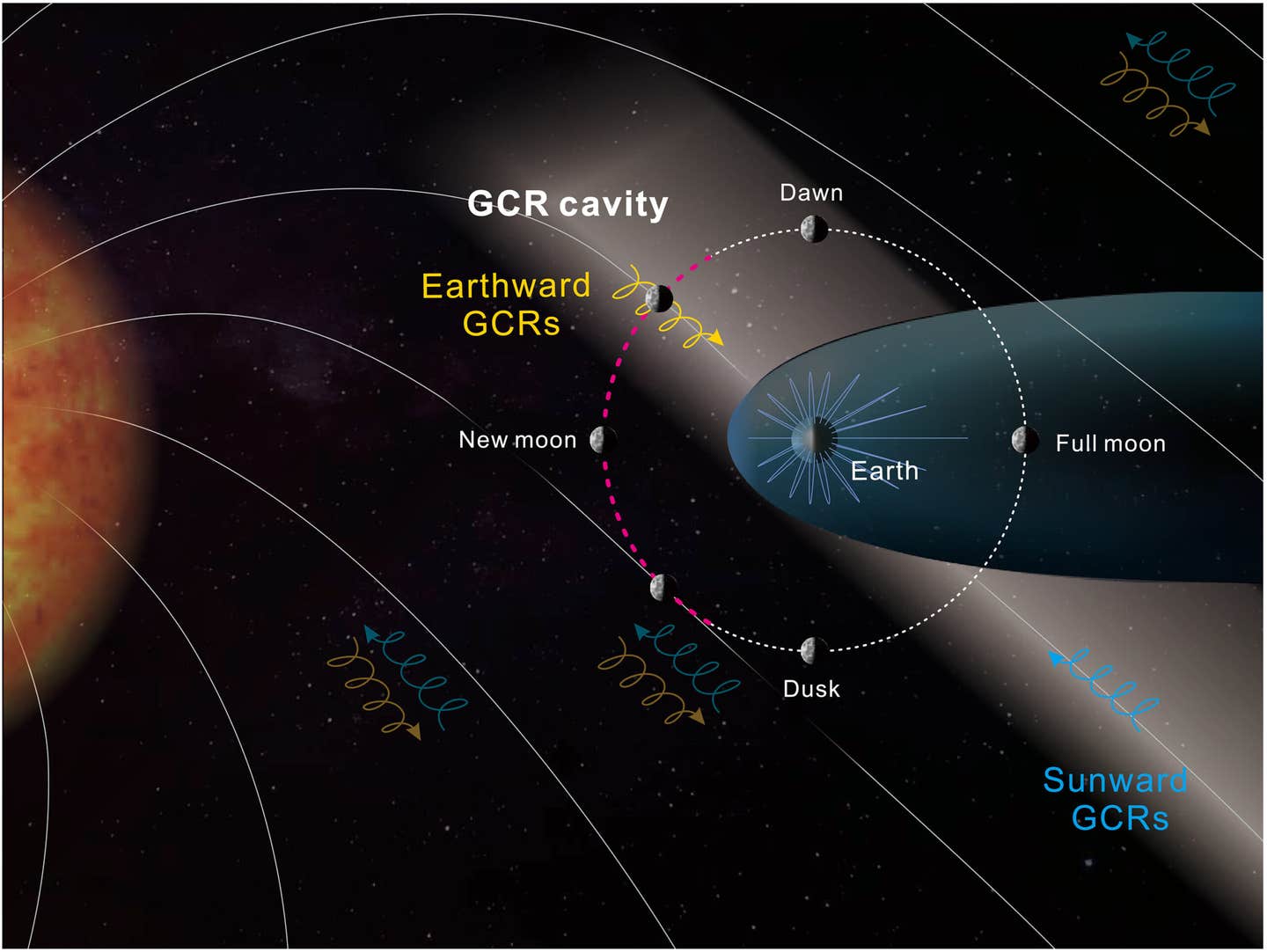
Illustration of the formation of the GCR cavity in the ecliptic plane. The white lines from the Sun show the typical pattern of magnetic field lines in interplanetary space, referred to as the Parker spiral IMF. (CREDIT: Shang et al., Sci. Adv. 12, eadv1908)
For a few hours each lunar day, the radiation environment near the moon quietly shifts.
Measurements now suggest that parts of the moon’s orbit pass through a region where harmful cosmic radiation drops noticeably. The effect is not dramatic, but it is consistent. And for astronauts, even a modest reduction could matter.
Data from China’s Chang’e-4 lander point to what researchers describe as a “cavity” in space, a zone where galactic cosmic rays thin out. The finding, published in Science Advances, adds a wrinkle to how scientists understand the space between Earth and its nearest neighbor.
A dip in radiation, tied to lunar time
The change appears during the moon’s local morning, specifically a few hours after lunar sunrise. During that window, lower-energy cosmic ray protons fall by about 20 percent compared with later periods in the lunar day.
That drop showed up repeatedly across 31 lunar cycles, using data collected between January 2019 and January 2022. The measurements came from the Lunar Lander Neutron and Dosimetry instrument aboard Chang’e-4, which sits on the far side of the moon.
Researchers sorted the incoming particles by energy and grouped them by local lunar time. The clearest signal came from lower-energy protons, in the range of 9.18 to 34.14 mega-electron-volts. Higher-energy particles showed a similar trend, though less pronounced.
The pattern was not random. It appeared at the same point in the moon’s orbit, during the waxing phase, when the moon sits in a specific position relative to Earth and the Sun.
“I had not expected to see this ‘shadow’ or cavity,” said Robert Wimmer-Schweingruber, a professor at Kiel University and a corresponding author of the study. “It makes absolute sense in retrospect, but I was very skeptical when I first saw this result.”
A magnetic reach farther than expected
Cosmic rays are high-energy particles that travel through space at nearly the speed of light. Most originate outside the solar system, likely from events such as supernova explosions. They can pass through spacecraft and human tissue, damaging DNA and raising long-term health risks, including cancer and nervous system effects.
On Earth, the planet’s magnetic field and atmosphere block most of that radiation. Beyond the magnetosphere, however, scientists have long assumed the particles spread fairly evenly through space.
This study challenges that assumption.
The team found that Earth’s magnetic field appears to interfere with cosmic rays even beyond its known boundary. The effect creates a region of reduced radiation extending toward the moon, on the side facing the Sun.
The mechanism comes down to how charged particles move. Cosmic ray protons spiral along magnetic field lines. When those lines connect back toward Earth, some particles are deflected or blocked, creating a relative drop in counts.
Simulations of particle motion reproduced the same pattern seen in the data, strengthening the case that Earth’s magnetic field is shaping the distribution.
Why lower-energy particles drop more
Not all cosmic rays behave the same way. Lower-energy protons are more easily influenced by magnetic fields than higher-energy ones.
That difference showed up clearly in the measurements.
Particles in the lower-energy range experienced a stronger reduction because their motion is more tightly curved by magnetic fields. Higher-energy particles, with larger trajectories, are less affected and continue moving more freely.
The size of Earth’s magnetosphere on the dayside, about 6 to 10 Earth radii, overlaps with the motion scale of these lower-energy particles. That overlap allows the magnetic field to act as a partial barrier, even far from the planet.
The effect appears strongest when the moon is in a “prenoon” position relative to Earth, when magnetic field lines are aligned in a way that links the moon back to Earth’s field.
A moving window of reduced exposure
The moon does not stay inside this lower-radiation region for long.
According to the study, it spends roughly two days during each orbit passing through this cavity. The timing corresponds to local lunar hours between about 8 and 10 in their phase-based system, which maps to the early part of the lunar day.
Outside that window, especially in the afternoon sector, cosmic rays flow more freely, and radiation levels rise again.
The researchers also confirmed similar patterns using data from another instrument, the Cosmic Ray Telescope for the Effects of Radiation aboard NASA’s Lunar Reconnaissance Orbiter.
Rethinking radiation between Earth and the moon
The findings suggest Earth’s magnetic influence extends farther into space than previously assumed, at least along certain directions shaped by the interplanetary magnetic field.
Scientists had expected some effects in the magnetotail, the long extension of Earth’s magnetic field on the nightside. Observing a similar influence on the sunward side was less anticipated.
The study does not yet define the full size of this cavity. The authors note that it likely extends beyond the moon’s orbit and gradually fades due to particle diffusion. More data will be needed to map its boundaries and behavior in detail.
Practical implications of the research
Even a 20 percent drop in radiation could shape how future lunar missions are planned. Activities outside spacecraft, including spacewalks and surface work, could be scheduled during these lower-exposure periods.
The timing will matter more as human missions move beyond low Earth orbit. With programs like Artemis aiming for sustained lunar presence, small reductions in radiation exposure could accumulate into meaningful health benefits over time.
The idea is simple: on the moon, morning may be the safest time to step outside.
Research findings are available online in the journal Science Advances.
The original story "Radiation 'cavity' near the moon may reduce astronaut exposure to cosmic radiation" is published in The Brighter Side of News.
Related Stories
- Earth’s magnetic field funneled atmospheric elements to the Moon over billions of years
- Chang’e-6 samples show ancient lunar impacts left rust on the Moon
- Innovative habitat enables astronauts to safely live on the Moon
Like these kind of feel good stories? Get The Brighter Side of News' newsletter.
Joshua Shavit
Writer and Editor
Joshua Shavit is a NorCal-based science and technology writer with a passion for exploring the breakthroughs shaping the future. As a co-founder of The Brighter Side of News, he focuses on positive and transformative advancements in technology, physics, engineering, robotics, and astronomy. Joshua's work highlights the innovators behind the ideas, bringing readers closer to the people driving progress.