Radiocarbon dating finds Ukraine’s mammoth bone shelters were used 18,000 years ago
New dating of fox, hare and wolf bones narrows the timeline for Ukraine’s famous mammoth-bone shelters.

 Edited By: Joseph Shavit

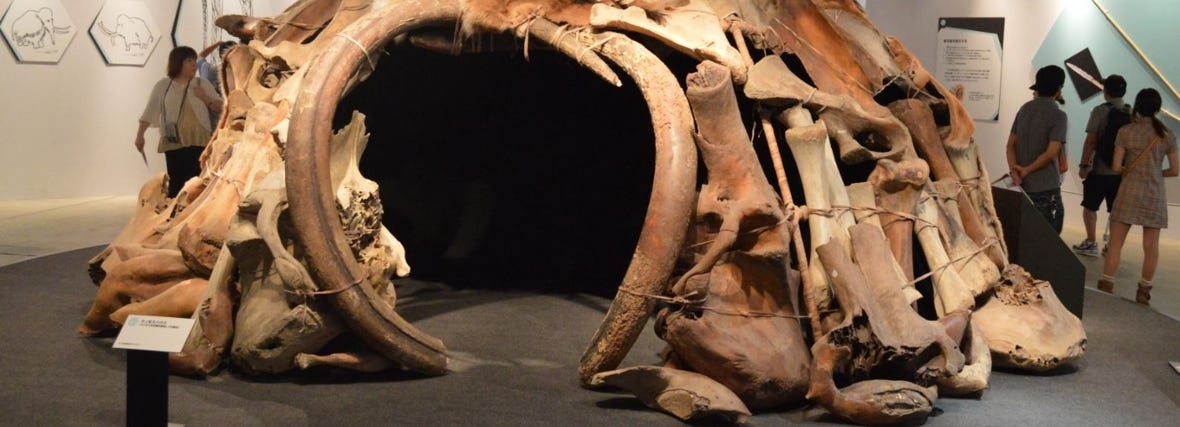
New radiocarbon dates show Ukraine’s mammoth bone shelters were used briefly around 18,000 years ago. (CREDIT: Leiden University)
Life on the windswept plains of what is now central Ukraine offered little mercy around 18,000 years ago. Trees were scarce. Winters could bite for months. Yet people still returned to certain places to hunt, work and rest. At a famous site called Mezhyrich, new research suggests they also built sturdy shelter using what the landscape provided in abundance: mammoth bones.
The new analysis, published in Open Research Europe, was co-authored by archaeologist Wei Chu of Leiden University and Pavlo Shydlovskyi of Taras Shevchenko National University of Kyiv. Their team revisited long-running questions about Mezhyrich’s mammoth-bone structures. Researchers have debated for decades whether these bone rings were homes, storage spaces or even monuments. The new study sharpens the timeline using more precise radiocarbon dating tied closely to human activity.
Mezhyrich sits about 70 miles southeast of Kyiv, near the village that shares its name. Excavations from 1966 to 1974 revealed mammoth remains arranged in ways that looked deliberate. Archaeologists later identified four mammoth-bone structures. Each structure measured roughly 12 to 24 square meters, with pits, toolmaking zones and dense cultural layers nearby.
Those early digs brought worldwide attention, but they also left gaps. Provenience records were limited for some finds, which made later interpretation harder. A fourth structure discovered in 1976, called Mammoth Bone Structure 4 or Dwelling 4, became especially important because it preserved clearer internal layers and surrounding activity areas.
A tighter clock for a famous site
Earlier dating placed Mezhyrich across a wide window, sometimes stretching from about 19,000 to 12,000 years ago. That spread fed uncertainty. Some dates came from mammoth bones, and those bones might not mark the moment people lived there. Hunters could have collected older remains from natural bone accumulations. If so, the radiocarbon clock would reflect when mammoths died, not when people built with their bones.
To reduce that problem, the team dated smaller animals found in specific cultural layers. They focused on bones from fox, hare and wolf because those remains are more likely to reflect human handling within particular occupation layers. One sample even showed cutmarks, supporting the idea that people accumulated at least part of the small-animal assemblage.
The researchers produced new AMS radiocarbon ages and modeled them with OxCal software using the IntCal20 calibration dataset. They also paired Bayesian start-end modeling with Kernel Density Estation to handle uncertainty across dates. The lab work followed standard pretreatment protocols at the Centre for Isotope Research at Groningen University.
Most samples preserved usable collagen. Carbon-to-nitrogen ratios fell in accepted ranges, which signals reliable preservation. Each AMS age came with a tight uncertainty of about ±40 years, a major improvement over older conventional dates that carried far larger error ranges.
The result: a much narrower period of activity. After removing two outlier dates that likely reflected mixing from trampling or burrowing animals, the preferred model constrained site use to less than 429 years. The largest structure’s modeled window fell within 18,248–17,764 years ago. That places Mezhyrich close to the cold aftermath of the Last Glacial Maximum, the harshest portion of the last Ice Age.
What the shelters may have looked like
The new timeline matters, but the construction details also help explain why these structures look like practical shelter rather than symbolic monuments. Shydlovskyi described how the base may have been built.
"We found the foundation of the shelters had mammoth skulls and large long bones, set vertically into the ground forming a foundation," Shydlovskyi told The Brighter Side of News.
"Above that, people likely added a wooden framework where they could, then covered it with hides or possibly birch bark. The roof needed to resist wind. Heavy bones helped," he continued.
In addition, "tusks and large flat bones were placed on the upper part of the roof structure functioning as weights and wind protection," he concluded.
Around the structures, researchers have documented pits filled with artifacts and animal remains, plus defined zones for butchering and toolmaking. Together, these features have been described as “economical settlement units,” with each mammoth-bone structure serving as the hub of a small activity cluster.
Short visits, not a permanent village
Even with a tighter model, one question stays tricky: how many times did people return? Radiocarbon dating cannot always separate repeated brief stays from a longer, continuous occupation. Dates can look nearly simultaneous even if visits were spaced out over years.
Still, the study argues that Mezhyrich’s Dwelling 4 and its nearby features overlap so strongly in time that clear gaps do not appear in the radiocarbon record. That pattern supports the idea of short occupations within a relatively brief period, perhaps on the scale of a few generations.
The findings also push back on claims that such mammoth-bone structures were mainly symbolic. Scholars have proposed alternatives at some sites, including food caches, burials, bone beds or ritual features. At Mezhyrich, the researchers emphasize dense domestic debris inside and around Dwelling 4, along with multiple internal layers that suggest repeated activity in the same footprint.
One line from the source material captures the broader point. "The mammoth dwellings show how communities thrived in extreme environments, turning the remnants of giant animals into protective architecture," the archaeologists shared with The Brighter Side of News.
Practical Implications of the Research
This work changes how you can think about early human engineering. By tightening the timeline, the study makes it harder to treat Mezhyrich as a long-lived Ice Age village. Instead, it looks like a place people used strategically, returning when conditions and game made it worth the journey. That shift matters for future research because it encourages archaeologists to test “how long” questions with materials closely tied to human activity, not just dramatic building bones that may be older than the occupation.
The study also strengthens a bigger lesson about adaptability. When wood ran short, people did not give up on building shelter. They experimented with available materials and created structures that could block wind, hold coverings and anchor a living space in frozen ground.
For humanity today, it is a reminder that innovation often comes from constraint. For science, the research offers a practical model for revisiting classic sites with better dating tools, clearer sampling strategies and careful attention to how deposits can mix over time.
Research findings are available online in the journal Open Research Europe.
Related Stories
- Oldest RNA ever discovered offers a rare look into the lives of woolly mammoths
- Million-year-old microbes found in mammoths reveal new purpose for DNA
- Scientists discover what caused the woolly mammoth to die-off
Like these kind of feel good stories? Get The Brighter Side of News' newsletter.
Joshua Shavit
Writer and Editor
Joshua Shavit is a NorCal-based science and technology writer with a passion for exploring the breakthroughs shaping the future. As a co-founder of The Brighter Side of News, he focuses on positive and transformative advancements in technology, physics, engineering, robotics, and astronomy. Joshua's work highlights the innovators behind the ideas, bringing readers closer to the people driving progress.