Researchers believe a satellite crash could happen in 5.5 days
A new CRASH Clock metric estimates a major collision could occur in 5.5 days if satellites lost steering, highlighting growing orbital stress.

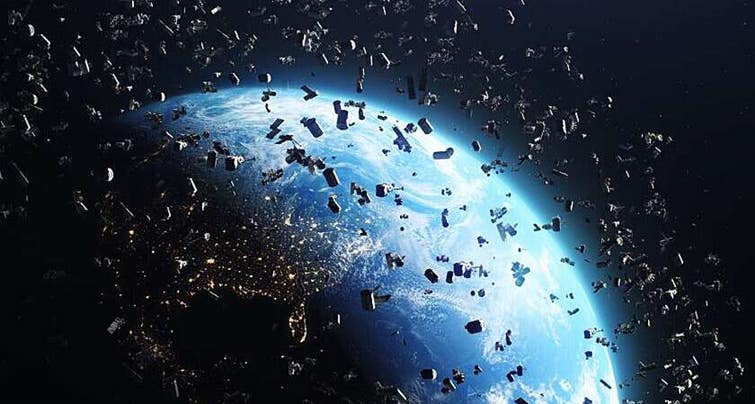
A new CRASH Clock metric shows how fast a major satellite collision could occur if maneuvers suddenly stopped. (CREDIT: Wikimedia / CC BY-SA 4.0)
Low Earth orbit now holds thousands of satellites, and the count keeps rising. That growth has made space feel roomy in theory, but tight in practice. In a new study, researchers from Princeton University, the University of British Columbia and the University of Regina propose a simple warning metric: the Collision Realization And Significant Harm Clock, or CRASH Clock.
Graduate student Sarah Thiele, now at Princeton, helped lead the work after starting it as a Ph.D. student at the University of British Columbia. Her co-authors include physics and astronomy professor Aaron Boley at the University of British Columbia in Vancouver, Canada, and astronomy associate professor Samantha Lawler at the University of Regina in Saskatchewan, Canada. Their paper asks a blunt “what if” question: If satellite operators suddenly could not steer, how long would it take before a major crash becomes likely?
Their current answer is 5.5 days. That number comes from a worst-case thought experiment where maneuvering stops across low Earth orbit, whether from a severe solar storm, a software failure, or some other broad disruption.
What the Clock Measures, and What It Does Not
Thiele says the CRASH Clock has been misunderstood as a countdown to Kessler syndrome, the scenario where debris triggers a runaway chain of collisions. “A lot of people are claiming we’re saying Kessler syndrome is days away, and that’s not what our work is saying. We’re not making any claim about this being a runaway collisional cascade. We only look at the timescale to the first collision, we don’t simulate secondary or tertiary collisions. The CRASH Clock reflects how reliant we are on errorless operations and is an indicator for stress on the orbital environment.”
Boley agrees the popular image of Kessler syndrome skews toward instant chaos. “A lot of people’s mental vision of Kessler syndrome is this very rapid runaway, and in reality this is something that can take decades to truly build.”
The clock is meant to show dependency. Low Earth orbit can remain stable, but only if operators keep making correct choices every day. As the margin for error shrinks, a single mistake can matter more, especially in crowded altitude bands.
The Real Threat Is Often the Debris You Cannot Track
Boley says the scariest hazard often is not the large junk that tracking networks can follow. “The biggest risk on orbit is the lethal non-trackable debris; this middle region where you can’t track it, it won’t cause an explosion, but it can disable the spacecraft if hit,” he told The Brighter Side of News.
"In other words, a small strike can turn a working satellite into a drifting obstacle. That increases risk for everyone. Collision danger depends on more than how many objects exist. It also depends on how much “target area” satellites present as they move through orbit," he added.
“The collisional area on orbit” rises as more satellites deploy, he concluded. "As that area grows, the odds increase that a satellite intersects tiny, untracked fragments."
Why Certain Altitudes Feel Like Rush Hour
Lawler points to the scale of modern operations. “Starlink just released a conjunction report; they’re doing one collision avoidance maneuver every two minutes on average in their megaconstellation.”
The 550-kilometer band stands out. Thiele says that region has the highest density of active payloads. Lawler adds that heavy use of one band creates problems for everyone who must pass through it. “The way Starlink has occupied 550 km and filled it to very high density means anybody who wants to use a higher-altitude orbit has to get through that really dense shell.”
That includes new constellations. “China’s megaconstellations are all at higher altitudes, so they have to go through Starlink,” Lawler says. She notes recent headlines about near-misses involving Starlink and Chinese hardware. “These problems are happening now.”
Above about 600 kilometers, drag no longer “cleans up” debris quickly. Thiele says that matters at 800 to 900 kilometers, where old fragments can linger for centuries. Two famous sources dominate that band: the 2007 Chinese anti-satellite missile test and the 2009 Cosmos-Iridium collision.
Solar Storms Turn Crowded Orbits Into Hard Mode
Solar storms do not just make auroras. They can swell Earth’s upper atmosphere, increasing drag and making satellite positions harder to predict. Lawler describes how fast uncertainty can spike. “Solar storms make the atmosphere puff up; high-energy particles smashing into the atmosphere. Drag can change very quickly. During the May 2024 solar storm, orbital uncertainties were kilometers. With things traveling 7 kilometers per second, that’s terrifying.”
Crowded conditions make that uncertainty more dangerous. Thiele says the first days after a storm can be especially risky. “Even if you can still communicate with your satellite, there’s so much uncertainty in your positions when everything is moving because of atmospheric drag. When you have high density of objects, it makes the likelihood of collision a lot more prominent.”
A second storm problem can be worse: loss of control. A solar event can disrupt navigation or communications, leaving a satellite unable to dodge. In the CRASH Clock scenario, that kind of widespread maneuver loss is the core trigger.
From 2018 to 2025, the Safety Margin Shrunk Fast
The team first posted its work to arXiv in December. After feedback, the authors updated key numbers. Thiele explains the change. “We updated based on community feedback, which was excellent. The newer numbers are 164 days for 2018 and 5.5 days for 2025. The paper is submitted and will hopefully go through peer review.”
Lawler says the feedback strengthened the study. “It’s been a very interesting process putting this on Arxiv and receiving community feedback. I feel like it’s been peer-reviewed almost; we got really good feedback from top-tier experts that improved the paper.” She also warns against treating 5.5 days as comforting. “If you think 5.5 days is okay when 2.8 days was not, you missed the point of the paper.”
Thiele says the goal is to build a shared language for risk. “The paper is quite interdisciplinary. My hope was to bridge astrophysicists, industry operators, and policymakers; give people a structure to assess space safety.”
In their analysis, close approaches have become routine. A “close approach” can mean two satellites pass within less than a kilometer. Across low Earth orbit megaconstellations, the authors estimate such events can happen about once every 22 seconds. For Starlink alone, similar close passes occur roughly every 11 minutes. The paper also cites operator reporting that suggests frequent collision-avoidance maneuvers across large constellations.
Practical Implications of the Research
The CRASH Clock offers a clear stress gauge for a shared environment. A short clock does not guarantee a cascade, but it signals low tolerance for error. That can shape policy by giving regulators and industry a measurable way to discuss “how crowded is too crowded.”
The metric can also influence engineering choices. More resilient navigation, better storm forecasting, faster tracking of new debris, and safer deorbit plans all become more valuable when the safety margin tightens.
For operators, the clock highlights a systems problem. Collision avoidance depends on continuous, correct actions from many players. That raises the case for stronger coordination norms, more transparent reporting, and better “rules of the road” across national and commercial fleets.
For the public, the findings underline a real dependency. Satellites support communication, navigation and Earth observation. A widespread loss of control in orbit could disrupt services on the ground and raise long-term costs by forcing more launches and replacements.
Research findings are available online in the journal arXiv.
Related Stories
- Scientists turn earthquake sensors into dangerous space debris trackers
- Space debris sensor promises safer future for satellites
- Danger from above: Space debris poses major risk of falling into busy airspace
Like these kind of feel good stories? Get The Brighter Side of News' newsletter.

Joseph Shavit
Writer, Editor-At-Large and Publisher
Joseph Shavit, based in Los Angeles, is a seasoned science journalist, editor and co-founder of The Brighter Side of News, where he transforms complex discoveries into clear, engaging stories for general readers. With vast experience at major media groups like Times Mirror and Tribune, he writes with both authority and curiosity. His writing focuses on space science, planetary science, quantum mechanics, geology. Known for linking breakthroughs to real-world markets, he highlights how research transitions into products and industries that shape daily life.