Researchers reveal when mosquitoes first developed a taste for early humans
A genetic timeline hints that human-feeding mosquitoes in Southeast Asia may date back to Homo erectus.

 Edited By: Joseph Shavit

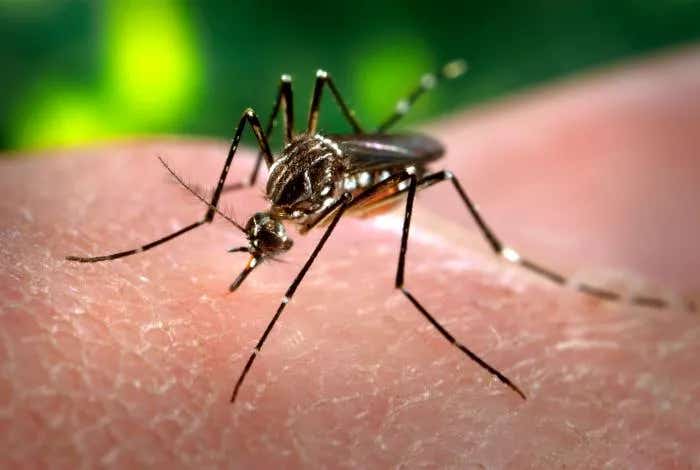
Malaria remains a major global health burden, with an estimated 249 million cases and 608,000 deaths worldwide in 2022. (CREDIT: James Gathany / CDC)
A warm body in the rainforest gives off a loud chemical signal. For most mosquitoes, that signal could belong to almost any mammal. For a small set of Southeast Asian malaria vectors, it may have become something more specific: a human scent worth seeking.
A study in Scientific Reports argues that this human-leaning appetite in parts of the Anopheles leucosphyrus group may trace back far deeper than modern history. It possibly traces to the time when early hominins first entered Southeast Asia.
The authors estimate that a preference for feeding on humans arose once in this mosquito group, between about 2.9 million and 1.6 million years ago. This occurred in a region called Sundaland, which included the Malay Peninsula, Borneo, Sumatra, and Java.
A rare taste for people
Among roughly 3,500 mosquito species, a strong preference for feeding on humans is uncommon. Yet it is the factor most tied to whether a mosquito can efficiently spread pathogens to people.
Upasana Shyamsunder Singh from Vanderbilt University, Catherine Walton from University of Manchester and their colleagues focused on the Leucosphyrus group, a set of 20 recognized Anopheles species in Southeast Asia. Some are notorious malaria vectors, including Anopheles dirus, Anopheles baimaii and Anopheles scanloni in mainland Southeast Asia, and Anopheles balabacensis in Borneo. Others largely feed on non-human primates high in the forest canopy. For example, Anopheles macarthuri, Anopheles pujutensis and Anopheles hackeri mainly transmit non-human primate malaria parasites.
Host choice in this group is not always clean-cut. Certain species, including Anopheles nemophilous, Anopheles latens and Anopheles introlatus, feed on both canopy primates and humans on the ground. Apparently, these mosquitoes track whatever host is available.
That detail matters. Many host-attraction experiments compared humans on the ground to monkeys in the canopy. As a result, it becomes difficult to separate “prefers humans” from “prefers ground-level hosts.”
Genomes from the forest, and a messy family tree
The team sequenced DNA from 38 mosquitoes across 11 Leucosphyrus-group species collected between 1992 and 2020 from Southeast Asia. Two publicly available genomes were also added. The collection work was not simple. Some species required larval sampling from animal wallows deep in forests and remote sites.
From these data, the researchers identified 2,657 high-confidence, single-copy nuclear genes across 40 genomes. Next, evolutionary trees were built using two different approaches. Mitochondrial trees were also constructed from 13 mitochondrial protein-coding genes.
The nuclear and mitochondrial histories did not always match.
In nuclear trees, Anopheles dirus and Anopheles baimaii formed distinct groups. In mitochondrial trees, distinguishing between the two became difficult, consistent with mitochondrial introgression from An. baimaii to An. dirus that earlier work had reported. Another surprise came from Anopheles pujutensis. It clustered with canopy-feeding relatives in the nuclear data but landed within the Dirus complex in the mitochondrial trees. The authors interpret this as older mitochondrial introgression.
Those conflicts pushed the team to rely more heavily on nuclear data for later steps. While doing so, the researchers also explored “phylonetworks” that allow reticulations, or branch crossings, rather than forcing a simple split-and-split tree. The likelihood of these networks improved as one to three reticulations were allowed. However, exploration could not go beyond that because of computational limits.
Dating an old switch, with caveats attached
To estimate when lineages diverged, the researchers used a multi-species coalescent method designed to handle issues like incomplete lineage sorting and introgression. The nuclear dataset was also narrowed to 25 “clock-like” genes that best fit steady-rate assumptions and matched the species tree.
The timeline could not be anchored with mosquito fossils or geological calibration points. Instead, the dating relies on a molecular clock built from a Drosophila melanogaster mutation rate, adjusted to account for using protein-coding data. The authors note that mutation rates can differ between species, even though the expected error may be small. This Drosophila rate has also been widely used for Anopheles research.
A separate check used a mitochondrial COI clock rate often applied to insects. Key divergence estimates broadly matched the nuclear timeline, although mitochondrial introgression complicates direct comparisons.
With that framework, ancestral-state reconstruction suggests a two-step path toward human-feeding.
First came a shift away from strict canopy feeding on non-human primates. The basal species in the Leucosphyrus subgroup, Anopheles latens, feeds on humans and other ground mammals while also biting primates in the canopy. The authors suggest that late Pliocene environmental changes, with more seasonal and open forests and increased savannah, could have boosted ground-dwelling mammals. Ground-level host seeking therefore became worthwhile.
Next came anthropophily, a strong evolved preference for human blood. The researchers argue this trait is difficult to evolve because host choice involves many odorants and many genes, including olfactory receptors. A single origin for anthropophily in this group is favored, potentially shaped by adaptive introgression during a period when lineages were not fully separated.
Hominins as the missing host
The headline claim lands here: the estimated window for anthropophily in the Leucosphyrus subgroup, between about 2.9 million and 1.6 million years ago, overlaps with proposed early dates for Homo erectus arriving in the region. Reports suggest hominins reached Java between 1.333 million and 1.8 million years ago.
The timeline also sits far earlier than anatomically modern humans, which the authors place at 76,000 to 63,000 years ago in Southeast Asia. That gap leads the researchers to reject the idea that modern humans triggered the original switch.
The team compares its results to earlier published estimates for anthropophily in the lineage leading to major African malaria vectors Anopheles gambiae and Anopheles coluzzii. Those estimates fall roughly between 509,000 and 61,000 years ago, using the same molecular clock rate and a species tree.
In the Leucosphyrus case, the authors propose that Homo erectus would have needed to be present in substantial numbers in Sundaland to drive a shift toward human odor.
This is a bold inference, and the paper acknowledges uncertainty. Dating depends on a clock rather than fossils. Introgression blurs relationships in parts of the tree. The sample covers 11 of 20 recognized species, missing those restricted to Sumatra and the Philippines for logistical reasons. Even the mechanism behind host preference remains indirect, since the study reconstructs evolutionary history rather than pinpointing the exact genes involved.
Still, the researchers frame the findings as independent, non-archaeological support for a limited and fragmentary fossil record in tropical Southeast Asia.
Practical implications of the research
Malaria remains a major global health burden, with an estimated 249 million cases and 608,000 deaths worldwide in 2022.
This study underscores that human-feeding behavior can be deeply rooted in mosquito lineages rather than simply a recent response to villages or farms.
If anthropophily depends on many genes and may spread through introgression, surveillance and control efforts may need to account for how such traits move across closely related mosquito species, especially in regions where vectors live near forests and primate hosts.
Research findings are available online in the journal Scientific Reports.
The original story "Researchers reveal when mosquitoes first developed a taste for early humans" is published in The Brighter Side of News.
Related Stories
- Color-coded mosquitoes safely enables male-only releases to combat Dengue and Zika
- Scientists discover natural mosquito killer that could save hundreds of thousands of lives each year
- Lifesaving Vaccine Patch Protects Against Mosquito-borne Zika Virus
Mac Oliveau
Writer
Mac Oliveau is a Los Angeles–based science and technology journalist for The Brighter Side of News, an online publication focused on uplifting, transformative stories from around the globe. Passionate about spotlighting groundbreaking discoveries and innovations, Mac covers a broad spectrum of topics including medical breakthroughs, health and green tech. With a talent for making complex science clear and compelling, they connect readers to the advancements shaping a brighter, more hopeful future.