Rotation rate helps astronomers differentiate giant planets from brown dwarf stars
Giant planets spin up to three times faster than brown dwarfs relative to their breakup speed, Northwestern researchers found.

 Edited By: Joshua Shavit

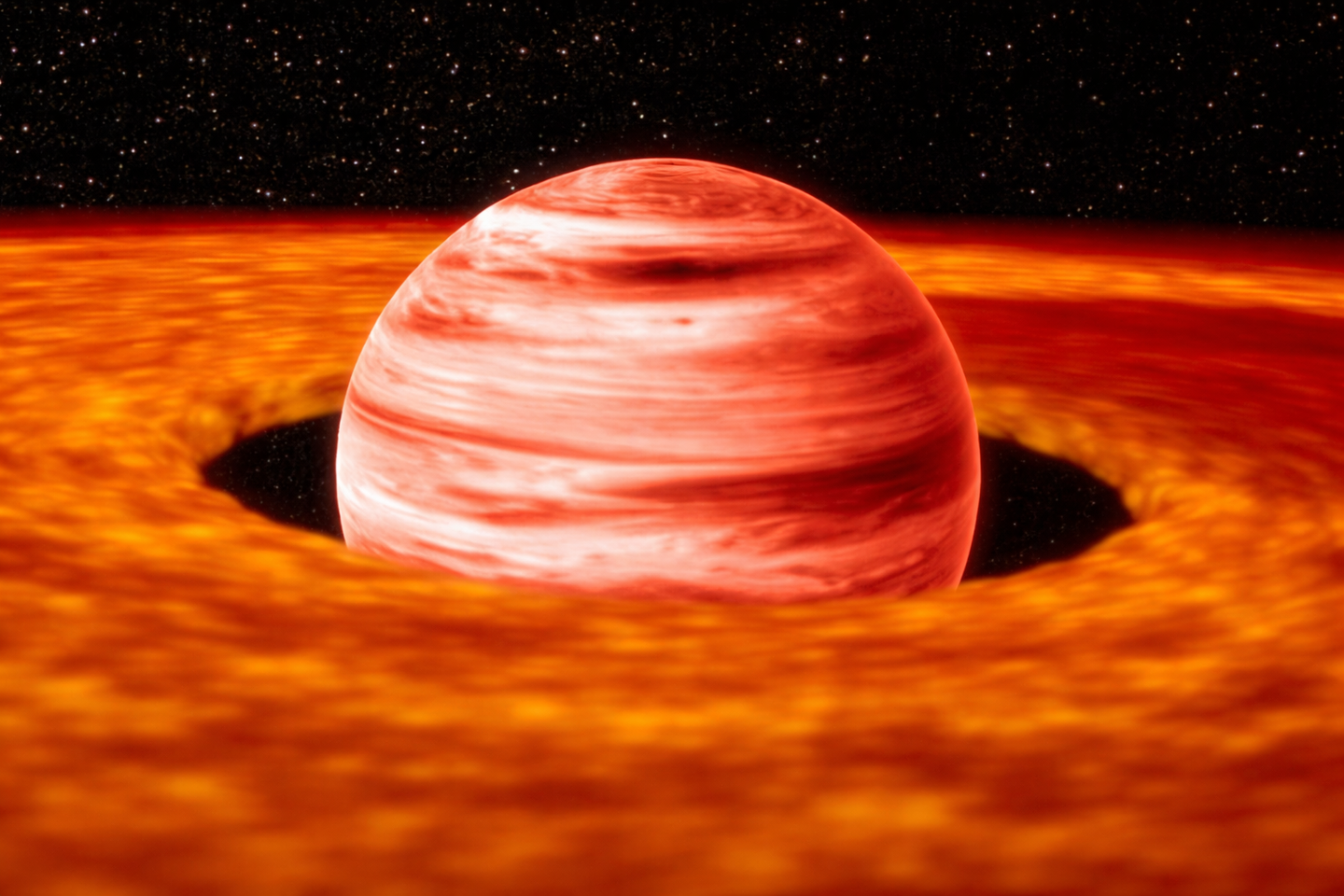
Study suggests moons orbiting rogue planets could host liquid oceans for billions of years using tidal heating and hydrogen atmospheres. (CREDIT: W. M. Keck Observatory/Adam Makarenko)
For centuries, astronomers faced the challenge of classifying objects in space based on their appearance. When observing an object that is orbiting a star at a distance, they would often assume it must be a large planet. It could also be a brown dwarf, which is a type of cosmic object that has a mass larger than a planet but falls short of being able to ignite the process of nuclear fusion that produces energy for stars. Due to the similarity in age, brightness, temperature, and atmospheric chemical makeup between brown dwarfs and large planets, for many years identifying them was difficult.
Now, a team of researchers from Northwestern University has found a method that allows for easier distinction between these two types of celestial bodies: rotation speed. In the largest survey of rotation speeds conducted to date of extrasolar planets and brown dwarfs, researchers have shown that giant planets spin significantly faster than brown dwarf objects on a relative basis compared to their maximum theoretical rotation speed.
With the publication of their findings in The Astronomical Journal, Brenner's team has provided the most convincing evidence to date that differences in rotation rates are one means of classifying these cosmic "twins." The discrepancies between the two types indicate differences in formation methods.
"The spin is a record of how a planet formed," said Dr. Chih-Chun "Dino" Hsu, the lead author and a postdoctoral researcher at the Center for Interdisciplinary Exploration and Research in Astrophysics at Northwestern University. "By measuring the rate at which these celestial bodies rotate around their axes, we can begin to understand the events that have created them over the previous tens or hundreds of millions of years."
The Brown Dwarf's Role In Cosmology
"Brown dwarfs sit uncomfortably between small planets and large stars in our understanding of the evolution of the universe. They have been difficult to class as either a small planet or a large star. They are sometimes referred to as "failed stars" due to their formation process being similar to stars, but they do not have enough mass to maintain hydrogen fusion", Dr. Chih-Chun "Dino" Hsu told The Brighter Side of News.
"The reason for this is that their light is produced due to residual heat instead of ongoing nuclear fusion processes. This means they look very similar to large planets when viewed from far away. However, the similarities are more than coincidental. The largest giant planets (Jupiter, Saturn, etc.) and the smallest brown dwarfs fall within similar ranges of size, mass, and surface features", he continued.
"In addition, atmospheric fingerprints from spectroscopy can be nearly indistinguishable. Also, a defining characteristic that has been proposed to distinguish between the two types of objects is a mass cut-off for deuterium burning, which is very hard to measure directly in most objects", he concluded.
Measuring Rotation To Distinguish Worlds
Hsu and his team at Northwestern University were considering whether the rotational motion of these objects can be a valuable method to potentially separate the ambiguity between the two categories. They used the Keck Planet Imager and Characterizer at the Keck Observatory in Mauna Kea, Hawaii, to determine the spin rates for six giant exoplanets and 25 brown dwarfs. They also used prior data to create a larger dataset of 43 objects.
"One of the reasons we were able to do such a large-scale survey is because Northwestern is a partner of the Keck Observatory," said co-author Jason Wang, Assistant Professor of Physics and Astronomy at Northwestern. "This partnership gave us access to Keck's telescope for many nights to allow us to successfully complete this survey."
To determine spin from spectroscopy, they employed a clever physics technique. The rotation pattern of a distant planet is predictable through the light emitted from that planet. The light from the side moving toward Earth is shifted differently than the light from the side moving away from Earth.
These changes are similar to pitch changes of a siren due to the Doppler effect. Scientists can determine the rate of rotation for a distant object through high-resolution spectroscopy, through the broadening of the light spectrum of distant planet and star systems.
What The Data Revealed
Hsu stated that they are able to measure very small rotation rates of planets orbiting stars that are much closer through a process called KPIC. The team measured the ratio of each object’s actual spin speed to the theoretical spin speed at which the object will break up due to centrifugal force. This allows the team to compare objects of different sizes. It also allows them to determine how the spin rates compare relative to the orbital plane of the objects.
The overall results of this study are significant. The team found that giant planets average about 27% of their breakup velocities in spin, while brown dwarf companions to giant planets averaged only about 9%. The statistical confidence of this gap is estimated at 4.5 sigma when the entire dataset was considered using the orbital orientations of the planets, which is a highly significant level of detection in astrophysics.
Using one of the pairings in this study, the difference in spin rates between two objects in a system is easily seen. A giant planet in the HR 8799 system, with an approximate mass of seven times Jupiter, spins fairly fast compared to its breakup speed.
According to the data analyzed, there is a nearby brown dwarf with about three times the mass of the planet in this study. However, the brown dwarf spins six times slower than the planet. It seems that both had angular momentum removed during formation, but the question remains: why did the brown dwarf, which is more massive, lose so much more than the planet?
Why Brown Dwarfs Spin More Slowly
The answer to this question probably lies in magnetic fields and the gas and dust disks that surround young objects. During their formation, both young planets and brown dwarfs are located in a circumstellar or circumplanetary disk. Magnetic fields within these disks act like brakes to remove angular momentum from the developing object.
The more massive an object is, the more powerful its magnetic field will be. This means it will remove more angular momentum and therefore result in a slower final rotational velocity. Thus, when a brown dwarf forms, it tends to develop a stronger magnetic field, lose more angular momentum during its formation, and emerge with a slower rotation rate.
Furthermore, the data show that an isolated brown dwarf that has no host star has a faster rotation rate than an orbiting brown dwarf. Therefore, the environment created by the host star must also have an influence on the eventual rotation rates of the objects. This means that differences between the two types of objects are caused by the temperature and ionization level of the surrounding disk, which affect how much of the object's initial spin it retains.
A Clear Divide In Angular Momentum
According to Hsu, "Our findings suggest that two things will influence the rotational velocity of an object: the object's mass and the relationship between the mass of the object and that of its host star." This narrows the field to provide greater clarity about the physical processes behind the formation of these systems.
The study of the angular momentum evolution of the substellar population also illustrates broader trends beyond a simple comparison between planets and brown dwarfs. By studying 221 objects that cover the entire mass range from giant planets to near-stellar mass (around 40 Jupiter masses), the results indicate that there is a clear division in angular momentum evolution around 40 Jupiter masses.
Objects with a total mass under 40 Jupiter masses retained substantially more angular momentum than objects with total mass over 40 Jupiter masses for approximately the first 10 million years of their existence. This is the time at which most surrounding accretion disks dissipate. As a result, smaller, cooler, and more magnetically quiet objects have lower rates of mass loss and retain greater amounts of angular momentum. Larger objects exhibit higher rates of mass loss, resulting in slower rotation rates across all ages.
Limitations And Future Research
The current dataset has several limitations that have been explicitly stated by the authors. The number of "gold standard" giant planets is limited to just six. Although there is significant statistical confidence in the survey's results, the sample is heavily skewed toward young objects. This is due to the difficulty in detecting and characterizing older, cooler giant planets with modern instruments.
Hsu and Wang aim to broaden the scope of their survey to include free-floating planetary-mass objects, often called rogue planets, in order to see if they exhibit the same rotational signature as their planet-like counterparts. Future research will examine the chemical makeup of the planetary atmospheres of these objects and determine if they also exhibit unique rotational signatures that may serve as additional formation fingerprints.
The advent of larger aperture instruments, particularly those that will be constructed in the next few years such as 30-meter telescopes, will provide access to spin measurements for a much larger number of worlds. This includes field-age giant planets, which can currently be detected only by the very largest telescopes.
"We are just beginning to understand what planet spin tells us," said Hsu. "As we continue to develop advanced instruments and as large telescopes become more common, we will be able to measure the spin of many more worlds and link their rotation rates to their chemistry and formation histories across an entire planetary system."
Practical Implications
The most immediate benefit of this research lies in classification. In particular, it identifies a new observable, rotation, that will assist astronomers in determining whether a distant world is a planet or a failed star. The advantage is that it allows classification without relying solely on mass estimates, which have significant uncertainties.
Understanding the classification of planets is critical because the mechanisms that lead to the formation of planet-like bodies are likely to differ from those that lead to the formation of brown dwarfs. Additionally, the population of planets in any given star system reflects the physical conditions present at the time of formation.
A better classification will provide a more accurate picture of how common planets are and how far away from their host stars planets can form. It will also clarify how the conditions necessary for planet formation differ from system to system.
The concept of rotation as a formation tracer provides additional information that chemical and atmospheric studies do not provide. If two objects have identical chemical compositions and atmospheres but exhibit different rotation rates, it may indicate that they formed through separate pathways.
Research findings are available online in The Astronomical Journal.
The original story "Rotation rate helps astronomers differentiate giant planets from brown dwarf stars" is published in The Brighter Side of News.
Related Stories
- Why are giant planets found at the outer reaches of solar systems
- From gas giants to rocky worlds: Why planets in our solar system differ
- Astronomers found the building blocks of new planets swirling around two young stars
Like these kind of feel good stories? Get The Brighter Side of News' newsletter.
Joseph Shavit
Writer, Editor-At-Large and Publisher
Joseph Shavit, based in Los Angeles, is a seasoned science journalist, editor and co-founder of The Brighter Side of News, where he transforms complex discoveries into clear, engaging stories for general readers. With vast experience at major media groups like Times Mirror and Tribune, he writes with both authority and curiosity. His writing focuses on space science, planetary science, quantum mechanics, geology. Known for linking breakthroughs to real-world markets, he highlights how research transitions into products and industries that shape daily life.